Kirjojen hintavertailu. Mukana 12 083 983 kirjaa ja 12 kauppaa.

Kirjahaku

Etsi kirjoja tekijän nimen, kirjan nimen tai ISBN:n perusteella.

4 kirjaa tekijältä Gregory S. Alexander

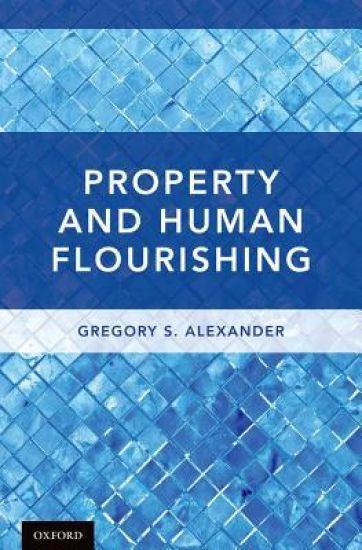
Property and Human Flourishing

Property and Human Flourishing

Gregory S. Alexander

Oxford University Press Inc
2018
sidottu
Many people assume that what morally justifies private ownership of property is either individual freedom or social welfare, defined in terms of maximizing personal preference-satisfaction. This book offers an alternative way of understanding the moral underpinning of private ownership of property. Rather than identifying any single moral value, this book argues that human flourishing, understood as morally pluralistic and objective, is property's moral foundation. The book goes on to develop a theory that connects ownership and human flourishing with obligations. Owners have obligations to members of the communities that enabled the owners to live flourishing lives by cultivating in their community members certain capabilities that are essential to leading a well-lived life. These obligations are rooted in the interdependence that exists between owners and their community members, and inherent in the human condition. Obligations have always been inherent in ownership. Owners are not free to inflict nuisances upon their neighbors, for example, by operating piggeries in residential neighborhoods. The human flourishing theory explains why owners at times have obligations that enable their fellow community members to develop certain necessary capabilities, such as health care and security. This is why, for example, farm owners may be required to allow providers of health care and legal assistance to enter their property to assist employees who are migrant workers. Moving from the abstract and theoretical to the practical, this book considers implications for a wide variety of property issues of importance both in the literature and in modern society. These include questions such as: When is a government's expropriation of property legitimated for the reason it is for public use? May the owner of a historic or architecturally significant house destroy it without restriction? Do institutions that owned African slaves or otherwise profited from the slave trade owe any obligations to members of the African-American community? What insights may be gained from the human flourishing concept into resolving current housing problems like homelessness, eviction, and mortgage foreclosure?
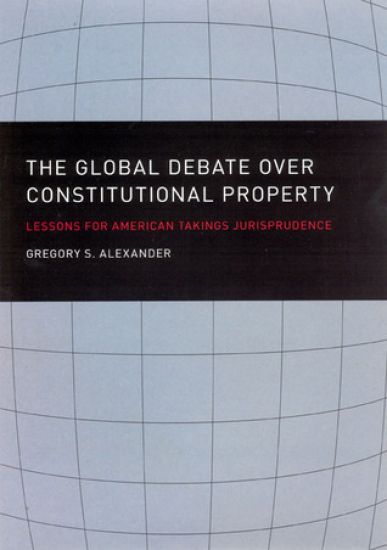
The Global Debate over Constitutional Property

The Global Debate over Constitutional Property

Gregory S. Alexander

University of Chicago Press
2006
sidottu
Countries around the world are heatedly debating whether property should be a constitutional right. But American lawyers have largely ignored this debate, which is divided into two clear camps: those who believe making property a constitutional right undermines democracy by fostering inequality, and those who believe it provides the security necessary to make democracy possible. In "The Global Debate over Constitutional Property", Gregory S. Alexander recasts this discussion, arguing that both sides overlook a key problem: that constitutional protection, or lack thereof, has little bearing on how a society actually treats property. A society's traditions and culture, Alexander argues, have a much greater effect on property rights. Laws must aim, then, to change cultural ideas of property, rather than deem whether one has the right to own it. Ultimately, Alexander builds a strong case for improving American Takings Law by borrowing features from the laws of other countries - particularly those laws based on the idea that owning property not only confers rights, but also entails responsibilities to society as a whole.
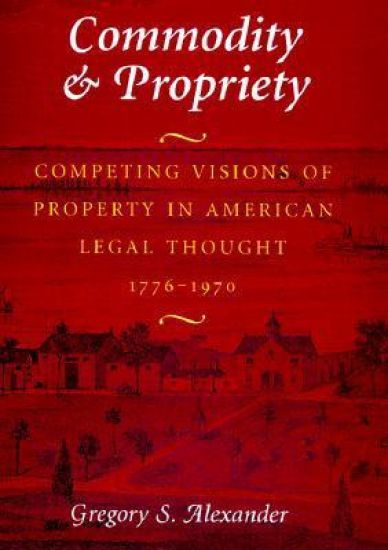
Commodity & Propriety

Commodity & Propriety

Gregory S. Alexander

University of Chicago Press
1998
sidottu
Most people understand property as something that is owned, a means of creating individual wealth. However, in this text a history of the meaning of property, Gregory Alexander uncovers in American legal writing a competing vision of property that has existed alongside the traditional conception. Property, Alexander argues, has also been understood as "proprietary", a mechanism for creating and maintaining a properly-ordered society. This view of property has even operated in periods such as the second half of the 19th century, when market forces seemed to dominate social and legal relationships. In demonstrating how the understanding of property as a private basis for the public good has competed with the better-known market-oriented conception, the author of this book rewrites the history of property, with significant implications for current political debates and recent Supreme Court decisions.
Commodity & Propriety

Commodity & Propriety

Gregory S. Alexander

University of Chicago Press
1999
nidottu
Most people understand property as something that is owned, a means of creating individual wealth. However, in this text a history of the meaning of property, Gregory Alexander uncovers in American legal writing a competing vision of property that has existed alongside the traditional conception. Property, Alexander argues, has also been understood as "proprietary", a mechanism for creating and maintaining a properly-ordered society. This view of property has even operated in periods such as the second half of the 19th century, when market forces seemed to dominate social and legal relationships. In demonstrating how the understanding of property as a private basis for the public good has competed with the better-known market-oriented conception, the author of this book rewrites the history of property, with significant implications for current political debates and recent Supreme Court decisions.