Kirjojen hintavertailu. Mukana 12 016 292 kirjaa ja 12 kauppaa.

Kirjahaku

Etsi kirjoja tekijän nimen, kirjan nimen tai ISBN:n perusteella.

2 kirjaa tekijältä Gregory S. Gordon

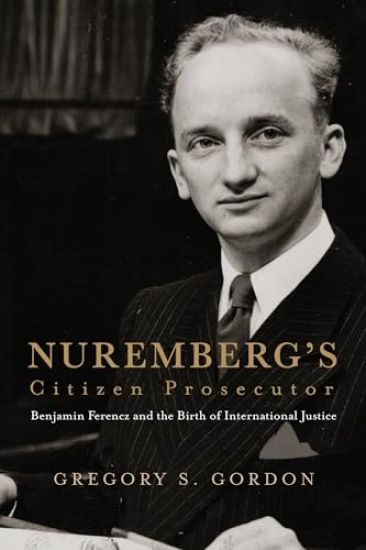
Nuremberg's Citizen Prosecutor

Nuremberg's Citizen Prosecutor

Gregory S. Gordon

UNIVERSITY OF VIRGINIA PRESS
2025
sidottu
The remarkable life of one of the twentieth century's great warriors for justice, from Nuremberg to the first trial of the International Criminal Court On September 29, 1947, in Courtroom 600, before the Nuremberg Military Tribunal, twenty-seven-year-old Benjamin Ferencz approached the lectern to deliver the prosecution's opening statement against the brutal henchmen of the Einsatzgruppen - the SS killing units responsible for more than 1.5 million deaths during the Holocaust - in what the Associated Press dubbed 'the biggest murder trial in history.' As the field of international criminal justice was being born in the aftermath of World War II, only Ferencz led in all its phases: investigation, prosecution, and restitution - an extraordinary feat given his humble origins as a dirt-poor immigrant escaping antisemitic persecution in Eastern Europe and growing up in New York's Hell's Kitchen. A Harvard Law scholarship student, Ferencz had been Patton's lead war crimes field investigator before becoming Chief Prosecutor at Nuremberg. Horrified by these experiences, he then dedicated his career to Holocaust survivors, pioneering key restitution efforts and helping negotiate the landmark Jewish civil society - Israel -West Germany reparations treaty. Later, he became a peace advocate and driving force behind the creation of the International Criminal Court, remarkably joining the prosecution for the Court's first trial as the last living Nuremberg prosecutor. Gregory Gordon, a former war crimes prosecutor and the first scholar with full access to Ferencz's personal papers, has produced an expansive, page-turning account of Ferencz's troubled early years, his historic Nuremberg achievements, and his post-Nuremberg life as a pioneer victims' advocate and catalyst behind the International Criminal Court's conceptualization and creation.
Atrocity Speech Law

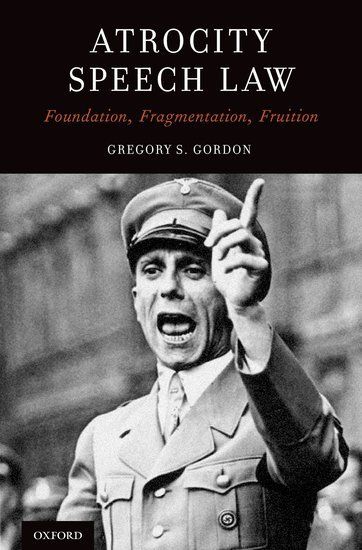
Atrocity Speech Law

Gregory S. Gordon

Oxford University Press Inc
2017
sidottu
The law governing the relationship between speech and core international crimes -- a key component in atrocity prevention -- is broken. Incitement to genocide has not been adequately defined. The law on hate speech as persecution is split between the International Criminal Tribunal for Rwanda (ICTR) and the International Criminal Tribunal for the former Yugoslavia (ICTY). Instigation is confused with incitement and ordering's scope is too circumscribed. At the same time, each of these modalities does not function properly in relation to the others, yielding a misshapen body of law riddled with gaps. Existing scholarship has suggested discrete fixes to individual parts, but no work has stepped back and considered holistic solutions. This book does. To understand how the law became so fragmented, it returns to its roots to explain how it was formulated. From there, it proposes a set of nostrums to deal with the individual deficiencies. Its analysis then culminates in a more comprehensive proposal: a Unified Liability Theory, which would systematically link the core crimes of genocide, crimes against humanity, and war crimes with the four illicit speech modalities. The latter would be placed in one statutory provision criminalizing the following types of speech: (1) incitement (speech seeking but not resulting in atrocity); (2) speech abetting (non-catalytic speech synchronous with atrocity commission); (3) instigation (speech seeking and resulting in atrocity); and (4) ordering (instigation/incitement within a superior-subordinate relationship). Apart from its fragmentation, this body of law lacks a proper name as Incitement Law or International Hate Speech Law, labels often used, fail to capture its breadth or relationship to mass violence. So this book proposes a new and fitting appellation: atrocity speech law.