Kirjojen hintavertailu. Mukana 11 342 620 kirjaa ja 12 kauppaa.

Kirjahaku

Etsi kirjoja tekijän nimen, kirjan nimen tai ISBN:n perusteella.

10 kirjaa tekijältä Guido Mazzoni

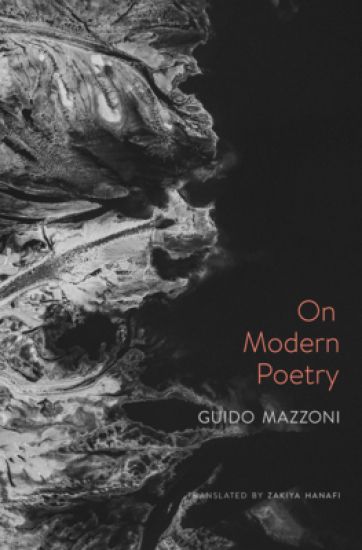
On Modern Poetry

On Modern Poetry

Guido Mazzoni

HARVARD UNIVERSITY PRESS
2022
sidottu
An incisive, unified account of modern poetry in the Western tradition, arguing that the emergence of the lyric as a dominant verse style is emblematic of the age of the individual.Between the end of the eighteenth century and the beginning of the twentieth, poetry in the West was transformed. The now-common idea that poetry mostly corresponds with the lyric in the modern sense—a genre in which a first-person speaker talks self-referentially—was foreign to ancient, medieval, and Renaissance poetics. Yet in a relatively short time, age-old habits gave way. Poets acquired unprecedented freedom to write obscurely about private experiences, break rules of meter and syntax, use new vocabulary, and entangle first-person speakers with their own real-life identities. Poetry thus became the most subjective genre of modern literature.On Modern Poetry reconstructs this metamorphosis, combining theoretical reflections with literary history and close readings of poets from Giacomo Leopardi to Louise Glück. Guido Mazzoni shows that the evolution of modern poetry involved significant changes in the way poetry was perceived, encouraged the construction of first-person poetic personas, and dramatically altered verse style. He interprets these developments as symptoms of profound historical and cultural shifts in the modern period: the crisis of tradition, the rise of individualism, the privileging of self-expression and its paradoxes. Mazzoni also reflects on the place of poetry in mass culture today, when its role has been largely assumed by popular music.The result is a rich history of literary modernity and a bold new account of poetry’s transformations across centuries and national traditions.
Theory of the Novel

Theory of the Novel

Guido Mazzoni

Harvard University Press
2017
sidottu
The novel is the most important form of Western art. It aims to represent the totality of life; it is the flagship that literature sends out against the systematic thought of science and philosophy. Indebted to Lukács and Bakhtin, to Auerbach and Ian Watt, Guido Mazzoni’s Theory of the Novel breaks new ground, building a historical understanding of how the novel became the modern book of life: one of the best representations of our experience of the world.The genre arose during a long metamorphosis of narrative forms that took place between 1550 and 1800. By the nineteenth century it had come to encompass a corpus of texts distinguished by their freedom from traditional formal boundaries and by the particularity of their narratives. Mazzoni explains that modern novels consist of stories told in any way whatsoever, by narrators who exist—like us—as contingent beings within time and space. They therefore present an interpretation, not a copy, of the world.Novels grant new importance to the stories of ordinary men and women and allow readers to step into other lives and other versions of truth. As Theory of the Novel makes clear, this art form narrates an epoch and a society in which individual experiences do not converge but proliferate, in which the common world has fragmented into a plurality of small, local worlds, each absolute in its particularity.
Nuove Poesie

Nuove Poesie

Guido Mazzoni

Hutson Street Press
2025
nidottu
"Nuove Poesie" is a collection of poems by Guido Mazzoni, first published in 1886. This volume showcases Mazzoni's lyrical talent and provides a glimpse into the literary landscape of late 19th-century Italy. The poems explore themes of love, nature, and the human condition with a distinctive voice that resonated with readers of his time. Mazzoni's work offers a valuable contribution to Italian literature and reflects the artistic and cultural sensibilities of the era. This collection allows contemporary readers to appreciate the beauty and emotional depth of his poetic expression. This work has been selected by scholars as being culturally important, and is part of the knowledge base of civilization as we know it. This work was reproduced from the original artifact, and remains as true to the original work as possible. Therefore, you will see the original copyright references, library stamps (as most of these works have been housed in our most important libraries around the world), and other notations in the work. This work is in the public domain in the United States of America, and possibly other nations. Within the United States, you may freely copy and distribute this work, as no entity (individual or corporate) has a copyright on the body of the work. As a reproduction of a historical artifact, this work may contain missing or blurred pages, poor pictures, errant marks, etc. Scholars believe, and we concur, that this work is important enough to be preserved, reproduced, and made generally available to the public. We appreciate your support of the preservation process, and thank you for being an important part of keeping this knowledge alive and relevant.