Kirjahaku
Etsi kirjoja tekijän nimen, kirjan nimen tai ISBN:n perusteella.
12 kirjaa tekijältä H. F. Baker
Abel's Theorem And The Allied Theory, Including The Theory Of The Theta Functions
H. F. Baker
Kessinger Pub
2007
pokkari

Henry Frederick Baker (1866–1956) was a renowned British mathematician specialising in algebraic geometry. He was elected a Fellow of the Royal Society in 1898 and appointed the Lowndean Professor of Astronomy and Geometry in the University of Cambridge in 1914. First published between 1922 and 1925, the six-volume Principles of Geometry was a synthesis of Baker's lecture series on geometry and was the first British work on geometry to use axiomatic methods without the use of co-ordinates. The first four volumes describe the projective geometry of space of between two and five dimensions, with the last two volumes reflecting Baker's later research interests in the birational theory of surfaces. The work as a whole provides a detailed insight into the geometry which was developing at the time of publication. This, the first volume, describes the foundations of projective geometry.
Henry Frederick Baker (1866–1956) was a renowned British mathematician specialising in algebraic geometry. He was elected a Fellow of the Royal Society in 1898 and appointed the Lowndean Professor of Astronomy and Geometry in the University of Cambridge in 1914. First published between 1922 and 1925, the six-volume Principles of Geometry was a synthesis of Baker's lecture series on geometry and was the first British work on geometry to use axiomatic methods without the use of co-ordinates. The first four volumes describe the projective geometry of space of between two and five dimensions, with the last two volumes reflecting Baker's later research interests in the birational theory of surfaces. The work as a whole provides a detailed insight into the geometry which was developing at the time of publication. This, the second volume, describes the principal configurations of space of two dimensions.
Henry Frederick Baker (1866–1956) was a renowned British mathematician specialising in algebraic geometry. He was elected a Fellow of the Royal Society in 1898 and appointed the Lowndean Professor of Astronomy and Geometry in the University of Cambridge in 1914. First published between 1922 and 1925, the six-volume Principles of Geometry was a synthesis of Baker's lecture series on geometry and was the first British work on geometry to use axiomatic methods without the use of co-ordinates. The first four volumes describe the projective geometry of space of between two and five dimensions, with the last two volumes reflecting Baker's later research interests in the birational theory of surfaces. The work as a whole provides a detailed insight into the geometry which was developing at the time of publication. This, the third volume, describes the principal configurations of space of three dimensions.

Henry Frederick Baker (1866–1956) was a renowned British mathematician specialising in algebraic geometry. He was elected a Fellow of the Royal Society in 1898 and appointed the Lowndean Professor of Astronomy and Geometry in the University of Cambridge in 1914. First published between 1922 and 1925, the six-volume Principles of Geometry was a synthesis of Baker's lecture series on geometry and was the first British work on geometry to use axiomatic methods without the use of co-ordinates. The first four volumes describe the projective geometry of space of between two and five dimensions, with the last two volumes reflecting Baker's later research interests in the birational theory of surfaces. The work as a whole provides a detailed insight into the geometry which was developing at the time of publication. This, the fourth volume, describes the principal configurations of space of four and five dimensions.
Henry Frederick Baker (1866–1956) was a renowned British mathematician specialising in algebraic geometry. He was elected a Fellow of the Royal Society in 1898 and appointed the Lowndean Professor of Astronomy and Geometry in the University of Cambridge in 1914. First published between 1922 and 1925, the six-volume Principles of Geometry was a synthesis of Baker's lecture series on geometry and was the first British work on geometry to use axiomatic methods without the use of co-ordinates. The first four volumes describe the projective geometry of space of between two and five dimensions, with the last two volumes reflecting Baker's later research interests in the birational theory of surfaces. The work as a whole provides a detailed insight into the geometry which was developing at the time of publication. This, the fifth volume, describes the birational geometry of curves.
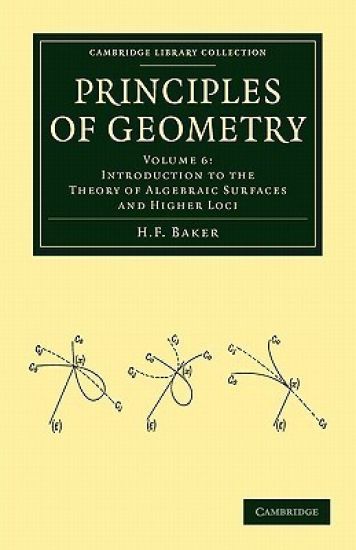
Henry Frederick Baker (1866–1956) was a renowned British mathematician specialising in algebraic geometry. He was elected a Fellow of the Royal Society in 1898 and appointed the Lowndean Professor of Astronomy and Geometry in the University of Cambridge in 1914. First published between 1922 and 1925, the six-volume Principles of Geometry was a synthesis of Baker's lecture series on geometry and was the first British work on geometry to use axiomatic methods without the use of co-ordinates. The first four volumes describe the projective geometry of space of between two and five dimensions, with the last two volumes reflecting Baker's later research interests in the birational theory of surfaces. The work as a whole provides a detailed insight into the geometry which was developing at the time of publication. This, the sixth and final volume, describes the birational geometric theory of surfaces.