Kirjojen hintavertailu. Mukana 12 016 292 kirjaa ja 12 kauppaa.

Kirjahaku

Etsi kirjoja tekijän nimen, kirjan nimen tai ISBN:n perusteella.

6 kirjaa tekijältä Hamish Ross

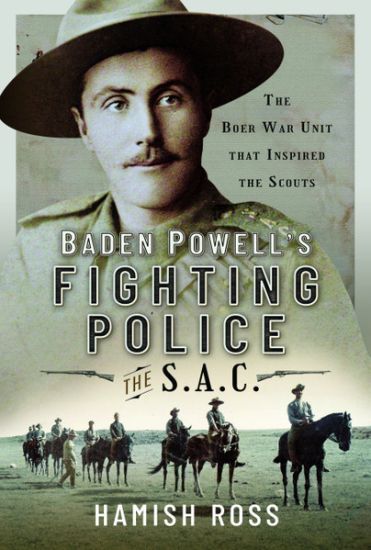
Baden Powell s Fighting Police   The SAC

Baden Powell s Fighting Police The SAC

Hamish Ross

PEN SWORD BOOKS LTD
2022
sidottu
This work begins in August 1900 during the war in South Africa, when mounted Boer commandos ranging across the veldt superseded pitched battles of massed armies and heavy weaponry. Thanks to his flair for organisation, Baden-Powell is asked to create a mounted force with a combined military and police role, and will be answerable to the Commander-in-Chief and the civil High Commissioner. Rejecting Army models of command, Baden-Powell creates the South African Constabulary (SAC) with a small number of officers, dividing it into Troops of 100 men, then sub-dividing again into sections and the key working unit - the squad of six men under a corporal. To get the calibre of recruit he wants, the SAC will be better paid than the Army and he expects the men to be motivated by a code of honour, to be self-reliant and handy men' able to tackle any kind of work. Most recruits come from the UK, but in Canada, however, the Governor General intervenes and botches selection. The SAC's effectiveness comes to light in this book - the first that deals with its creation and development; its wartime achievements and its peace-time transition into a community support helping local people returning to their homes. This work also highlights what Baden-Powell brought from the SAC and gave anew to the Scouts. Based on research using archive material in the UK, South Africa and Canada, it also includes images that have not previously appeared before in the public domain.
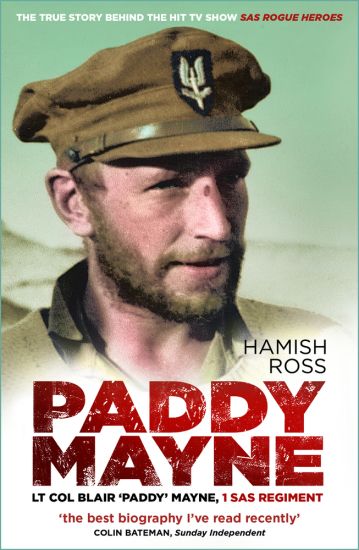
Paddy Mayne

Paddy Mayne

Hamish Ross

THE HISTORY PRESS LTD
2023
pokkari
‘The best biography I’ve read recently’ – Colin Bateman, Sunday Independent'An excellent examination of Mayne… Ross corrects many of the myths about him that have flourished over the years' - History of War magazine‘This welcome reassessment, officially backed and well-researched, sets the record straight’ – Soldier Magazine‘Paddy’ Mayne was one of the most outstanding special forces leaders of the Second World War. Hamish Ross’s authoritative study follows Mayne from solicitor and rugby international to troop commander in the Commandos and then the SAS, whose leader he later became and whose annals he graced, winning the DSO and three bars, the Croix de Guerre and the Légion d’Honneur.Mayne’s achievements attracted attention, and after his early death legends emerged, based largely on anecdote and assertion. Hamish Ross’s closely researched biography challenges much of the received version, using contemporary sources, the official war diaries, the chronicle of 1 SAS, Mayne’s papers and diaries, and a number of extended interviews with key contemporaries.Ross’s analysis shows Mayne to be a dynamic, yet principled and thoughtful man, committed to the unit’s original concepts. He was far from flawless, but his leadership and tactical brilliance in the field secured the reputation of the SAS, proving he was every bit a rogue hero.
Law as a Social Institution

Law as a Social Institution

Hamish Ross

Hart Publishing
2001
sidottu
This book develops the rudiments of a sociological perspective on state law and legal theory. It outlines a distinctive approach to theoretical enquiry that offers an improved understanding of law as a social and institutional phenomenon. The book draws upon Max Weber's sociological and juristic writings as a context in which to explore themes arising or selectively developed from a critical reassessment of key aspects of H.L.A. Hart's theory of law. The discussion initially centres around three problematical areas or 'Gordian Knots': essentially weaknesses in the analytical nucleus of The Concept of Law,matters of misplaced emphasis and other elements that, it is argued, have obscured fundamental aspects of a perceived social reality. Using the critique as a point of departure the book explores key issues that Hart merely touched upon or seemingly passed over: the role of the (sociologically inclined) jurist, the defensibility of an 'institutional insider's' perspective, the institutional behavioural dimension of the legal world, and the relational and social power dynamics of law-affected human behaviour.
Law as a Social Institution

Law as a Social Institution

Hamish Ross

Hart Publishing
2001
nidottu
This book develops the rudiments of a sociological perspective on state law and legal theory. It outlines a distinctive approach to theoretical enquiry that offers an improved understanding of law as a social and institutional phenomenon. The book draws upon Max Weber's sociological and juristic writings as a context in which to explore themes arising or selectively developed from a critical reassessment of key aspects of H.L.A. Hart's theory of law. The discussion initially centres around three problematical areas or 'Gordian Knots': essentially weaknesses in the analytical nucleus of The Concept of Law,matters of misplaced emphasis and other elements that, it is argued, have obscured fundamental aspects of a perceived social reality. Using the critique as a point of departure the book explores key issues that Hart merely touched upon or seemingly passed over: the role of the (sociologically inclined) jurist, the defensibility of an 'institutional insider's' perspective, the institutional behavioural dimension of the legal world, and the relational and social power dynamics of law-affected human behaviour.
Legal Rights and the Institutional Imagination

Legal Rights and the Institutional Imagination

Hamish Ross

BLOOMSBURY PUBLISHING PLC
2026
sidottu
This book presents a contemporary perspective on legal rights centred on the longstanding will theory–interest theory debate. Starting with classical rights literature, central aspects of the debate in its modern idiom are contextualised within a social theory setting developed from the writings of Max Weber. The book explores the idea that the institutional and coercive character of legal enforcement necessitates viewing legal rights as a locus of social power residing within the ‘institutional imagination’: that is, in the decision-making of key institutional actors such as judges, prosecutors, police, governmental authorities – and ultimately supreme court judges – who routinely mobilise coercive mechanisms towards the enforcement of legal rights and powers. This marks a departure from the trend of rights literature to view legal rights largely from the standpoint of the right-holder. The book also touches on whether the emerging perspective points towards a ‘third way’ beyond the traditional two theoretical approaches. A major task of the study is the construction of an archetypal supreme court judge – personifying the ‘institutional imagination’ – fashioned, via Weberian sociology, from a critique of Ronald Dworkin’s ‘Herculean’ judge and measured against doctrinal exegesis that draws on sources which include UK higher appellate court judgments.
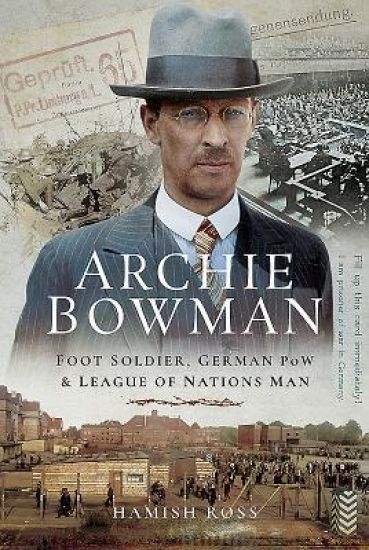
Archie Bowman

Archie Bowman

Hamish Ross

Pen Sword Military
2018
sidottu
In 1915, Archie Bowman, a philosophy professor at Princeton, was granted leave of absence to join the British army. He served in the HLI and was captured at the Battle of the Lys. Prison camp, though, turned out not to be the living death he expected: he was fluent in German and became the main go-between with camp authorities and British prisoners; he gave talks to hundreds of prisoners, and wrote up in verse form his account of the battle and his capture and two-day march into captivity. When he was transferred to another camp, his writings were confiscated; but in his new camp his responsibilities increased, and he became key negotiator and formed a bond with the Commandant, a fellow academic, who secured the release of his confiscated work, which, when completed, was published as prison camp verses. After the Armistice, he was posted to the British Army of the Rhine in Cologne, where he found his most interesting work in the service, interviewing German civilians wishing to travel into another Occupied Zone. Although Bowman didn't become a pacifist he was convinced more could be done to prevent wars; and he dedicated himself to the cause of peace and championed the ideal of the League of Nations, at the cost of his health. Based on the archived Bowman Papers, it is a fascinating story of a man of high principle and great depth of feeling who had the love and support of his wife Mabel.