
Kirjojen hintavertailu. Mukana 11 244 527 kirjaa ja 12 kauppaa.

Kirjahaku

Etsi kirjoja tekijän nimen, kirjan nimen tai ISBN:n perusteella.

2 kirjaa tekijältä Hamza Walker

Hamza Walker

Hamza Walker

Hamza Walker

Renaissance Society at the University of Chicago
2025
sidottu
The collected exhibition essays of Hamza Walker, former director of education at the Renaissance Society. Hamza Walker was director of education at the Renaissance Society for twenty-one years, between 1994 and 2015. During that time, he wrote essays about almost every single exhibition, both those he curated and many others curated by Suzanne Ghez. These texts were published first in the Renaissance Society’s newsletters and then eventually on the exhibition posters, which were distributed far more widely. In the course of this workman-like writing in the service of the institution, Walker developed not only his distinctive personal writing style and a keen eye but also a theory of what museum education could be and do. In his writing, Walker draws on his art's historical knowledge but looks equally to current events (both minutely local and international), insisting on the mutual relevance and related nature of the two. In Walker’s own words, “If we’re going to live up to the idea that art is for everybody, it needs a set of wider reference points,” an emphasis that has arguably shaped the identity of the institution in turn. This book collects those essays together into a volume that celebrates Walker’s brilliant, joyful, and generous writing. It also serves as a lively record of two decades of the Renaissance Society’s exhibition programming and reflects the prevalent theories, issues, and fashions of the art world during that time, not to mention the events occurring in the wider world.
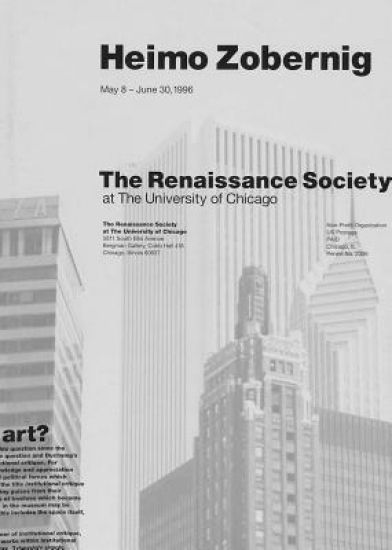
Heimo Zobernig

Heimo Zobernig

Hamza Walker

Renaissance Society at the University of Chicago
1998
nidottu
Austrian Heimo Zobernig's work intervenes, rearranges, recontextualizes, and down-right makes fun of the architecture of museum/gallery spaces so as to demystify its illusory potential and reinscribe it with self-referentiality. Zobernig is among several significant contemporary artists such as Michael Asher, General Idea, and Daniel Buren who have made it their mission to critique sites of modern art. In Zobernig's 1996 installation, the gallery walls from the Society's preceding exhibition were laid flat on the floor-a neat-handed figure/ground reversal turning support into sculpture. In another provocative turn, Zobernig brought the outside in to this altered gallery space via video - he had himself filmed cavorting arond the Renaissance Society hallway naked in front of walls that were painted video back-drop blue; this image was then super-imposed on footage shot while driving around Chicago. This informative and engaging book, designed by Zobernig, serves as a valuable pictorial document, and an insightful critical analysis of this important work. Walker's essay speaks to the challenge Zobernig's art poses for art history and the implications of that challenge for the future of art. In addition, the catalog features a transcript of the panel discussion: Planned Obsolescence, in which a group of critics, curators and architectural historians gathered to discuss how Zobernig's practice differs from, or further informs, practices that have made an art out of calling for an end of art.