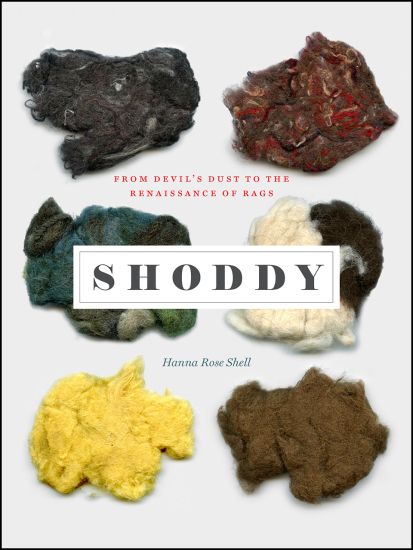
You know shoddy: an adjective meaning cheap and likely poorly made. But did you know that before it became a popular descriptor, shoddy was first coined as a noun? In the early nineteenth century, shoddy was the name given to a new textile material made from reclaimed wool. Shoddy was, in fact, one of the earliest forms of industrial recycling as old rags and fabric clippings were ground into "devil's dust" and respun to be used in the making of suits, army uniforms, carpet lining, mattress stuffing, and more. In Shoddy, Hanna Rose Shell takes readers on a vivid ride beginning in West Yorkshire's Heavy Woollen District and its "shoddy towns," and traveling to the United States, the third world, and waste dumps, textile labs, and rag shredding factories, in order to unravel the threads of this story and its long history. Since the time of its first appearance, shoddy had become both pervasive and politically and culturally controversial on multiple levels. The use of the term "virgin" wool--still noticeable today in the labels on our sweaters--thus emerged as an effort by the wool industry to counter shoddy's appeal: to make shoddy seem shoddy. Public health experts, with encouragement from the wool industry, worried about sanitation and disease--how could old clothes be disinfected? As well, the idea of wearing someone else's old clothes so close to your own skin was discomforting in and of itself. Could you sleep peacefully knowing that your mattress was stuffed with dead soldiers' overcoats? Over time, shoddy the noun was increasingly used as an adjective that, according to Shell, captured a host of personal, ethical, commercial, and societal failings. Introducing us to many richly drawn characters along the way, Shell reveals an interwoven tale of industrial espionage, political infighting, scientific inquiry, ethnic prejudices, and war profiteering. By exploring a variety of sources from political and literary texts to fabric samples and old military uniforms, antique and art photographs and political cartoons, medical textbooks, and legal cases, Shell unspools the history of shoddy to uncover the surprising journey that individual strands of recycled wool - and more recently a whole range of synthetic fibers from nylon to Kevlar - may take over the course of several lifetimes. Not only in your garments and blankets, but under your rug, in your mattress pads, the peculiar confetti-like stuffing in your mailing envelopes, even the insulation in your walls. The resulting fabric is at once rich and sumptuous, and cheap and tawdry--and likely connected to something you are wearing right now. After reading, you will never use the word shoddy or think about your clothes, or even the world around you, the same way again.