Kirjojen hintavertailu. Mukana 12 429 873 kirjaa ja 12 kauppaa.

Kirjahaku

Etsi kirjoja tekijän nimen, kirjan nimen tai ISBN:n perusteella.

16 kirjaa tekijältä Hannu Nurmi

Models of Political Economy

Models of Political Economy

Hannu Nurmi

Routledge
2006
sidottu
Models of Political Economy will introduce students to the basic methodology of political economics. It covers all core theories as well as new developments including:decision theorygame theorymechanism designgames of asymmetric information.Hannu Nurmi's text will prove to be invaluable to all students who wish to understand this increasingly technical field.
Models of Political Economy

Models of Political Economy

Hannu Nurmi

Routledge
2006
nidottu
Models of Political Economy will introduce students to the basic methodology of political economics. It covers all core theories as well as new developments including:decision theorygame theorymechanism designgames of asymmetric information.Hannu Nurmi's text will prove to be invaluable to all students who wish to understand this increasingly technical field.
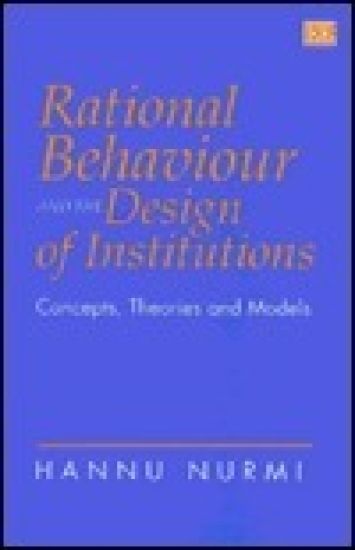
Rational Behaviour and the Design of Institutions

Rational Behaviour and the Design of Institutions

Hannu Nurmi

Edward Elgar Publishing Ltd
1998
sidottu
The structures of the world's national and international, political and economic institutions have largely resulted from intuitive and ad hoc organization with reforms taking place on a costly trial-and-error basis. This book offers a comprehensive evaluation of the tools which can be used for a more rational and formal approach to institutional design.As new institutions and, indeed, new national governments are being formed and developed all the time, there is a considerable need for formal models that can facilitate their design. This book offers conceptual approaches and theories that shed new light on how various social and political institutions can emerge as the outcome of goal-directed rational behaviour. The author provides tools for evaluating existing institutions and for setting up new ones, demonstrating the applicability of decision and game theoretic tools, social choice theory and mechanism design to the construction of political and economic institutions. Using these approaches he particularly discusses the practical implications for the design of institutions in the European Union.This important book will be welcomed by students and scholars interested in government and political science, rational choice theory, methodology in the social sciences, and the microeconomics of rational behaviour.
Voting Procedures under Uncertainty

Voting Procedures under Uncertainty

Hannu Nurmi

Springer-Verlag Berlin and Heidelberg GmbH Co. K
2002
sidottu
We live in an uncertain world, is a truism most of us hear more often than we would like. What one usually means to say by this is that we do not know what will happen in the future. Since changes, even major ones, have occurred in the past, it is possible that they will occur again in the future. In politics institutions are ways of coping with continuity and change. In democratic systems the electoral institutions provide ways of peaceful adjustment to changes in popular opinions. This book is about uncertainty as it pertains to electoral institutions. We shall deal with the ways in which analytic models are capable of taking into account voter uncertainty, ignorance and incompetence. We shall also discuss how uncertainty pertains to electoral outcomes. Given voter opinions, there is often a wide variation in the possible electoral outcomes. This could be called procedure-dependence of outcomes. Its existence shows that uncertainty is not something that can characterize only future events. It can pertain to past ones as well. This work is part of the Democracy and Constitution Project of Center for Business and Policy Studies (SNS). The idea of writing a book on the performance of voting procedures under uncertain cir­ cumstances came up in my correspondence with Dr. Per Molander of SNS a few years ago.
Voting Paradoxes and How to Deal with Them

Voting Paradoxes and How to Deal with Them

Hannu Nurmi

Springer-Verlag Berlin and Heidelberg GmbH Co. K
1999
sidottu
Voting paradoxes are unpleasant surprises encountered in voting. Typically they suggest that something is wrong with the way in­ dividual opinions are being expressed or processed in voting. The outcomes are bizarre, unfair or otherwise implausible, given the expressed opinions of voters. Voting paradoxes have an important role in the history of social choice theory. The founding fathers of the theory, Marquis de Condorcet and Jean-Charles de Borda, were keenly aware of some of them. Indeed, much of the work of these and other forerunners of the modern social choice theory dealt with ways of avoiding paradoxes related to voting. One of the early paradoxes, viz. that bearing the name of Condorcet, has subsequently gained such a prominent place in the literature that it is sometimes called the paradox of voting. One of the aims of the present work is to show that Condorcet's is but one of many paradoxes of voting. Some of these are pretty closely interrelated making it meaningful to classify them. This is the second main aim of this book. The third objective is to suggest ways of dealing with paradoxes. Since voting is and has always been an essential instrument of democratic rule, it is of some in­ terest to find out how voting paradoxes are being dealt with by past and present methods of voting. Of even greater interest is to find ways of minimizing the probability of occurrence of various paradoxes. By their very nature some paradoxes are unavoidable.
Voting Paradoxes and How to Deal with Them

Voting Paradoxes and How to Deal with Them

Hannu Nurmi

Springer-Verlag Berlin and Heidelberg GmbH Co. K
2010
nidottu
Voting paradoxes are unpleasant surprises encountered in voting. Typically they suggest that something is wrong with the way in­ dividual opinions are being expressed or processed in voting. The outcomes are bizarre, unfair or otherwise implausible, given the expressed opinions of voters. Voting paradoxes have an important role in the history of social choice theory. The founding fathers of the theory, Marquis de Condorcet and Jean-Charles de Borda, were keenly aware of some of them. Indeed, much of the work of these and other forerunners of the modern social choice theory dealt with ways of avoiding paradoxes related to voting. One of the early paradoxes, viz. that bearing the name of Condorcet, has subsequently gained such a prominent place in the literature that it is sometimes called the paradox of voting. One of the aims of the present work is to show that Condorcet's is but one of many paradoxes of voting. Some of these are pretty closely interrelated making it meaningful to classify them. This is the second main aim of this book. The third objective is to suggest ways of dealing with paradoxes. Since voting is and has always been an essential instrument of democratic rule, it is of some in­ terest to find out how voting paradoxes are being dealt with by past and present methods of voting. Of even greater interest is to find ways of minimizing the probability of occurrence of various paradoxes. By their very nature some paradoxes are unavoidable.
Voting Procedures under Uncertainty

Voting Procedures under Uncertainty

Hannu Nurmi

Springer-Verlag Berlin and Heidelberg GmbH Co. K
2012
nidottu
We live in an uncertain world, is a truism most of us hear more often than we would like. What one usually means to say by this is that we do not know what will happen in the future. Since changes, even major ones, have occurred in the past, it is possible that they will occur again in the future. In politics institutions are ways of coping with continuity and change. In democratic systems the electoral institutions provide ways of peaceful adjustment to changes in popular opinions. This book is about uncertainty as it pertains to electoral institutions. We shall deal with the ways in which analytic models are capable of taking into account voter uncertainty, ignorance and incompetence. We shall also discuss how uncertainty pertains to electoral outcomes. Given voter opinions, there is often a wide variation in the possible electoral outcomes. This could be called procedure-dependence of outcomes. Its existence shows that uncertainty is not something that can characterize only future events. It can pertain to past ones as well. This work is part of the Democracy and Constitution Project of Center for Business and Policy Studies (SNS). The idea of writing a book on the performance of voting procedures under uncertain cir­ cumstances came up in my correspondence with Dr. Per Molander of SNS a few years ago.
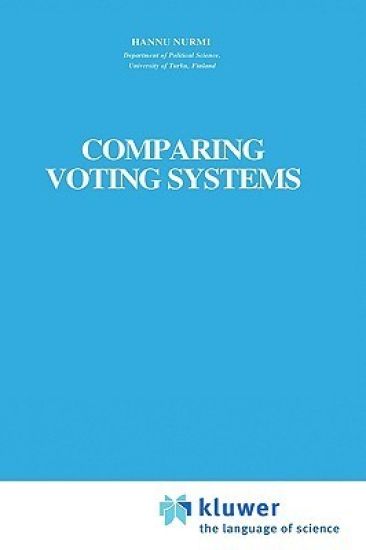
Comparing Voting Systems

Comparing Voting Systems

Hannu Nurmi

Kluwer Academic Publishers
1987
sidottu
In many contexts of everyday life we find ourselves faced with the problem of reconciling the views of several persons. These problems are usually solved by resorting to some opinion aggre­ gating procedure, like voting. Very often the problem is thought of as being solved after the decision to take a vote has been made and the ballots have been counted. Most official decision making bodies have formally instituted procedures of voting but in informal groups such procedures are typically chosen in casu. Curiously enough people do not seem to pay much attention to which particular procedure is being resorted to as long as some kind of voting takes place. As we shall see shortly the procedure being used often makes a great difference to the voting outcomes. Thus, the Question arises as to which voting procedure is best. This book is devoted to a discussion of this problem in the light of various criteria of optimality. We shall deal with a number of procedures that have been proposed foruse or are actually in use in voting contexts. The aim of this book is to give an evaluation of the virtues and shortcomings of these procedures. On the basis of this evaluation the reader will hopefully be able to determine which procedure is optimal for the decision setting that he or she has in mind.
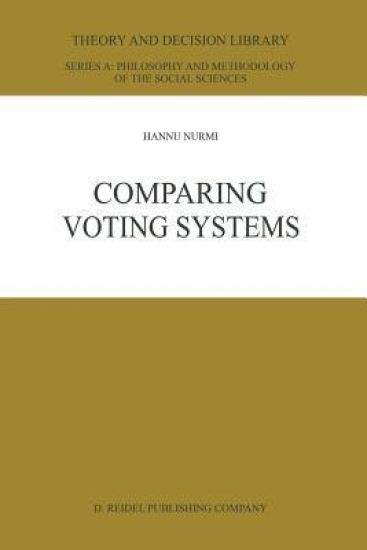
Comparing Voting Systems

Comparing Voting Systems

Hannu Nurmi

Springer
2011
nidottu
In many contexts of everyday life we find ourselves faced with the problem of reconciling the views of several persons. These problems are usually solved by resorting to some opinion aggre­ gating procedure, like voting. Very often the problem is thought of as being solved after the decision to take a vote has been made and the ballots have been counted. Most official decision making bodies have formally instituted procedures of voting but in informal groups such procedures are typically chosen in casu. Curiously enough people do not seem to pay much attention to which particular procedure is being resorted to as long as some kind of voting takes place. As we shall see shortly the procedure being used often makes a great difference to the voting outcomes. Thus, the Question arises as to which voting procedure is best. This book is devoted to a discussion of this problem in the light of various criteria of optimality. We shall deal with a number of procedures that have been proposed foruse or are actually in use in voting contexts. The aim of this book is to give an evaluation of the virtues and shortcomings of these procedures. On the basis of this evaluation the reader will hopefully be able to determine which procedure is optimal for the decision setting that he or she has in mind.
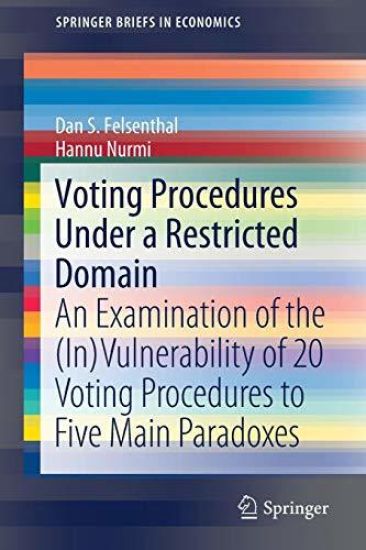
Voting Procedures Under a Restricted Domain

Voting Procedures Under a Restricted Domain

Dan S. Felsenthal; Hannu Nurmi

Springer Nature Switzerland AG
2019
nidottu
This book deals with 20 voting procedures used or proposed for use in elections resulting in the choice of a single winner. These procedures are evaluated in terms of their ability to avoid five important paradoxes in a restricted domain, viz., when a Condorcet winner exists and is elected in the initial profile. Together with the two companion volumes by the same authors, published by Springer in 2017 and 2018, this book aims at giving a comprehensive overview of the most important advantages and disadvantages of voting procedures thereby assisting decision makers in the choice of a voting procedure that would best suit their purposes.
Systems, Procedures and Voting Rules in Context

Systems, Procedures and Voting Rules in Context

Adiel Teixeira De Almeida; Danielle Costa Morais; Hannu Nurmi

Springer Nature Switzerland AG
2019
sidottu
This book deals with the choice of methods to be applied in the decision processes within organizations. It discusses the use of voting procedures for group decision in business organizations, focusing on decision-making contexts. Within this book the reader explores the relevant part of the decision-making process consisting of choosing the voting procedures and recognizing the drawbacks of that procedure. This book includes a unique feature of providing a framework for choosing the voting procedure that is the most appropriate for a particular business decision process. The book is useful for a broad researcher audience dealing with the group decision making processes within business organizations and for practitioners and students working in the group decision and negotiation field.
Systems, Procedures and Voting Rules in Context

Systems, Procedures and Voting Rules in Context

Adiel Teixeira de Almeida; Danielle Costa Morais; Hannu Nurmi

Springer Nature Switzerland AG
2020
nidottu
This book deals with the choice of methods to be applied in the decision processes within organizations. It discusses the use of voting procedures for group decision in business organizations, focusing on decision-making contexts. Within this book the reader explores the relevant part of the decision-making process consisting of choosing the voting procedures and recognizing the drawbacks of that procedure. This book includes a unique feature of providing a framework for choosing the voting procedure that is the most appropriate for a particular business decision process. The book is useful for a broad researcher audience dealing with the group decision making processes within business organizations and for practitioners and students working in the group decision and negotiation field.
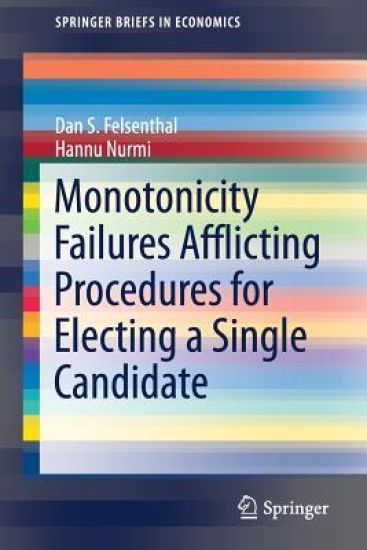
Monotonicity Failures Afflicting Procedures for Electing a Single Candidate

Monotonicity Failures Afflicting Procedures for Electing a Single Candidate

Dan S. Felsenthal; Hannu Nurmi

Springer International Publishing AG
2017
nidottu
This book provides an evaluation of 18 voting procedures in terms of the most important monotonicity-related criteria in fixed and variable electorates. All voting procedures studied aim at electing one out of several candidates given the voters' preferences over the candidates. In addition to (strict) monotonicity failures, the vulnerability of the procedures to variation of the no-show paradoxes is discussed. All vulnerabilities are exemplified and explained. The occurrence of the no-show paradoxes is related to the presence or absence of a Condorcet winner. The primary readership of this book are scholars and students in the area of social choice.
Voting Procedures for Electing a Single Candidate

Voting Procedures for Electing a Single Candidate

Dan S. Felsenthal; Hannu Nurmi

Springer International Publishing AG
2018
nidottu
This book deals with 18 voting procedures used or proposed for use in elections resulting in the choice of a single winner. These procedures are evaluated in terms of their ability to avoid paradoxical outcomes. Together with a companion volume by the same authors, Monotonicity Failures Afflicting Procedures for Electing a Single Candidate, published by Springer in 2017, this book aims at giving a comprehensive overview of the most important advantages and disadvantages of procedures thereby assisting decision makers in the choice of a voting procedure that would best suit their purposes.