Kirjojen hintavertailu. Mukana 12 390 323 kirjaa ja 12 kauppaa.

Kirjahaku

Etsi kirjoja tekijän nimen, kirjan nimen tai ISBN:n perusteella.

48 kirjaa tekijältä Hans Blumenberg

Shipwreck with Spectator

Shipwreck with Spectator

Hans Blumenberg

MIT Press
1996
pokkari
Shipwreck with Spectator traces the evolution of the complex of metaphors related to the sea, to shipwreck, and to the role of the spectator in human culture from ancient Greece to modern times.This elegant essay exemplifies Blumenberg's ideas about the ability of the historical study of metaphor to illuminate essential aspects of being human. Originally published in the same year as his monumental Work on Myth, Shipwreck with Spectator traces the evolution of the complex of metaphors related to the sea, to shipwreck, and to the role of the spectator in human culture from ancient Greece to modern times. The sea is one of humanity's oldest metaphors for life, and a sea journey, Blumenberg observes, has often stood for our journey through life. We all know the role that shipwrecks can play in this journey, and at some level we have all played witness to others' wrecks, standing in safety and knowing that there is nothing we can do to help, yet fixed comfortably or uncomfortably in our ambiguous role as spectator. Through Blumenberg's seemingly inexhaustible knowledge of letters, from ancient texts through nineteenth-century reminiscences and modern speeches, we see layer upon layer revealed in the meaning humans have given to these metaphors; and in this way we begin to understand what metaphors can do that more straightforward modes of expression cannot. This edition of Shipwreck with Spectator also includes "Prospect for a Theory of Nonconceptuality," an essay that recounts the evolution of Blumenberg's ideas about metaphorology in the years following his early manifesto "Paradigms for a Metaphorology."

The Legitimacy of the Modern Age

The Legitimacy of the Modern Age

Hans Blumenberg

MIT Press
1985
pokkari
In this major work, Blumenberg takes issue with Karl Loewith's well-known thesis that the idea of progress is a secularized version of Christian eschatology, which promises a dramatic intervention that will consummate the history of the world from outside. Instead, Blumenberg argues, the idea of progress always implies a process at work within history, operating through an internal logic that ultimately expresses human choices and is legitimized by human self-assertion, by man's responsibility for his own fate.
Work on Myth

Work on Myth

Hans Blumenberg

MIT Press
1988
pokkari
In this rich examination of how we inherit and transform myths, Hans Blumenberg continues his study of the philosophical roots of the modern world. Work on Myth is in five parts. The first two analyze the characteristics of myth and the stages in the West's work on myth, including long discussions of such authors as Freud, Joyce, Cassirer, and ValA (c)ry. The latter three parts present a comprehensive account of the history of the Prometheus myth, from Hesiod and Aeschylus to Gide and Kafka. This section includes a detailed analysis of Goethe's lifelong confrontation with the Prometheus myth, which is a unique synthesis of "psychobiography" and history of ideas.Work on Myth is included in the series Studies in Contemporary German Social Thought, edited by Thomas McCarthy.
The Genesis of the Copernican World

The Genesis of the Copernican World

Hans Blumenberg

MIT Press
1989
pokkari
This major work by the German philosopher Hans Blumenberg is a monumental rethinking of the significance of the Copernican revolution for our understanding of modernity. It provides an important corrective to the view of science as an autonomous enterprise and presents a new account of the history of interpretations of the significance of the heavens for man.This book is included in the series Studies in Contemporary German Social Thought, edited by Thomas McCarthy
Paradigms for a Metaphorology

Paradigms for a Metaphorology

Hans Blumenberg

Cornell University Press and Cornell University Library
2010
sidottu
What role do metaphors play in philosophical language? Are they impediments to clear thinking and clear expression, rhetorical flourishes that may well help to make philosophy more accessible to a lay audience, but that ought ideally to be eradicated in the interests of terminological exactness? Or can the images used by philosophers tell us more about the hopes and cares, attitudes and indifferences that regulate an epoch than their carefully elaborated systems of thought? In Paradigms for a Metaphorology, originally published in 1960 and here made available for the first time in English translation, Hans Blumenberg (1920-1996) approaches these questions by examining the relationship between metaphors and concepts. Blumenberg argues for the existence of "absolute metaphors" that cannot be translated back into conceptual language. "Absolute metaphors" answer the supposedly naïve, theoretically unanswerable questions whose relevance lies quite simply in the fact that they cannot be brushed aside, since we do not pose them ourselves but find them already posed in the ground of our existence. They leap into a void that concepts are unable to fill. An afterword by the translator, Robert Savage, positions the book in the intellectual context of its time and explains its continuing importance for work in the history of ideas.
Care Crosses the River

Care Crosses the River

Hans Blumenberg

Stanford University Press
2010
sidottu
In this collection of short meditations on various topics, Hans Blumenberg eschews academic ponderousness and writes in a genre evocative of Montaigne's Essais, Walter Benjamin's Denkbilder, or Adorno's Minima Moralia. Drawing upon an intellectual tradition that ranges from Aesop to Wittgenstein and from medieval theology to astrophysics, he works as a detective of ideas scouring the periphery of intellectual and philosophical history for clues—metaphors, gestures, anecdotes—essential to grasping human finitude. Images of shipwrecks, attempts at ordering the world, and questions of foundations are traced through the work of Goethe, Schopenhauer, Simmel, Husserl, Thomas Mann, and others. The book's reflections culminate in a rereading of the fable "Care Crosses the River" that lies at the center of Heidegger's analysis of Dasein in which the fable's elided Gnostic center is recovered: Care creates the human in its own image, as a reflection of its narcissism. At stake throughout are two inextricable elements of Blumenberg's thought: a theory of nonconceptuality as essential to philosophizing and an exploration of culture understood as humanity's unceasing attempts to relieve itself of the weight of the absolutism of reality.
Care Crosses the River

Care Crosses the River

Hans Blumenberg

Stanford University Press
2010
pokkari
In this collection of short meditations on various topics, Hans Blumenberg eschews academic ponderousness and writes in a genre evocative of Montaigne's Essais, Walter Benjamin's Denkbilder, or Adorno's Minima Moralia. Drawing upon an intellectual tradition that ranges from Aesop to Wittgenstein and from medieval theology to astrophysics, he works as a detective of ideas scouring the periphery of intellectual and philosophical history for clues—metaphors, gestures, anecdotes—essential to grasping human finitude. Images of shipwrecks, attempts at ordering the world, and questions of foundations are traced through the work of Goethe, Schopenhauer, Simmel, Husserl, Thomas Mann, and others. The book's reflections culminate in a rereading of the fable "Care Crosses the River" that lies at the center of Heidegger's analysis of Dasein in which the fable's elided Gnostic center is recovered: Care creates the human in its own image, as a reflection of its narcissism. At stake throughout are two inextricable elements of Blumenberg's thought: a theory of nonconceptuality as essential to philosophizing and an exploration of culture understood as humanity's unceasing attempts to relieve itself of the weight of the absolutism of reality.
Lions

Lions

Hans Blumenberg

Seagull Books London Ltd
2018
sidottu
For distinguished philosopher Hans Blumenberg, lions were a life-long obsession. Lions, translated by Kari Driscoll, collects thirty-two of Blumenberg's philosophical vignettes to reveal that the figure of the lion unites two of his other great preoccupations: metaphors and anecdotes as non-philosophical forms of knowledge. Each of these short texts, sparkling with erudition and humor, is devoted to a peculiar leonine presence or, in many cases, absence in literature, art, philosophy, religion, and politics. From Ecclesiastes to the New Testament Apocrypha, Durer to Henri Rousseau, Aesop and La Fontaine to Rilke and Thomas Mann, the extraordinary breadth of Blumenberg's knowledge and intellectual curiosity is on full display. Lions has much to offer readers, both those already familiar with Blumenberg's oeuvre and newcomers looking for an introduction to the thought of one of Germany's most important postwar philosophers.
Lions

Lions

Hans Blumenberg

Seagull Books London Ltd
2021
nidottu
For distinguished philosopher Hans Blumenberg, lions were a life-long obsession. Lions, translated by Kári Driscoll, collects thirty-two of Blumenberg’s philosophical vignettes to reveal that the figure of the lion unites two of his other great preoccupations: metaphors and anecdotes as non-philosophical forms of knowledge. Each of these short texts, sparkling with erudition and humor, is devoted to a peculiar leonine presence—or, in many cases, absence—in literature, art, philosophy, religion, and politics. From Ecclesiastes to the New Testament Apocrypha, Dürer to Henri Rousseau, Aesop and La Fontaine to Rilke and Thomas Mann, the extraordinary breadth of Blumenberg’s knowledge and intellectual curiosity is on full display. Lions has much to offer readers, both those already familiar with Blumenberg’s oeuvre and newcomers looking for an introduction to the thought of one of Germany’s most important postwar philosophers.
Paradigms for a Metaphorology

Paradigms for a Metaphorology

Hans Blumenberg

Cornell University Press
2016
pokkari
What role do metaphors play in philosophical language? Are they impediments to clear thinking and clear expression, rhetorical flourishes that may well help to make philosophy more accessible to a lay audience, but that ought ideally to be eradicated in the interests of terminological exactness? Or can the images used by philosophers tell us more about the hopes and cares, attitudes and indifferences that regulate an epoch than their carefully elaborated systems of thought? In Paradigms for a Metaphorology, originally published in 1960 and here made available for the first time in English translation, Hans Blumenberg (1920-1996) approaches these questions by examining the relationship between metaphors and concepts. Blumenberg argues for the existence of "absolute metaphors" that cannot be translated back into conceptual language. "Absolute metaphors" answer the supposedly naïve, theoretically unanswerable questions whose relevance lies quite simply in the fact that they cannot be brushed aside, since we do not pose them ourselves but find them already posed in the ground of our existence. They leap into a void that concepts are unable to fill. An afterword by the translator, Robert Savage, positions the book in the intellectual context of its time and explains its continuing importance for work in the history of ideas.
Rigorism of Truth

Rigorism of Truth

Hans Blumenberg

Cornell University Press
2018
sidottu
In "Moses the Egyptian"—the centerpiece of Rigorism of Truth, the German philosopher Hans Blumenberg addresses two defining figures in the intellectual history of the twentieth century: Sigmund Freud and Hannah Arendt. Unpublished during his lifetime, this essay analyzes Freud's Moses and Monotheism (1939) and Arendt's Eichmann in Jerusalem (1963), and discovers in both a principled rigidity that turns into recklessness because it is blind to the politics of the unknown. Offering striking insights into the importance of myth in politics and the extent to which truth can be tolerated in adversity, the essay also provides one of the few instances where Blumenberg reveals his thinking about Judaism and Zionism. Rigorism of Truth also includes commentaries by Ahlrich Meyer that give a fuller understanding of the philosopher's engagement with Freud, Arendt, and the Eichmann trial, as well as situating these reflections in the broader context of Blumenberg's life and thought.
St. Matthew Passion

St. Matthew Passion

Hans Blumenberg

Cornell University Press
2021
sidottu
St. Matthew Passion is Hans Blumenberg's sustained and devastating meditation on Jesus's anguished cry on the cross, "My God, my God, why have you forsaken me?" Why did this abandonment happen, what does it mean within the logic of the Gospels, how have believers and nonbelievers understood it, and how does it live on in art? With rare philological acuity and vast historical learning, Blumenberg unfolds context upon context in which this cry has reverberated, from early Christian apologetics and heretics to twentieth-century literature and philosophy. Blumenberg's guide through this unending story of divine abandonment is Johann Sebastian Bach's monumental Matthäuspassion, the parabolic mirror that bundled eighteen hundred years of reflection on the fate of the crucified and the only available medium that allows us post-Christian listeners to feel the anguish of those who witnessed the events of the Passion. With interspersed references to writers such as Goethe, Rilke, Kafka, Freud, and Benjamin, Blumenberg gathers evidence to raise the singular question that, in his view, Christian theology has not been able to answer: How can an omnipotent God be so offended by his creatures that he must sacrifice and abandon his own Son?
Rigorism of Truth

Rigorism of Truth

Hans Blumenberg

Cornell University Press
2018
pokkari
In "Moses the Egyptian"—the centerpiece of Rigorism of Truth, the German philosopher Hans Blumenberg addresses two defining figures in the intellectual history of the twentieth century: Sigmund Freud and Hannah Arendt. Unpublished during his lifetime, this essay analyzes Freud's Moses and Monotheism (1939) and Arendt's Eichmann in Jerusalem (1963), and discovers in both a principled rigidity that turns into recklessness because it is blind to the politics of the unknown. Offering striking insights into the importance of myth in politics and the extent to which truth can be tolerated in adversity, the essay also provides one of the few instances where Blumenberg reveals his thinking about Judaism and Zionism. Rigorism of Truth also includes commentaries by Ahlrich Meyer that give a fuller understanding of the philosopher's engagement with Freud, Arendt, and the Eichmann trial, as well as situating these reflections in the broader context of Blumenberg's life and thought.
History, Metaphors, Fables

History, Metaphors, Fables

Hans Blumenberg

Cornell University Press and Cornell University Library
2020
sidottu
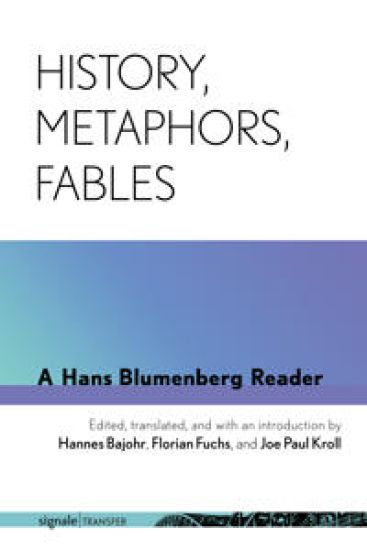
History, Metaphors, Fables collects the central writings by Hans Blumenberg and covers topics such as on the philosophy of language, metaphor theory, non-conceptuality, aesthetics, politics, and literary studies. This landmark volume demonstrates Blumenberg's intellectual breadth and gives an overview of his thematic and stylistic range over four decades. Blumenberg's early philosophy of technology becomes tangible, as does his critique of linguistic perfectibility and conceptual thought, his theory of history as successive concepts of reality", his anthropology, or his studies of literature. History, Metaphors, Fables allows readers to discover a master thinker whose role in the German intellectual post-war scene can hardly be overestimated.
History, Metaphors, Fables

History, Metaphors, Fables

Hans Blumenberg

Cornell University Press and Cornell University Library
2020
pokkari
History, Metaphors, Fables collects the central writings by Hans Blumenberg and covers topics such as on the philosophy of language, metaphor theory, non-conceptuality, aesthetics, politics, and literary studies. This landmark volume demonstrates Blumenberg's intellectual breadth and gives an overview of his thematic and stylistic range over four decades. Blumenberg's early philosophy of technology becomes tangible, as does his critique of linguistic perfectibility and conceptual thought, his theory of history as successive concepts of reality", his anthropology, or his studies of literature. History, Metaphors, Fables allows readers to discover a master thinker whose role in the German intellectual post-war scene can hardly be overestimated.
The Readability of the World

The Readability of the World

Hans Blumenberg

CORNELL UNIVERSITY PRESS
2022
sidottu
The Readability of the World represents Hans Blumenberg's first extended demonstration of the metaphorological method he pioneered in Paradigms for a Metaphorology. For Blumenberg, metaphors are symptomatic of patterns of thought and feeling that escape conceptual formulation but are nonetheless indispensable, because they allow humans to orient themselves in an otherwise overwhelming world. The Readability of the World applies this method to the idea that the world presents itself as a book. The metaphor of the book of nature has been central to Western interpretations of reality, and Blumenberg traces the evolution of this metaphor from ancient Greek cosmology to the model of the genetic code to access the different expectations of reality that it articulates, reflects, and projects. Writing with equal authority on literature and science, theology and philosophy, ancient metaphysics and twentieth-century biochemistry, Blumenberg advances rich and original interpretations of the thinking of a range of canonical figures, including Berkeley, Vico, Goethe, Spinoza, Leibniz, Bacon, Flaubert, and Freud. Through his interdisciplinary, anthropologically sharpened gaze, Blumenberg uncovers a wealth of new insights into the continuities and discontinuities across human history of the longing to contain all of nature, history, and reality in a book, from the Bible, the Talmud, and the Qur'an to Diderot's Encyclopedia and Humboldt's Cosmos to the ACGT of the DNA code.
The Laughter of the Thracian Woman

The Laughter of the Thracian Woman

Hans Blumenberg

Bloomsbury Academic USA
2015
nidottu
An important work by 20-century philosopher Hans Blumenberg, here translated into English for the first time, The Laughter of the Thracian Woman describes the reception history of an anecdote best known from Plato’s Theaetetus dialogue: while focused on observing the stars, the early astronomer and proto-philosopher Thales of Miletus fails to see a well directly in his path and tumbles down. A Thracian servant girl laughs, amused that he sought to understand what was above him when he was not mindful of what was right in front of him. Blumenberg sees the story as a highly sought substitute for our missing knowledge of the earliest historical events that would fit the label “theory.” By retelling the anecdote, philosophers reveal their distinctive values regarding absorption in curiosity, philosophy’s past, and the demand that theorists abide by sanctioned methods and procedures. In this work and others, Blumenberg demonstrates that philosophers’ most beloved images and anecdotes have become indispensable to philosophy as metaphors; that is, as representations whose meanings remain indefinite and invite frequent reinterpretation.
The Laughter of the Thracian Woman

The Laughter of the Thracian Woman

Hans Blumenberg

Bloomsbury Academic USA
2015
sidottu
An important work by 20-century philosopher Hans Blumenberg, here translated into English for the first time, The Laughter of the Thracian Woman describes the reception history of an anecdote best known from Plato’s Theaetetus dialogue: while focused on observing the stars, the early astronomer and proto-philosopher Thales of Miletus fails to see a well directly in his path and tumbles down. A Thracian servant girl laughs, amused that he sought to understand what was above him when he was not mindful of what was right in front of him. Blumenberg sees the story as a highly sought substitute for our missing knowledge of the earliest historical events that would fit the label “theory.” By retelling the anecdote, philosophers reveal their distinctive values regarding absorption in curiosity, philosophy’s past, and the demand that theorists abide by sanctioned methods and procedures. In this work and others, Blumenberg demonstrates that philosophers’ most beloved images and anecdotes have become indispensable to philosophy as metaphors; that is, as representations whose meanings remain indefinite and invite frequent reinterpretation.
Die Sorge geht über den Fluß

Die Sorge geht über den Fluß

Hans Blumenberg

SUHRKAMP VERLAG
1987
sidottu
"Plötzlich kommt einer", schrieb Frank Schirrmacher 1987 in der Frankfurter Allgemeinen Zeitung zur Erstveröffentlichung dieses Bandes des Philosophen Hans Blumenberg (1920-1996) in der Bibliothek Suhrkamp, "und erzählt ganz neue, abenteuerliche und poetische Geschichten. ... Wir werden künftig, wenn wir von den führenden Schriftstellern des Landes reden, auch den Namen Blumenberg erwähnen müssen."