Kirjojen hintavertailu. Mukana 12 053 051 kirjaa ja 12 kauppaa.

Kirjahaku

Etsi kirjoja tekijän nimen, kirjan nimen tai ISBN:n perusteella.

15 kirjaa tekijältä Harald Fritzsch

An Equation That Changed the World

An Equation That Changed the World

Harald Fritzsch

University of Chicago Press
1994
sidottu
Fritzsch offers readers the opportunity to listen in on a meeting of Isaac Newton, Albert Einstein, and a present-day physicist. While he introduces the theory of relativity, Fritzsch teaches its sources, its workings, and the ways it has revolutionized our view of the physical world. An Equation That Changed the World dramatizes the importance of relativity, for the human race, and the survival of our planet. "Fritzsch could not give the modern reader a more memorable introduction to the personalities and science of Isaac Newton and Albert Einstein unless somehow he could find the keys to H. G. Wells' time machine...Many readers will applaud Fritzsch for this lively but profoundly insightful book." --Booklist, starred review "[Fritzsch] has dreamed up a dialogue between the two great physicists, helped along by a fictional modern physicist...The conversation builds up to an explanation of E=mc2, and on the way illuminates the important points where Newtonian and Einsteinian theory diverge." --David Lindley, New York Times Book Review
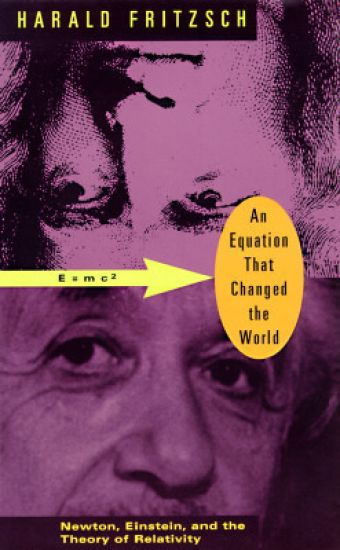
An Equation That Changed the World

An Equation That Changed the World

Harald Fritzsch

University of Chicago Press
1997
nidottu
Fritzsch offers readers the opportunity to listen in on a meeting of Isaac Newton, Albert Einstein, and a present-day physicist. While he introduces the theory of relativity, Fritzsch teaches its sources, its workings, and the ways it has revolutionized our view of the physical world. An Equation That Changed the World dramatizes the importance of relativity, for the human race, and the survival of our planet."Fritzsch could not give the modern reader a more memorable introduction to the personalities and science of Isaac Newton and Albert Einstein unless somehow he could find the keys to H. G. Wells' time machine. . . . Many readers will applaud Fritzsch for this lively but profoundly insightful book." —Booklist, starred review"[Fritzsch] has dreamed up a dialogue between the two great physicists, helped along by a fictional modern physicist. . . . The conversation builds up to an explanation of E=mc2, and on the way illuminates the important points where Newtonian and Einsteinian theory diverge." —David Lindley, New York Times Book Review
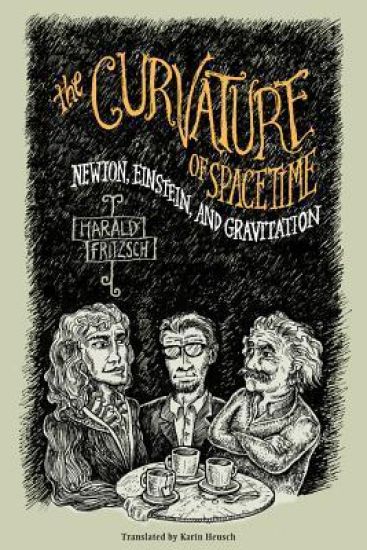
The Curvature of Spacetime

The Curvature of Spacetime

Harald Fritzsch

Columbia University Press
2004
pokkari
The internationally renowned physicist Harald Fritzsch deftly explains the meaning and far-flung implications of the general theory of relativity and other mysteries of modern physics by presenting an imaginary conversation among Newton, Einstein, and a fictitious contemporary particle physicist named Adrian Haller-the same device Fritzsch employed to great acclaim in his earlier book An Equation That Changed the World, which focused on the special theory of relativity. Einstein's theory of gravitation, his general theory of relativity, touches on basic questions of our existence. Matter, according to Einstein, has no existence independent of space and time. It is even capable of bending the structure of space and changing the course of time-it introduces a "curvature." Gravity emerges not as an actual physical force but as a consequence of space-time geometry. Even the apple that drops from the tree follows the curvature of time and space. In this entertaining and involving account of relativity, Newton serves as the skeptic and asks the questions a modern reader might ask. Einstein himself does the explaining, while Haller explains the new developments that have occurred since the general theory was proposed. The result is an intellectual roller-coaster ride in which concepts that have entered the vernacular become clear for the first time: the Big Bang, "black holes," elementary particles, and much more.
Murray Gell-Mann and the Physics of Quarks

Murray Gell-Mann and the Physics of Quarks

Harald Fritzsch

Springer Nature Switzerland AG
2019
nidottu
Murray Gell-Mann, Physics Nobel Prize Laureate in 1969 is known for his theoretical work on elementary particle physics and the introduction of quarks and together with H. Fritzsch the “Quantum Chromodynamics”. Based on four sections the Editor gives an overview on the work of Gell-Mann and his contributions to various aspects of the physics, related to quarks. His most important and influential papers were selected and reprinted so that the reader easily can check the original work of Gell-Mann.
Murray Gell-Mann and the Physics of Quarks

Murray Gell-Mann and the Physics of Quarks

Harald Fritzsch

Birkhauser Verlag AG
2018
sidottu
Murray Gell-Mann, Physics Nobel Prize Laureate in 1969 is known for his theoretical work on elementary particle physics and the introduction of quarks and together with H. Fritzsch the “Quantum Chromodynamics”. Based on four sections the Editor gives an overview on the work of Gell-Mann and his contributions to various aspects of the physics, related to quarks. His most important and influential papers were selected and reprinted so that the reader easily can check the original work of Gell-Mann.
Quantenfeldtheorie - Wie man beschreibt, was die Welt im Innersten zusammenhält

Quantenfeldtheorie - Wie man beschreibt, was die Welt im Innersten zusammenhält

Harald Fritzsch

Springer-Verlag Berlin and Heidelberg GmbH Co. K
2015
sidottu
Die Geheimnisse des Mikrokosmos aufzudecken, hat die Physiker seit Jahrhunderten fasziniert. Doch obwohl in den vergangenen Jahrzehnten viele interessante Entdeckungen gemacht wurden, bleiben noch Fragen offen, die Harald Fritzsch in diesem Buch von der physikalischen und mathematischen Seite beleuchtet:- Haben die Physiker mit der Standardtheorie der Elementarteilchenphysik schon eine exakte Beschreibung der Teilchenwelt gefunden?- Gibt es wirklich eine „Große Vereinigung“ aller fundamentalen Kräfte?- Und sind die Leptonen, (wie das Elektron), oder die Bausteine der Hadronen, (die Quarks), vielleicht gar nicht wirklich punktförmig, sondern kleine eindimensionale Objekte, die man als „Strings“ bezeichnet?Dieses Buch setzt mathematische Vorbildung voraus und versteht sich als Überblick über die modernen Grundlagen der Quantenfeldtheorie und als Diskussionsbeitrag. Somit eignet sich das Werk insbesondere auch als Überblick und Wiederholungfür Physiker. Harald Fritzsch ist bereits als Autor populärwissenschaftlicher Bücher bekannt. Sein Buch "Quarks", das in München 1980 erschien, wurde in mehr als 20 Sprachen übersetzt.Der AutorProf. Harald Fritzsch (* 10. Februar 1943 in Zwickau) ist ein theoretischer Physiker, der vor allem wichtige Beiträge zur Theorie der Quarks, zur Entwicklung der Quantenchromodynamik und zur Großen Vereinheitlichung des Standardmodells der Elementarteilchen geleistet hat.
Elementary Particles: Building Blocks Of Matter

Elementary Particles: Building Blocks Of Matter

Harald Fritzsch

World Scientific Publishing Co Pte Ltd
2005
sidottu
This highly readable book uncovers the mysteries of the physics of elementary particles for a broad audience. From the familiar notions of atoms and molecules to the complex ideas of the grand unification of all the basic forces, this book allows the interested lay public to appreciate the fascinating building blocks of matter that make up our universe.Beginning with a description of the quantum nature of atoms and particles, readers are introduced to the elementary constituents of atomic nuclei: quarks. The book goes on to consider all of the important ideas in particle physics: quantum electrodynamics and quantum chromodynamics, the theory of strong interactions, the gauge theories of the weak and electromagnetic interactions, as well as the problem of mass generation. To conclude the book, the ideas of grand unification are described, and finally, some applications to astrophysics are discussed.Your guide to this exciting world is an author who, together with the originator of the idea of quarks, Murray Gell-Mann, has played an important role in the development of the theory of quantum chromodynamics and the concept of grand unification.
Elementary Particles: Building Blocks Of Matter

Elementary Particles: Building Blocks Of Matter

Harald Fritzsch

World Scientific Publishing Co Pte Ltd
2005
nidottu
This highly readable book uncovers the mysteries of the physics of elementary particles for a broad audience. From the familiar notions of atoms and molecules to the complex ideas of the grand unification of all the basic forces, this book allows the interested lay public to appreciate the fascinating building blocks of matter that make up our universe.Beginning with a description of the quantum nature of atoms and particles, readers are introduced to the elementary constituents of atomic nuclei: quarks. The book goes on to consider all of the important ideas in particle physics: quantum electrodynamics and quantum chromodynamics, the theory of strong interactions, the gauge theories of the weak and electromagnetic interactions, as well as the problem of mass generation. To conclude the book, the ideas of grand unification are described, and finally, some applications to astrophysics are discussed.Your guide to this exciting world is an author who, together with the originator of the idea of quarks, Murray Gell-Mann, has played an important role in the development of the theory of quantum chromodynamics and the concept of grand unification.
Escape From Leipzig

Escape From Leipzig

Harald Fritzsch

World Scientific Publishing Co Pte Ltd
2008
sidottu
With a foreword written by G *#x0027;t HooftIn the 1960s, Leipzig was the center of resistance in East Germany. Harald Fritzsch, then a physics student, contemplated escape. But before he left, he wanted to demonstrate to the government that they had gone too far when they destroyed St. Paul's Church in May 1968. He accomplished that by unrolling a protest transparency in spectacular fashion. Despite the great efforts of the secret police, the STASI, the government was unable to find out who was responsible for this act. Soon after, together with a friend, Fritzsch began his journey to Bulgaria in order to escape into Turkey by traversing the Black Sea in a folding canoe. This was a daredevil endeavor, never done before.In this book, Harald Fritzsch — now a world-renowned physicist — portrays in captivating detail an authentic picture of the East German regime and the events of the late 1960s. Today, 40 years later, he critically takes stock of the events since German reunification.
Escape From Leipzig

Escape From Leipzig

Harald Fritzsch

World Scientific Publishing Co Pte Ltd
2008
nidottu
With a foreword written by G *#x0027;t HooftIn the 1960s, Leipzig was the center of resistance in East Germany. Harald Fritzsch, then a physics student, contemplated escape. But before he left, he wanted to demonstrate to the government that they had gone too far when they destroyed St. Paul's Church in May 1968. He accomplished that by unrolling a protest transparency in spectacular fashion. Despite the great efforts of the secret police, the STASI, the government was unable to find out who was responsible for this act. Soon after, together with a friend, Fritzsch began his journey to Bulgaria in order to escape into Turkey by traversing the Black Sea in a folding canoe. This was a daredevil endeavor, never done before.In this book, Harald Fritzsch — now a world-renowned physicist — portrays in captivating detail an authentic picture of the East German regime and the events of the late 1960s. Today, 40 years later, he critically takes stock of the events since German reunification.
Fundamental Constants, The: A Mystery Of Physics

Fundamental Constants, The: A Mystery Of Physics

Harald Fritzsch

World Scientific Publishing Co Pte Ltd
2009
sidottu
The speed of light, the fine structure constant, and Newton's constant of gravity — these are just three among the many physical constants that define our picture of the world. Where do they come from? Are they constant in time and across space? In this book, physicist and author Harald Fritzsch invites the reader to explore the mystery of the fundamental constants of physics in the company of Isaac Newton, Albert Einstein, and a modern-day physicist. The conversation that the three scientists are imagined to have provides an entertaining introduction to the constants and covers topics ranging from atomic, nuclear, and particle physics to astrophysics and cosmology.
Fundamental Constants, The: A Mystery Of Physics

Fundamental Constants, The: A Mystery Of Physics

Harald Fritzsch

World Scientific Publishing Co Pte Ltd
2009
nidottu
The speed of light, the fine structure constant, and Newton's constant of gravity — these are just three among the many physical constants that define our picture of the world. Where do they come from? Are they constant in time and across space? In this book, physicist and author Harald Fritzsch invites the reader to explore the mystery of the fundamental constants of physics in the company of Isaac Newton, Albert Einstein, and a modern-day physicist. The conversation that the three scientists are imagined to have provides an entertaining introduction to the constants and covers topics ranging from atomic, nuclear, and particle physics to astrophysics and cosmology.
Quantum Field Theory

Quantum Field Theory

Harald Fritzsch

World Scientific Publishing Co Pte Ltd
2017
sidottu
The matter in our universe is composed of electrons and quarks. The dynamics of electrons and quarks is described by the Standard Model of particle physics, which is based on quantum field theories. The general framework of quantum field theories is described in this book. After the classical mechanics and the relativistic mechanics the details of classical scalar fields, of electrodynamics and of quantum mechanics are discussed. Then the quantization of scalar fields, of spinor fields and of vector fields is described.The basic interactions are described by gauge theories. These theories are discussed in detail, in particular the gauge theories of quantum electrodynamics (QED) and of quantum chromodynamics (QCD), based on the gauge group SU(3). In both theories the gauge bosons, the photon and the gluons, have no mass. The gauge theory of the electroweak interactions, based on the gauge group SU(2) x U(1), describes both the electromagnetic and the weak interactions. The weak force is generated by the exchange of the weak bosons. They have a large mass, and one believes that these masses are generated by a spontaneous breaking of the gauge symmetry.It might be that the strong and the electroweak interactions are unified at very high energies ('Grand Unification'). The gauge groups SU(3) and SU(2) x U(1) must be subgroups of a big gauge group, describing the Grand Unification. Two such theories are discussed, based on the gauge groups SU(5) and SO(10).
You Are Wrong, Mr Einstein!: Newton, Einstein, Heisenberg And Feynman Discussing Quantum Mechanics
With Foreword by S L GlashowWerner Heisenberg and Richard Feynman find quantum physics fascinating and necessary for understanding the atoms. Albert Einstein dislikes it and Isaac Newton does not understand it, which is not surprising. This is the scenario for animated discussions between five people. Harald Fritzsch brings together Newton and the three great physicists of the 20th century in an imaginary meeting. His “alter ego” Adrian Haller moderates the discussions.By means of questions and answers the whole cosmos of quantum physics is described in a simple way, easily understandable non-physicists. The beginnings of quantum theory and atomic physics as well as the importance of quantum physics for our daily life — these and many more topics are the subjects of the interesting and fascinating discussions.
Microcosmos: The World Of Elementary Particles - Fictional Discussions Between Einstein, Newton, And Gell-mann
This book provides the readers with a broad introduction to the field of particle physics through fictional discussions between three prominent physicists — Albert Einstein, Issac Newton, and Murray Gell-Mann — together with a modern physicist.Matter is composed of quarks and electrons. The forces between quarks are generated by exchanges of gluons and are so strong that they result in the confinement of quarks in atomic nuclei, whereas the forces between electrons and atomic nuclei are generated by exchanges of photons, and the forces between quarks and electrons (or any other leptons) are generated by exchanges of weak bosons.The book is suitable for non-experts in physics.