Kirjojen hintavertailu. Mukana 11 359 578 kirjaa ja 12 kauppaa.

Kirjahaku

Etsi kirjoja tekijän nimen, kirjan nimen tai ISBN:n perusteella.

8 kirjaa tekijältä Harriet Murav

David Bergelson's Strange New World

David Bergelson's Strange New World

Harriet Murav

Indiana University Press
2019
sidottu
David Bergelson (1884–1952) emerged as a major literary figure who wrote in Yiddish before WWI. He was one of the founders of the Kiev Kultur-Lige and his work was at the center of the Yiddish-speaking world of the time. He was well known for creating characters who often felt the painful after-effects of the past and the clumsiness of bodies stumbling through the actions of daily life as their familiar worlds crumbled around them. In this contemporary assessment of Bergelson and his fiction, Harriet Murav focuses on untimeliness, anachronism, and warped temporality as an emotional, sensory, existential, and historical background to Bergleson's work and world. Murav grapples with the great modern theorists of time and memory, especially Henri Bergson, Sigmund Freud, and Walter Benjamin, to present Bergelson as an integral part of the philosophical and artistic experiments, political and technological changes, and cultural context of Russian and Yiddish modernism that marked his age. As a comparative and interdisciplinary study of Yiddish literature and Jewish culture, this work adds a new, ethnic dimension to understandings of the turbulent birth of modernism.
David Bergelson's Strange New World

David Bergelson's Strange New World

Harriet Murav

Indiana University Press
2019
pokkari
David Bergelson (1884–1952) emerged as a major literary figure who wrote in Yiddish before WWI. He was one of the founders of the Kiev Kultur-Lige and his work was at the center of the Yiddish-speaking world of the time. He was well known for creating characters who often felt the painful after-effects of the past and the clumsiness of bodies stumbling through the actions of daily life as their familiar worlds crumbled around them. In this contemporary assessment of Bergelson and his fiction, Harriet Murav focuses on untimeliness, anachronism, and warped temporality as an emotional, sensory, existential, and historical background to Bergleson's work and world. Murav grapples with the great modern theorists of time and memory, especially Henri Bergson, Sigmund Freud, and Walter Benjamin, to present Bergelson as an integral part of the philosophical and artistic experiments, political and technological changes, and cultural context of Russian and Yiddish modernism that marked his age. As a comparative and interdisciplinary study of Yiddish literature and Jewish culture, this work adds a new, ethnic dimension to understandings of the turbulent birth of modernism.
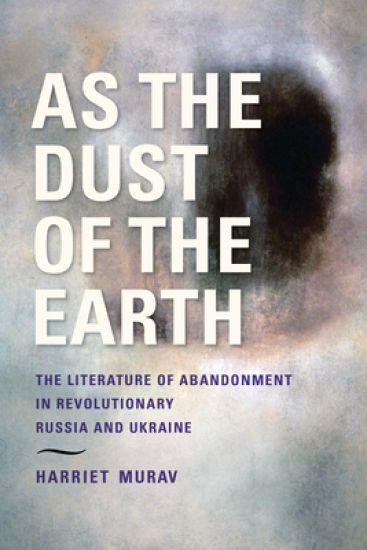
As the Dust of the Earth

As the Dust of the Earth

Harriet Murav

INDIANA UNIVERSITY PRESS
2024
sidottu
An estimated forty thousand Jews were murdered during the Russian Civil War between 1918 and 1922. As the Dust of the Earth examines the Yiddish and Russian literary response to the violence (pogroms) and the relief effort, exploring both the poetry of catastrophe and the documentation of catastrophe and care. Brilliantly weaving together narrative fiction, poetry, memoirs, newspaper articles, and documentary, Harriet Murav argues that poets and pogrom investigators were doing more than recording the facts of violence and expressing emotions in response to it. They were interrogating what was taking place through a central concept familiar from their everyday lifeworld—hefker, or abandonment. Hefker shaped the documentation of catastrophe by Jewish investigators at pogrom sites impossibly tasked with producing comprehensive reports of chaos. Hefker also became a framework for Yiddish writers to think through such incomprehensible violence by creating new forms of poetry. Focusing less on the perpetrators and more on the responses to the pogroms, As the Dust of the Earth offers a fuller understanding of the seismic effects of such organized violence and a moving testimony to the resilience of survivors to process and cope with catastrophe.
As the Dust of the Earth

As the Dust of the Earth

Harriet Murav

INDIANA UNIVERSITY PRESS
2024
pokkari
An estimated forty thousand Jews were murdered during the Russian Civil War between 1918 and 1922. As the Dust of the Earth examines the Yiddish and Russian literary response to the violence (pogroms) and the relief effort, exploring both the poetry of catastrophe and the documentation of catastrophe and care. Brilliantly weaving together narrative fiction, poetry, memoirs, newspaper articles, and documentary, Harriet Murav argues that poets and pogrom investigators were doing more than recording the facts of violence and expressing emotions in response to it. They were interrogating what was taking place through a central concept familiar from their everyday lifeworld—hefker, or abandonment. Hefker shaped the documentation of catastrophe by Jewish investigators at pogrom sites impossibly tasked with producing comprehensive reports of chaos. Hefker also became a framework for Yiddish writers to think through such incomprehensible violence by creating new forms of poetry. Focusing less on the perpetrators and more on the responses to the pogroms, As the Dust of the Earth offers a fuller understanding of the seismic effects of such organized violence and a moving testimony to the resilience of survivors to process and cope with catastrophe.
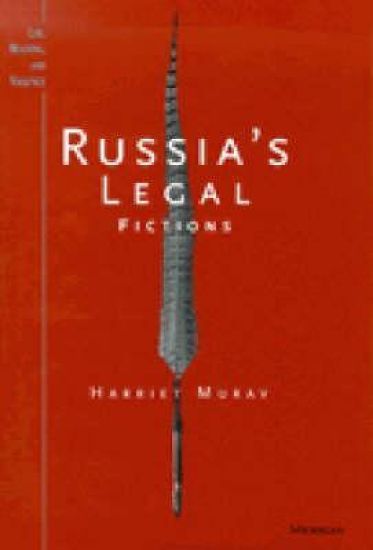
Russia's Legal Fictions

Russia's Legal Fictions

Harriet Murav

The University of Michigan Press
1998
sidottu
Legal scholars and literary critics have shown the significance of storytelling, not only as part of the courtroom procedure, but as part of the very foundation of law. Russia's Legal Fictions examines the relationship between law, narrative and authority in nineteenth- and twentieth-century Russia. The conflict between the Russian writer and the law is a well-known feature of Russian literary life in the past two centuries. With one exception, the authors discussed in this book--Sukhovo-Kobylin, Akhsharumov, Suvorin, and Dostoevsky in the nineteenth century and Solzhenitsyn and Siniavskii in the twentieth--were all put on trial. In Russia's Legal Fictions, Harriet Murav starts with the authors' own writings about their experience with law and explores the history of these Russian literary trials, including censorship, libel cases, and one case of murder, in their specific historical context, showing how particular aspects of the culture of the time relate to the case. The book explores the specifically Russian literary and political conditions in which writers claim the authority not only as the authors of fiction but as lawgivers in the realm of the real, and in which the government turns to the realm of the literary to exercise its power. The author uses specific aspects of Russian culture, history and literature to consider broader theoretical questions about the relationship between law, narrative, and authority. Murav offers a history of the reception of the jury trial and the development of a professional bar in late Imperial Russia as well as an exploration of theories of criminality, sexuality, punishment, and rehabilitation in Imperial and Soviet Russia.This book will be of interest to scholars of law and literature and Russian law, history and culture.Harriet Murav is Associate Professor of Russian and Comparative Literature, University of California at Davis.
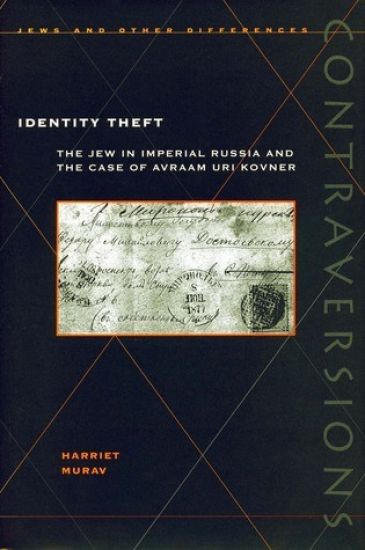
Identity Theft

Identity Theft

Harriet Murav

Stanford University Press
2003
sidottu
Identity Theft focuses on the life and writing of Avraam Uri Kovner. As one of the fiery Jewish nihilists of his generation, variously a critic, author, and bank embezzler, Kovner embodies the problem of identity as a series of translations across cultural boundaries. Kovner, who initiated modern Hebrew criticism, published two novels in Russian as well as a weekly column in a widely read Russian newspaper. He forged a bank check and became notorious in the Russian press as an example of the danger integration of the Jews represented to Russian society. From prison, and later in exile, Kovner defended the Jews in a series of letters to Fedor Dostoevsky and Vasilii Rozanov, both of whom vilified Jews in their writings. Ostracized by both the Jewish and Russian communities, he mimed and at the same time undermined rigid stereotypes of Jewish and Russian behavior, pointing out the uneasy interdependence of the two cultures he inhabited.
Music from a Speeding Train

Music from a Speeding Train

Harriet Murav

Stanford University Press
2011
sidottu
Music from a Speeding Train explores the uniquely Jewish space created by Jewish authors working within the limitations of the Soviet cultural system. It situates Russian- and Yiddish- language authors in the same literary universe—one in which modernism, revolution, socialist realism, violence, and catastrophe join traditional Jewish texts to provide the framework for literary creativity. These writers represented, attacked, reformed, and mourned Jewish life in the pre-revolutionary shtetl as they created new forms of Jewish culture. The book emphasizes the Soviet Jewish response to World War II and the Nazi destruction of the Jews, disputing the claim that Jews in Soviet Russia did not and could not react to the killings of Jews. It reveals a largely unknown body of Jewish literature beginning as early as 1942 that responds to the mass killings. By exploring works through the early twenty-first century, the book reveals a complex, emotionally rich, and intensely vibrant Soviet Jewish culture that persisted beyond Stalinist oppression.