Kirjojen hintavertailu. Mukana 12 016 292 kirjaa ja 12 kauppaa.

Kirjahaku

Etsi kirjoja tekijän nimen, kirjan nimen tai ISBN:n perusteella.

13 kirjaa tekijältä Harry Collins

Tacit and Explicit Knowledge

Tacit and Explicit Knowledge

Harry Collins

University of Chicago Press
2012
nidottu
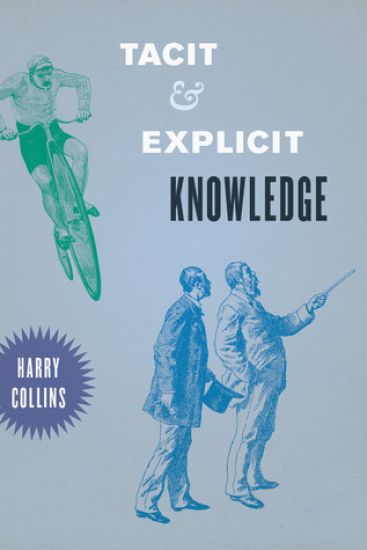
Much of what we know we cannot say. And much of what we do we cannot describe. For example, how do we know how to ride a bike when we can't explain how we do it? These abilities, which we are unable to articulate, were labeled "tacit knowledge" by chemist and philosopher Michael Polanyi, but here Harry Collins analyzes the term, and the behavior, in much greater detail, often departing from Polanyi's treatment. In "Tacit and Explicit Knowledge", Collins develops a common conceptual language to bridge the concept's disparate domains by explaining explicit knowledge and classifying tacit knowledge. Collins then teases apart the three very different meanings, which, until now, all fell under the umbrella of Polanyi's term: relational tacit knowledge (things we could describe in principle if we put in the effort), somatic tacit knowledge (things our bodies can do but we cannot describe, like balancing on a bike), and collective tacit knowledge (knowledge we draw on that is the property of society, such as the rules for language). Thus, bicycle riding consists of some somatic tacit knowledge and some collective tacit knowledge, such as the knowledge that allows us to navigate in traffic. The intermixing of the three kinds of tacit knowledge has led to confusion in the past; Collins' book unravels these complexities and thus enables us to make new and better use of the underlying concept.
Gravity's Ghost and Big Dog

Gravity's Ghost and Big Dog

Harry Collins

University of Chicago Press
2014
nidottu
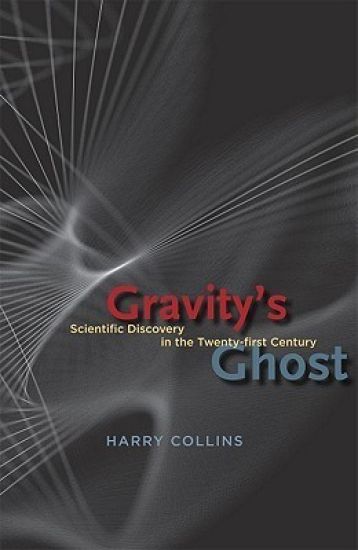
Gravity's Ghost and Big Dog brings to life science's efforts to detect cosmic gravitational waves. These ripples in space-time are predicted by general relativity, and their discovery will not only demonstrate the truth of Einstein's theories but also transform astronomy. Although no gravitational wave has ever been directly detected, the previous five years have been an especially exciting period in the field. Here sociologist Harry Collins offers readers an unprecedented view of gravitational wave research and explains what it means for an analyst to do work of this kind. Collins was embedded with the gravitational wave physicists as they confronted two possible discoveries - "Big Dog," fully analyzed in this volume for the first time, and the "Equinox Event," which was first chronicled by Collins in Gravity's Ghost. He records the agonizing arguments that arose as the scientists worked out what they had seen and how to present it to the world, along the way demonstrating how even the most statistical of sciences rest on social and philosophical choices. Gravity's Ghost and Big Dog draws on nearly fifty years of fieldwork observing scientists at the American Laser Interferometer Gravitational Wave Observatory and elsewhere around the world to offer an inspired commentary on the place of science in society today.
Gravity's Ghost

Gravity's Ghost

Harry Collins

University of Chicago Press
2010
sidottu
In theory, at least, gravitational waves do exist. We are constantly bathed in gravitational radiation, which is generated when stars explode or collide and a portion of their mass becomes energy that ripples out like a disturbance on the surface of a serene pond. But unfortunately no gravitational wave has ever been directly detected, even though the search has lasted more than forty years. As the leading chronicler of the search for gravitational waves, Harry Collins has been right there with the scientists since the start. The result of his unprecedented access to the front lines of physical science is "Gravity's Ghost", a thrilling chronicle of high-stakes research and cutting-edge discovery. Here, Collins reveals that scientific discovery and nondiscovery can turn on scientific traditions and rivalries, that ideal statistical analysis rests on impossible procedures and unattainable knowledge, and that fact in one place is baseless assumption in another. He also argues that sciences like gravitational wave detection, in exemplifying how the intractable is to be handled, can offer scientific leadership a moral beacon for the twenty-first century. In the end, "Gravity's Ghost" shows that discoveries are the denouements of dramatic scientific mysteries.
Changing Order

Changing Order

Harry Collins

University of Chicago Press
1992
nidottu
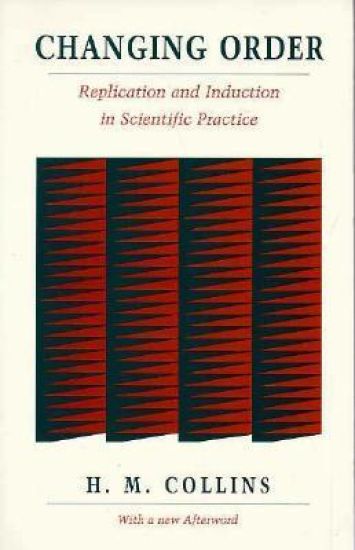
This fascinating study in the sociology of science explores the way scientists conduct, and draw conclusions from, their experiments. The book is organized around three case studies: replication of the TEA-laser, detecting gravitational rotation, and some experiments in the paranormal. "In his superb book, Collins shows why the quest for certainty is disappointed. He shows that standards of replication are, of course, social, and that there is consequently no outside standard, no Archimedean point beyond society from which we can lever the intellects of our fellows."--Donald M. McCloskey, Journal of Economic Psychology
Gravity's Shadow

Gravity's Shadow

Harry Collins

University of Chicago Press
2004
nidottu
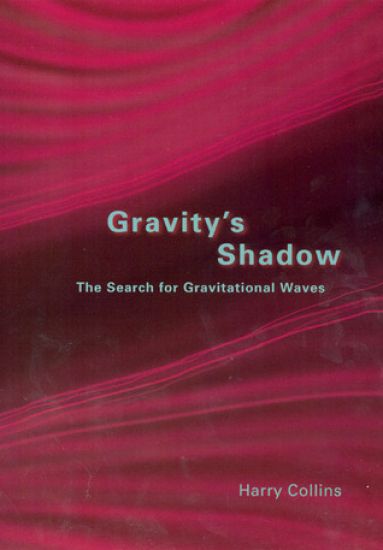
According to the theory of relativity, we are constantly bathed in gravitational radiation. When stars explode or collide, a portion of their mass becomes energy that disturbs the very fabric of the space-time continuum like ripples in a pond. But proving the existence of these waves has been difficult; the cosmic shudders are so weak that only the most sensitive instruments can be expected to observe them directly. Fifteen times during the last thirty years scientists have claimed to have detected gravitational waves, but so far none of those claims have survived the scrutiny of the scientific community. Gravity's Shadow chronicles the forty-year effort to detect gravitational waves, while exploring the meaning of scientific knowledge and the nature of expertise.Gravitational wave detection involves recording the collisions, explosions, and trembling of stars and black holes by evaluating the smallest changes ever measured. Because gravitational waves are so faint, their detection will come not in an exuberant moment of discovery but through a chain of inference; for forty years, scientists have debated whether there is anything to detect and whether it has yet been detected. Sociologist Harry Collins has been tracking the progress of this research since 1972, interviewing key scientists and delineating the social process of the science of gravitational waves.Engagingly written and authoritatively comprehensive, Gravity's Shadow explores the people, institutions, and government organizations involved in the detection of gravitational waves. This sociological history will prove essential not only to sociologists and historians of science but to scientists themselves.
Gravity's Kiss

Gravity's Kiss

Harry Collins

MIT Press
2018
pokkari
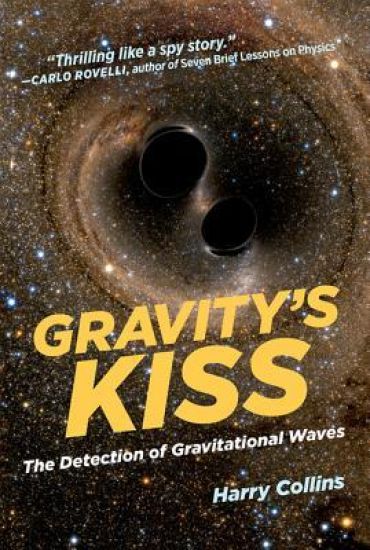
A fascinating account, written in real time, of the unfolding of a scientific discovery: the first detection of gravitational waves.Scientists have been trying to confirm the existence of gravitational waves for fifty years. Then, in September 2015, came a "very interesting event" (as the cautious subject line in a physicist's email read) that proved to be the first detection of gravitational waves. In Gravity's Kiss, Harry Collins-who has been watching the science of gravitational wave detection for forty-three of those fifty years and has written three previous books about it-offers a final, fascinating account, written in real time, of the unfolding of one of the most remarkable scientific discoveries ever made. Predicted by Einstein in his theory of general relativity, gravitational waves carry energy from the collision or explosion of stars. Dying binary stars, for example, rotate faster and faster around each other until they merge, emitting a burst of gravitational waves. It is only with the development of extraordinarily sensitive, highly sophisticated detectors that physicists can now confirm Einstein's prediction. This is the story that Collins tells.Collins, a sociologist of science who has been embedded in the gravitational wave community since 1972, traces the detection, the analysis, the confirmation, and the public presentation and the reception of the discovery-from the first email to the final published paper and the response of professionals and the public. Collins shows that science today is collaborative, far-flung (with the physical location of the participants hardly mattering), and sometimes secretive, but still one of the few institutions that has integrity built into it.
Forms of Life

Forms of Life

Harry Collins

MIT Press
2019
pokkari
A concise, accessible, and engaging guide for students and practitioners of sociology.In Forms of Life, Harry Collins offers an introduction to social science methodology, drawing on his forty-plus years of conducting high-profile sociological research. In this concise, accessible, and engaging book, Collins explains not only how to do sociology (the method) but also how to think about sociology (the meaning). For example, he describes the three activities that are the foundations of sociological method (immersing oneself in a society; estranging oneself from that society; and explaining what has been discovered to those who have not been immersed) and goes on to consider broader questions of the meaning of science in relation to social science and the scientific authority of "subjective" methods. He explains that sociology is the study of social collectivities (often overlapping, subdividable, and embedded), and cites Wittgenstein's notion of "forms of life" in his definition of collectivity. Collins covers such methodological topics as participant comprehension; interview-based fieldwork ("expect plans to fail"); interactional expertise; alternation and methodological relativism; tangible and inferential experiments; tribalism and emotional loyalty; and how to communicate your findings. Finally, he offers recommendations for "saving the science of sociology," considering, among other things, sociology's identity as a discipline and the perils of both "groupism" and being too afraid of it. Appendixes offer a code of conduct for interviews; a list of his relevant publications; and an account, in Q&A form, of a disastrous day in the life of a sociologist doing fieldwork.
Are We All Scientific Experts Now?

Are We All Scientific Experts Now?

Harry Collins

Polity Press
2014
sidottu
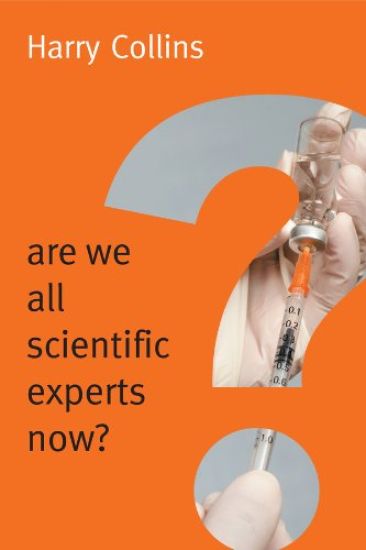
To ordinary people, science used to seem infallible. Scientists were heroes, selflessly pursuing knowledge for the common good. More recently, a series of scientific scandals, frauds and failures have led us to question science’s pre-eminence. Revelations such as Climategate, or debates about the safety of the MMR vaccine, have dented our confidence in science. In this provocative new book Harry Collins seeks to redeem scientific expertise, and reasserts science’s special status. Despite the messy realities of day-to-day scientific endeavor, he emphasizes the superior moral qualities of science, dismissing the dubious “default” expertise displayed by many of those outside the scientific community. Science, he argues, should serve as an example to ordinary citizens of how to think and act, and not the other way round.
Are We All Scientific Experts Now?

Are We All Scientific Experts Now?

Harry Collins

Polity Press
2014
nidottu
To ordinary people, science used to seem infallible. Scientists were heroes, selflessly pursuing knowledge for the common good. More recently, a series of scientific scandals, frauds and failures have led us to question science’s pre-eminence. Revelations such as Climategate, or debates about the safety of the MMR vaccine, have dented our confidence in science. In this provocative new book Harry Collins seeks to redeem scientific expertise, and reasserts science’s special status. Despite the messy realities of day-to-day scientific endeavor, he emphasizes the superior moral qualities of science, dismissing the dubious “default” expertise displayed by many of those outside the scientific community. Science, he argues, should serve as an example to ordinary citizens of how to think and act, and not the other way round.
Artifictional Intelligence

Artifictional Intelligence

Harry Collins

Polity Press
2018
sidottu
Recent startling successes in machine intelligence using a technique called ‘deep learning’ seem to blur the line between human and machine as never before. Are computers on the cusp of becoming so intelligent that they will render humans obsolete? Harry Collins argues we are getting ahead of ourselves, caught up in images of a fantastical future dreamt up in fictional portrayals. The greater present danger is that we lose sight of the very real limitations of artificial intelligence and readily enslave ourselves to stupid computers: the ‘Surrender’. By dissecting the intricacies of language use and meaning, Collins shows how far we have to go before we cannot distinguish between the social understanding of humans and computers. When the stakes are so high, we need to set the bar higher: to rethink ‘intelligence’ and recognize its inherent social basis. Only if machine learning succeeds on this count can we congratulate ourselves on having produced artificial intelligence.
Artifictional Intelligence

Artifictional Intelligence

Harry Collins

Polity Press
2018
nidottu
Recent startling successes in machine intelligence using a technique called ‘deep learning’ seem to blur the line between human and machine as never before. Are computers on the cusp of becoming so intelligent that they will render humans obsolete? Harry Collins argues we are getting ahead of ourselves, caught up in images of a fantastical future dreamt up in fictional portrayals. The greater present danger is that we lose sight of the very real limitations of artificial intelligence and readily enslave ourselves to stupid computers: the ‘Surrender’. By dissecting the intricacies of language use and meaning, Collins shows how far we have to go before we cannot distinguish between the social understanding of humans and computers. When the stakes are so high, we need to set the bar higher: to rethink ‘intelligence’ and recognize its inherent social basis. Only if machine learning succeeds on this count can we congratulate ourselves on having produced artificial intelligence.
Works Like Magic

Works Like Magic

Harry Collins

Libresco Feeds Private Limited
2023
pokkari
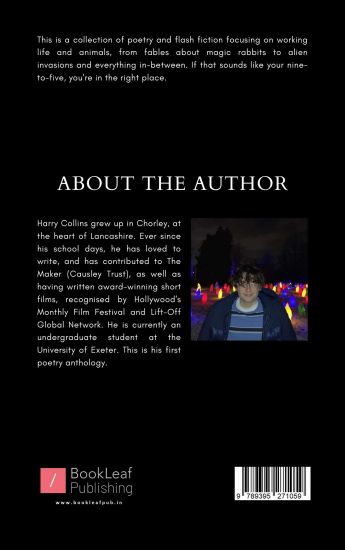
This is a collection of poetry and flash fiction focusing on working life and animals, from fables about magic rabbits to alien invasions and everything in-between. If that sounds like your nine-to-five, you're in the right place.