Kirjojen hintavertailu. Mukana 12 390 323 kirjaa ja 12 kauppaa.

Kirjahaku

Etsi kirjoja tekijän nimen, kirjan nimen tai ISBN:n perusteella.

4 kirjaa tekijältä Harry Harmer

Longman Companion to Slavery, Emancipation and Civil Rights
This Companion provides the essential background to the defining fate of the African diaspora in the Americas and the Caribbean from the 15th to the 20th centuries. Central to the book are detailed chronologies on the development and decline of the slave trade, slavery in colonial North and South America, the Caribbean and the United States, movements for emancipation, and the progress of black civil rights. Separate sections look at the long-running resistance against slavery and the black civil rights movements in the Americas and the Caribbean, with a comparative chronology of apartheid in South Africa. Supported by biographies of over 100 key individuals and a full glossary providing definitions of crucial terms, expressions, ideas and events, this is required reading for anyone interested in the historical experience of slavery.
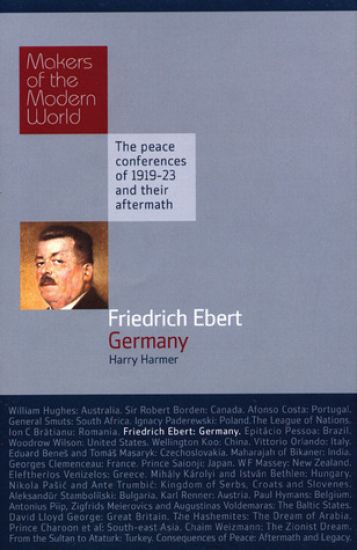
Friedrich Ebert: Germany

Friedrich Ebert: Germany

Harry Harmer

Haus Publishing
2008
sidottu
This title is about Friedrich Ebert (1871-1925). Ebert was influential in securing SPD support for the war in 1914. On the eve of war he travelled to Switzerland to arrange the movement of SPD funds if the party was outlawed. As the leader of organized labour, Ebert had close relations with government and military authorities throughout the war. Two of his sons were killed during the war, something he used to emphasise his patriotism. On 9 November, 1918, Ebert became Imperial Chancellor as revolution broke out in Berlin. He opposed the radical left, declaring, 'Without democracy there is no freedom. Violence, no matter who is using it, is always reactionary', but he compromised Weimar democracy by his dependence on the army command and his use of the para-military Freikorps against the left.Ebert headed a joint SPD-USPD government until elections were held to a National Constituent Assembly in January 1919. Ebert became president of the new Weimar Republic (Germany's first democratically elected head of state) and retained office in a turbulent period in German politics. Ebert reluctantly accepted the need for Germany to sign the Treaty of Versailles, at one point saying he might be prepared to resume the war. It was left to Johannes Bell (depicted by Sir William Orpen from behind) and Hermann Muller (shown leaning over him) to sign on behalf of Germany. There were arguments among the Allies over how Germany should be treated, as France, Britain and the United States prioritised different objectives.In May 1919, the terms of the Treaty - on reparations, war guilt clause, loss of territories in Europe and colonies, limitations on armed forces - were presented to German representatives, precipitating opposition in government and the Armed Forces, and heated discussion in Cabinet. He continued as President until 1925, forced to confront the issues that arose from the Treaty and its political and economic consequences. After his death came the unravelling of the Treaty and the book examines how much of a part it played in creating the circumstances of the Second World War.
Martin Luther King: The Peaceful Revolutionary

Martin Luther King: The Peaceful Revolutionary

Harry Harmer

Albert Bridge Books
2016
nidottu
In 1963, Martin Luther King led 250,000 followers to the Lincoln Memorial in Washington and began to tell the assembled mass of all races and creeds of his vision for the future, 'I have a dream....'. The following year the Civil Rights Act became law, and then the Voting Rights Act, but as the effectiveness of peaceful demonstration was called into question by activists demanding more militant action, he turned to a wider front, attaching the Vietnam War, and the conditions of the poor generally. Increasingly controversial and criticised by some for his milder tactics, in April 1968 he was assassinated by James Earl Ray. This short biography traces the life of Dr King from his birth in Atlanta, through his ministry in Alabama, his involvement with the Montgomery Improvement Association, and his leading role in the civil rights movement to the death which made him its martyr. Harry Harmer has written, among other books, The Longman Companion to Slavery, Emancipation and Civil Rights and co-authored The Black Handbook: The People, History and Politics of Africa and the African Diaspora.