Kirjojen hintavertailu. Mukana 12 390 323 kirjaa ja 12 kauppaa.

Kirjahaku

Etsi kirjoja tekijän nimen, kirjan nimen tai ISBN:n perusteella.

5 kirjaa tekijältä Heidi Tinsman

Partners in Conflict

Partners in Conflict

Heidi Tinsman

Duke University Press
2002
sidottu
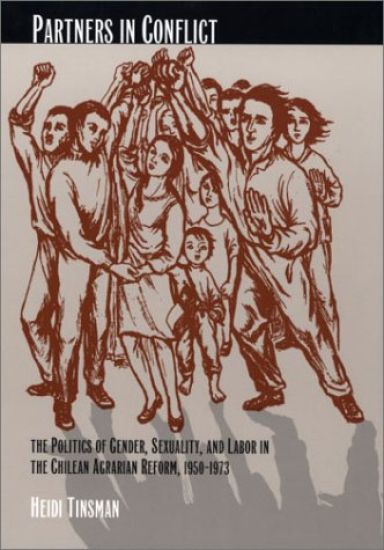
Partners in Conflict examines the importance of sexuality and gender to rural labor and agrarian politics during the last days of Chile’s latifundia system of traditional landed estates and throughout the governments of Eduardo Frei and Salvador Allende. Heidi Tinsman analyzes differences between men’s and women’s participation in Chile’s Agrarian Reform movement and considers how conflicts over gender and sexuality shape the contours of working-class struggles and national politics. Tinsman restores women to a scholarly narrative that has been almost exclusively about men, recounting the centrality of women’s labor to the pre-Agrarian Reform world of the hacienda during the 1950s and recovering women’s critical roles in union struggles and land occupations during the Agrarian Reform itself. Providing a theoretical framework for understanding why the Agrarian Reform ultimately empowered men more than women, Tinsman argues that women were marginalized not because the Agrarian Reform ignored women but because, under both the Frei and Allende governments, it promoted the male-headed household as the cornerstone of a new society. Although this emphasis on gender cooperation stressed that men should have more respect for their wives and funneled unprecedented amounts of resources into women’s hands, the reform defined men as its protagonists and affirmed their authority over women. This is the first monographic social history of Chile’s Agrarian Reform in either English or Spanish, and the first historical work to make sexuality and gender central to the analysis of the reforms.
Partners in Conflict

Partners in Conflict

Heidi Tinsman

Duke University Press
2002
pokkari
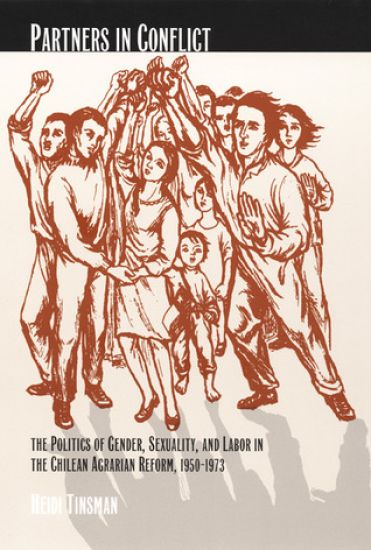
Partners in Conflict examines the importance of sexuality and gender to rural labor and agrarian politics during the last days of Chile’s latifundia system of traditional landed estates and throughout the governments of Eduardo Frei and Salvador Allende. Heidi Tinsman analyzes differences between men’s and women’s participation in Chile’s Agrarian Reform movement and considers how conflicts over gender and sexuality shape the contours of working-class struggles and national politics. Tinsman restores women to a scholarly narrative that has been almost exclusively about men, recounting the centrality of women’s labor to the pre-Agrarian Reform world of the hacienda during the 1950s and recovering women’s critical roles in union struggles and land occupations during the Agrarian Reform itself. Providing a theoretical framework for understanding why the Agrarian Reform ultimately empowered men more than women, Tinsman argues that women were marginalized not because the Agrarian Reform ignored women but because, under both the Frei and Allende governments, it promoted the male-headed household as the cornerstone of a new society. Although this emphasis on gender cooperation stressed that men should have more respect for their wives and funneled unprecedented amounts of resources into women’s hands, the reform defined men as its protagonists and affirmed their authority over women. This is the first monographic social history of Chile’s Agrarian Reform in either English or Spanish, and the first historical work to make sexuality and gender central to the analysis of the reforms.
Buying Into the Regime

Buying Into the Regime

Heidi Tinsman

Duke University Press
2014
sidottu
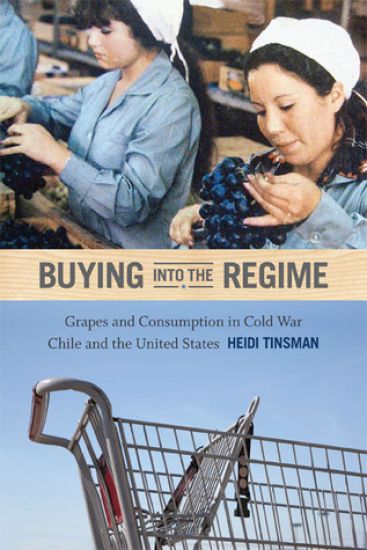
Buying into the Regime is a transnational history of how Chilean grapes created new forms of consumption and labor politics in both the United States and Chile. After seizing power in 1973, Augusto Pinochet embraced neoliberalism, transforming Chile’s economy. The country became the world's leading grape exporter. Heidi Tinsman traces the rise of Chile's fruit industry, examining how income from grape production enabled fruit workers, many of whom were women, to buy the commodities-appliances, clothing, cosmetics-flowing into Chile, and how this new consumerism influenced gender relations, as well as pro-democracy movements. Back in the United States, Chilean and U.S. businessmen aggressively marketed grapes as a wholesome snack. At the same time, the United Farm Workers and Chilean solidarity activists led parallel boycotts highlighting the use of pesticides and exploitation of labor in grape production. By the early-twenty-first century, Americans may have been better informed, but they were eating more grapes than ever.
Buying Into the Regime

Buying Into the Regime

Heidi Tinsman

Duke University Press
2014
pokkari
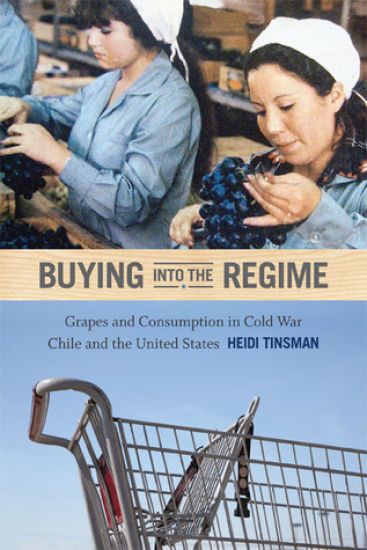
Buying into the Regime is a transnational history of how Chilean grapes created new forms of consumption and labor politics in both the United States and Chile. After seizing power in 1973, Augusto Pinochet embraced neoliberalism, transforming Chile’s economy. The country became the world's leading grape exporter. Heidi Tinsman traces the rise of Chile's fruit industry, examining how income from grape production enabled fruit workers, many of whom were women, to buy the commodities-appliances, clothing, cosmetics-flowing into Chile, and how this new consumerism influenced gender relations, as well as pro-democracy movements. Back in the United States, Chilean and U.S. businessmen aggressively marketed grapes as a wholesome snack. At the same time, the United Farm Workers and Chilean solidarity activists led parallel boycotts highlighting the use of pesticides and exploitation of labor in grape production. By the early-twenty-first century, Americans may have been better informed, but they were eating more grapes than ever.
Our Americas

Our Americas

Sandhya Shukla; Heidi Tinsman

Duke University Press
2004
pokkari
Named 2004 Best Special Issue by the Council of Editors of Learned JournalsThis special issue of Radical History Review takes as its inspiration Cuban writer and revolutionary JosÉ MartÍ’s famous 1891 essay “Our America.” Focusing on MartÍ’s appropriation of the term “America”-used to refer to a transnational, regional project of solidarity in Latin America and to suggest a new epistemology that challenged the ideologies underpinning U.S. imperialism-Our Americas: Political and Cultural Imaginings investigates the highly contested concept of “the Americas” as it has been defined and deployed in differing strategic and politically informed ways across history. The issue is dedicated to probing the transnational political and social possibilities that emerge when the discursive boundaries established by fields such as “Latin American studies” and “American studies”-as well as the geopolitical boundaries drawn during the colonial era-are expanded or transgressed.Drawing on history, cultural anthropology, literary criticism, and memoirs, the works in this collection, gathered from contributors from an array of geographic locales, seek to integrate “Latin America,” “North America,” “the Caribbean,” and other regions. Striving to move beyond a simple joining of “Latin America” and the United States, the transnational concept of “the Americas” is explored and complicated through essays that examine the contrasting visions of Latin American independence embodied in the writings of revolutionaries from different nations; discuss the ramifications of a political treaty that institutionalized a separation between Mexico and the United States; deconstruct the exclusionary discourses of U.S. nationalism; and expose the ways in which institutionalized racism and homophobia are roadblocks to social and political solidarity in Latin America. In discussion forums, contributors plumb the history and current relevance of the concept of “Latin America” for intellectual, social, and political work and address the unique challenges facing those who seek to teach “the Americas.”Contributors. Arturo Arias, John Beck, John D. Blanco, Nestor Garcia Canclini, Patricio Del Real, Ian Christopher Fletcher, Paul Giles, Salah D. Hassan, Martin Hopenhayn, Aisha Khan, R. J. Lambrose, Ian Lekus, Kate Masur, Enrique C. Ochoa, Diana Paton, Rossana Reguillo, Gemma Robinson, Aimee Carillo Rowe, Maria Josefina Saldana-Portillo, Sandhya Shukla, Heidi Tinsman, Carlos E. Bojorquez Urzaiz