Kirjojen hintavertailu. Mukana 12 039 528 kirjaa ja 12 kauppaa.

Kirjahaku

Etsi kirjoja tekijän nimen, kirjan nimen tai ISBN:n perusteella.

28 kirjaa tekijältä Helge Kragh

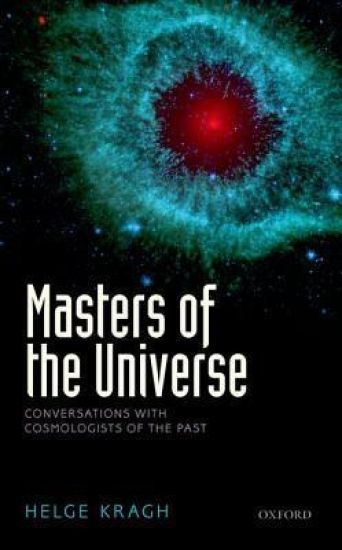
Masters of the Universe

Masters of the Universe

Helge Kragh

Oxford University Press
2014
sidottu
How did our modern picture of the universe come into being? Masters of the Universe tells this fascinating story in an unusual format that blends factual and fictional elements. It is based on a series of interviews that a fictional person conducted with leading astronomers and physicists between 1913 and 1965. Among the interviewed scientists are giants such as Albert Einstein, Edwin Hubble, and George Gamow, but also scientists who are less well known today or not primarily known as cosmologists such as Karl Schwarzschild, Paul Dirac, and Svante Arrhenius. By following the interviews the reader gets a lively and "almost authentic" impression of the problems that faced this early generation of cosmologists. Although the interviews are purely fictional, a product of the author's imagination, they could have taken place in just the way that is described. They are solidly based on historical facts and, moreover, supplemented with careful annotations and references to the literature. In this way the book bridges the gap between scholarly and popular history of science.
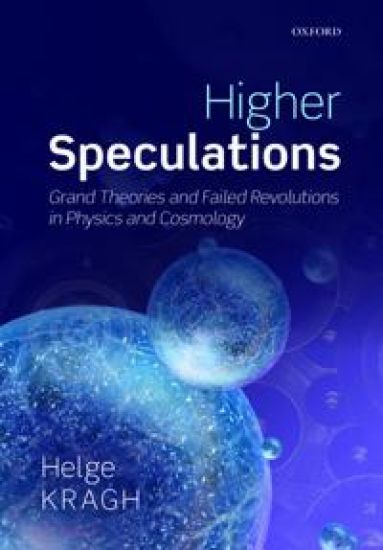
Higher Speculations

Higher Speculations

Helge Kragh

Oxford University Press
2015
nidottu
Throughout history, people have tried to construct 'theories of everything': highly ambitious attempts to understand nature in its totality. This account presents these theories in their historical contexts, from little-known hypotheses from the past to modern developments such as the theory of superstrings, the anthropic principle, and ideas of many universes, and uses them to problematize the limits of scientific knowledge. Do claims to theories of everything belong to science at all? Which are the epistemic standards on which an alleged scientific theory of the universe - or the multiverse - is to be judged? Such questions are currently being discussed by physicists and cosmologists, but rarely within a historical perspective. This book argues that these questions have a history and that knowledge of the historical development of 'higher speculations' may inform and qualify the current debate on the nature and limits of scientific explanation.
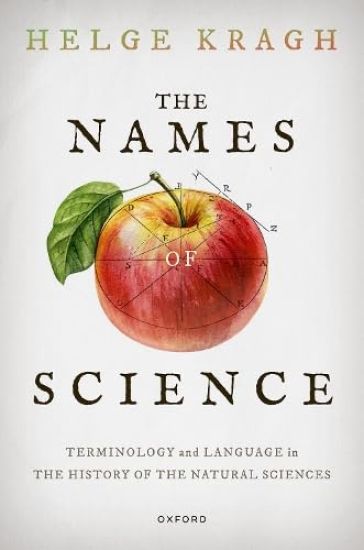
The Names of Science

The Names of Science

Helge Kragh

Oxford University Press
2024
nidottu
The history of science is echoed in the development of its language and the names chosen for its technical terms. The Names of Science examines in detail how, over time, new words have entered the scientific lexicon and how some of them, but far from all, have survived to the present. Why is a transistor called a transistor and not something else? Why was the term 'scientist' only coined in 1834, and why was the name regarded as controversial for a long time afterwards? There is a story behind every scientific word we use today. In this work, Helge Kragh tells many of these stories, taking a broad historical perspective from the Renaissance to the present. By combining elements of linguistics with the history of the natural sciences including physics, chemistry, and astronomy, this book offers a new and innovative perspective on the historical development of the natural sciences. Following an introductory list of useful linguistic terms, the book is structured in six chapters, which cover important phases in the history of science, dealing with a vast range of scientific terminology from physics, chemistry, geology, astronomy, to cosmology. It also considers, if only briefly, how English - and not, say, Latin or French - developed to become the internationally accepted language of science. Contrary to other works dealing with the subject, The Names of Science pays serious attention to the historical dimension of scientific language, and to the way in which scientists have, sometimes unconsciously, acted as linguists and neologists in their research work.
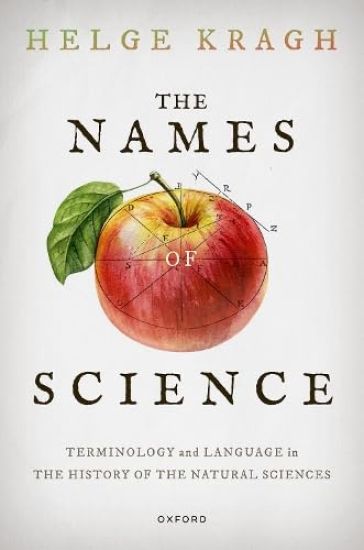
The Names of Science

The Names of Science

Helge Kragh

Oxford University Press
2024
sidottu
The history of science is echoed in the development of its language and the names chosen for its technical terms. The Names of Science examines in detail how, over time, new words have entered the scientific lexicon and how some of them, but far from all, have survived to the present. Why is a transistor called a transistor and not something else? Why was the term 'scientist' only coined in 1834, and why was the name regarded as controversial for a long time afterwards? There is a story behind every scientific word we use today. In this work, Helge Kragh tells many of these stories, taking a broad historical perspective from the Renaissance to the present. By combining elements of linguistics with the history of the natural sciences including physics, chemistry, and astronomy, this book offers a new and innovative perspective on the historical development of the natural sciences. Following an introductory list of useful linguistic terms, the book is structured in six chapters, which cover important phases in the history of science, dealing with a vast range of scientific terminology from physics, chemistry, geology, astronomy, to cosmology. It also considers, if only briefly, how English - and not, say, Latin or French - developed to become the internationally accepted language of science. Contrary to other works dealing with the subject, The Names of Science pays serious attention to the historical dimension of scientific language, and to the way in which scientists have, sometimes unconsciously, acted as linguists and neologists in their research work.
Higher Speculations

Higher Speculations

Helge Kragh

Oxford University Press
2011
sidottu
Throughout history, people have tried to construct 'theories of everything': highly ambitious attempts to understand nature in its totality. This account presents these theories in their historical contexts, from little known hypotheses from the past to modern developments such as the theory of superstrings, the anthropic principle and ideas of many universes, and uses them to problematize the limits of scientific knowledge. Do claims to theories of everything belong to science at all? Which are the epistemic standards on which an alleged scientific theory of the universe - or the multiverse - is to be judged? Such questions are currently being discussed by physicists and cosmologists, but rarely within a historical perspective. This book argues that these questions have a history and that knowledge of the historical development of 'higher speculations' may inform and qualify the current debate of the nature and limits of scientific explanation.
Niels Bohr and the Quantum Atom

Niels Bohr and the Quantum Atom

Helge Kragh

Oxford University Press
2012
sidottu
Niels Bohr and the Quantum Atom is the first book that focuses in detail on the birth and development of Bohr's atomic theory and gives a comprehensive picture of it. At the same time it offers new insight into Bohr's peculiar way of thinking, what Einstein once called his 'unique instinct and tact'. Contrary to most other accounts of the Bohr atom, the book presents it in a broader perspective which includes the reception among other scientists and the criticism launched against it by scientists of a more conservative inclination. Moreover, it discusses the theory as Bohr originally conceived it, namely, as an ambitious theory covering the structure of atoms as well as molecules. By discussing the theory in its entirety it becomes possible to understand why it developed as it did and thereby to use it as an example of the dynamics of scientific theories.
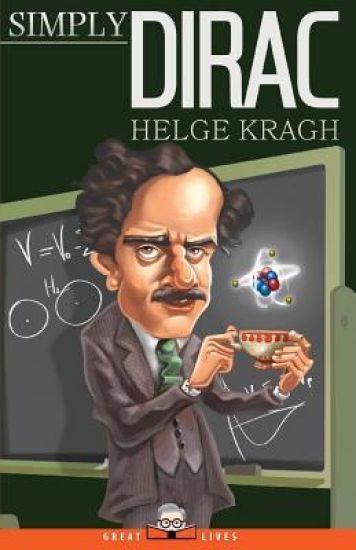
Dirac

Dirac

Helge Kragh

Cambridge University Press
2005
pokkari
Paul Adrien Maurice Dirac was undoubtedly one of the most brilliant and influential physicists of the twentieth century. Between 1925 and 1934, this Nobel Laureate revolutionized physics with his contributions to quantum theory. This book, the first full length biography of Dirac, offers a comprehensive account of his life and presents his physics in its historical context, including known areas such as cosmology and classical electron theory. The author examines Dirac's successes and failures, and pays particular attention to Dirac's opposition to modern quantum electrodynamics - an opposition based on aesthetic objections. This book, which draws extensively from unpublished sources, including Dirac's correspondence with Bohr, Heisenberg, Pauli, Schrödinger, Gamow, and other physicists, is a history of modern physics as seen through one scientist's career.
Dirac

Dirac

Helge Kragh

Cambridge University Press
1990
sidottu
Paul Adrien Maurice Dirac was undoubtedly one of the most brilliant and influential physicists of the twentieth century. Between 1925 and 1934, this Nobel Laureate revolutionized physics with his contributions to quantum theory. This book, the first full length biography of Dirac, offers a comprehensive account of his life and presents his physics in its historical context, including known areas such as cosmology and classical electron theory. The author examines Dirac’s successes and failures, and pays particular attention to Dirac’s opposition to modern quantum electrodynamics - an opposition based on aesthetic objections. This book, which draws extensively from unpublished sources, including Dirac’s correspondence with Bohr, Heisenberg, Pauli, Schrödinger, Gamow, and other physicists, is a history of modern physics as seen through one scientist’s career.
Cosmology and Controversy

Cosmology and Controversy

Helge Kragh

Princeton University Press
1999
pokkari
For over three millennia, most people could understand the universe only in terms of myth, religion, and philosophy. Between 1920 and 1970, cosmology transformed into a branch of physics. With this remarkably rapid change came a theory that would finally lend empirical support to many long-held beliefs about the origins and development of the entire universe: the theory of the big bang. In this book, Helge Kragh presents the development of scientific cosmology for the first time as a historical event, one that embroiled many famous scientists in a controversy over the very notion of an evolving universe with a beginning in time. In rich detail he examines how the big-bang theory drew inspiration from and eventually triumphed over rival views, mainly the steady-state theory and its concept of a stationary universe of infinite age. In the 1920s, Alexander Friedmann and Georges Lemaitre showed that Einstein's general relativity equations possessed solutions for a universe expanding in time. Kragh follows the story from here, showing how the big-bang theory evolved, from Edwin Hubble's observation that most galaxies are receding from us, to the discovery of the cosmic microwave background radiation. Sir Fred Hoyle proposed instead the steady-state theory, a model of dynamic equilibrium involving the continuous creation of matter throughout the universe. Although today it is generally accepted that the universe started some ten billion years ago in a big bang, many readers may not fully realize that this standard view owed much of its formation to the steady-state theory. By exploring the similarities and tensions between the theories, Kragh provides the reader with indispensable background for understanding much of today's commentary about our universe.
Quantum Generations

Quantum Generations

Helge Kragh

Princeton University Press
2002
pokkari
At the end of the nineteenth century, some physicists believed that the basic principles underlying their subject were already known, and that physics in the future would only consist of filling in the details. They could hardly have been more wrong. The past century has seen the rise of quantum mechanics, relativity, cosmology, particle physics, and solid-state physics, among other fields. These subjects have fundamentally changed our understanding of space, time, and matter. They have also transformed daily life, inspiring a technological revolution that has included the development of radio, television, lasers, nuclear power, and computers. In Quantum Generations, Helge Kragh, one of the world's leading historians of physics, presents a sweeping account of these extraordinary achievements of the past one hundred years. The first comprehensive one-volume history of twentieth-century physics, the book takes us from the discovery of X rays in the mid-1890s to superstring theory in the 1990s. Unlike most previous histories of physics, written either from a scientific perspective or from a social and institutional perspective, Quantum Generations combines both approaches. Kragh writes about pure science with the expertise of a trained physicist, while keeping the content accessible to nonspecialists and paying careful attention to practical uses of science, ranging from compact disks to bombs. As a historian, Kragh skillfully outlines the social and economic contexts that have shaped the field in the twentieth century. He writes, for example, about the impact of the two world wars, the fate of physics under Hitler, Mussolini, and Stalin, the role of military research, the emerging leadership of the United States, and the backlash against science that began in the 1960s. He also shows how the revolutionary discoveries of scientists ranging from Einstein, Planck, and Bohr to Stephen Hawking have been built on the great traditions of earlier centuries. Combining a mastery of detail with a sure sense of the broad contours of historical change, Kragh has written a fitting tribute to the scientists who have played such a decisive role in the making of the modern world.
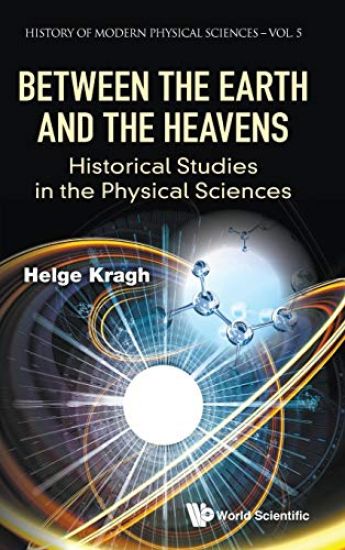
Between The Earth And The Heavens: Historical Studies In The Physical Sciences
Consisting of separate cases organized by chapter and divided into independent sections, this is no ordinary history of science book. Between the Earth and the Heavens is an episodic history of modern physical sciences covering the chronological development of physics, chemistry and astronomy since about 1860. Integrating historical authenticity and modern scientific knowledge, the cases within deal with the often surprising connections between science done in the laboratory (physics, chemistry) and science based on observation (astronomy, cosmology).Between the Earth and the Heavens presupposes an interest in and a certain knowledge of the physical sciences, but it is written for non-specialists and includes only a limited number of equations which are all clearly explained in simple terms. For readers who wish to delve further, the book is fully documented and ends with a bibliography of cited quotations and other relevant sources.
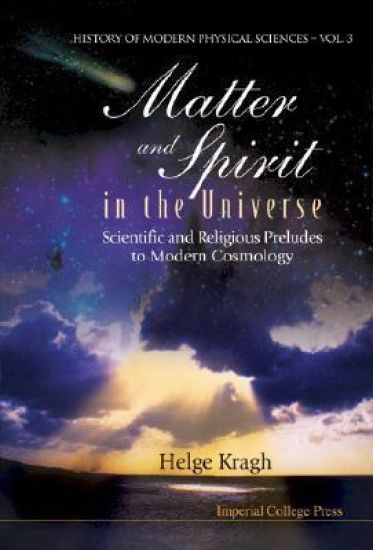
Matter And Spirit In The Universe: Scientific And Religious Preludes To Modern Cosmology
Cosmology is an unusual science with an unusual history. This book examines the formative years of modern cosmology from the perspective of its interaction with religious thought. As the first study of its kind, it reveals how closely associated the development of cosmology has been with considerations of a philosophical and religious nature. From nineteenth-century thermodynamics to the pioneering cosmological works of Georges Lemaître and Arthur E Milne, religion has shaped parts of modern cosmological theory. By taking the religious component seriously, a new and richer history of cosmology emerges.
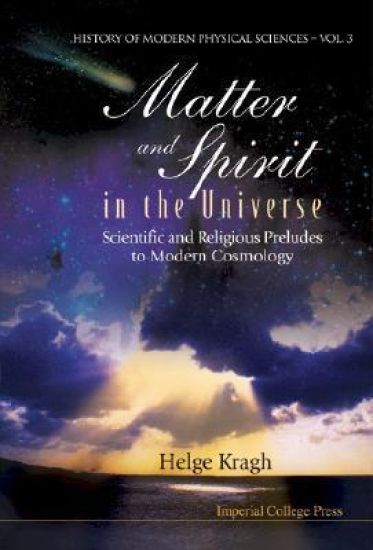
Matter And Spirit In The Universe: Scientific And Religious Preludes To Modern Cosmology
Cosmology is an unusual science with an unusual history. This book examines the formative years of modern cosmology from the perspective of its interaction with religious thought. As the first study of its kind, it reveals how closely associated the development of cosmology has been with considerations of a philosophical and religious nature. From nineteenth-century thermodynamics to the pioneering cosmological works of Georges Lemaître and Arthur E Milne, religion has shaped parts of modern cosmological theory. By taking the religious component seriously, a new and richer history of cosmology emerges.
Varying Gravity

Varying Gravity

Helge Kragh

Birkhauser Verlag AG
2016
sidottu
The main focus of this book is on the interconnection of two unorthodox scientific ideas, the varying-gravity hypothesis and the expanding-earth hypothesis. As such, it provides a fascinating insight into a nearly forgotten chapter in both the history of cosmology and the history of the earth sciences.The hypothesis that the force of gravity decreases over cosmic time was first proposed by Paul Dirac in 1937. In this book the author examines in detail the historical development of Dirac’s hypothesis and its consequences for the structure and history of the earth, the most important of which was that the earth must have been smaller in the past.
From Transuranic to Superheavy Elements

From Transuranic to Superheavy Elements

Helge Kragh

Springer International Publishing AG
2018
nidottu
The story of superheavy elements - those at the very end of the periodic table - is not well known outside the community of heavy-ion physicists and nuclear chemists. But it is a most interesting story which deserves to be known also to historians, philosophers, and sociologists of science and indeed to the general public. This is what the present work aims at. It tells the story or rather parts of the story, of how physicists and chemists created elements heavier than uranium or searched for them in nature. And it does so with an emphasis on the frequent discovery and naming disputes concerning the synthesis of very heavy elements. Moreover, it calls attention to the criteria which scientists have adopted for what it means to have discovered a new element. In this branch of modern science it may be more appropriate to speak of creation instead of discovery. The work will be of interest to scientists as well as to scholars studying modern science from a meta-perspective.
Varying Gravity

Varying Gravity

Helge Kragh

Birkhauser Verlag AG
2018
nidottu
The main focus of this book is on the interconnection of two unorthodox scientific ideas, the varying-gravity hypothesis and the expanding-earth hypothesis. As such, it provides a fascinating insight into a nearly forgotten chapter in both the history of cosmology and the history of the earth sciences.The hypothesis that the force of gravity decreases over cosmic time was first proposed by Paul Dirac in 1937. In this book the author examines in detail the historical development of Dirac’s hypothesis and its consequences for the structure and history of the earth, the most important of which was that the earth must have been smaller in the past.
The Moon that Wasn't

The Moon that Wasn't

Helge Kragh

Birkhauser Verlag AG
2008
sidottu
The planet Venus is the closest neighbour to the Earth and in several respects similar to our globe. It revolves around the Sun at an average distance of 0. 72 astronomical units, in an elliptical orbit of eccentricity 0. 007. The corresponding 3 numbers for the Earth are 1 and 0. 017. The mean density of Venus is 5. 2 g/cm , 3 that of the Earth 5. 5 g/cm . Venus’ acceleration of gravity at its equator is 8. 9 2 2 m/s , compared with 9. 8 m/s at the Earth. The escape velocity is 10. 4 km/s, while the corresponding ?gure of the Earth is 11. 2 km/s. Although the mass of Venus is somewhat smaller than that of the Earth – the ratio is M /M =0. 815 V E – the diameters of the two planets are almost the same. In other words, Venus is indeed a sister planet of the Earth. In earlier times, when almost nothing was known about the physical con- tions of Venus, the similarity appeared even stronger than today. Not only was Venus’ period of rotation thought to be close to that of the Earth, it wasalso p- sible (and indeed common) to imagine intelligent life on Venus.
Sandhed

Sandhed

Helge Kragh

AARHUS UNIVERSITY PRESS
2014
nidottu
Den kan vAere ilde hort, hel og halv, og den hele far du fra born og fulde folk. Der er sandt at sige tale om sandheden. Eller maske sandheder, for der er flere udgaver. Astronomer mener ikke lAengere, Pluto er en planet, men det gjorde de engang. Nogle tror, Jesus er sandheden, andre Koranen. Uanset hvad vil en ungkarl altid vAere ugift. Alt er nemlig ikke relativt. Din lognedetektor styres heldigvis hverken af born eller berusede, men af Helge Kragh, professor i videnskabshistorie ved Aarhus Universitet, og han har sandt for dyden tAenkt sig at sige dig et par sandheder.
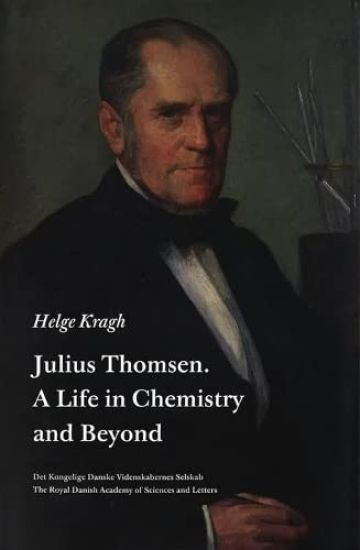
Julius Thomsen

Julius Thomsen

Helge Kragh

Det Kongelige Danske Videnskabernes Selskab
2016
nidottu
Julius Thomsen (1826-1909) was a prominent Danish chemist who acquired fame for his systematic and meticulous measurements of the thermal effects associated with chemical processes. For this work he received numerous honours, among them the Davy Medal from the Royal Society. Apart from his position as one of the founders of classical thermodynamics, he also has a place in the history of chemical technology due to his invention of a method of producing soda from the Greenlandic mineral cryolite. This invention resulted in a major industrial enterprise which was of great importance to Danish economy. Keenly interested in the electrical sciences, Thomsen constructed a new type of battery which for a while attracted international attention. Last but not least, he made significant contributions to the understanding of the periodic system in terms of the hypothesis of composite atoms. He ended his career by questioning if argon was really a chemical element.