
Kirjahaku
Etsi kirjoja tekijän nimen, kirjan nimen tai ISBN:n perusteella.
45 kirjaa tekijältä Henri Joly







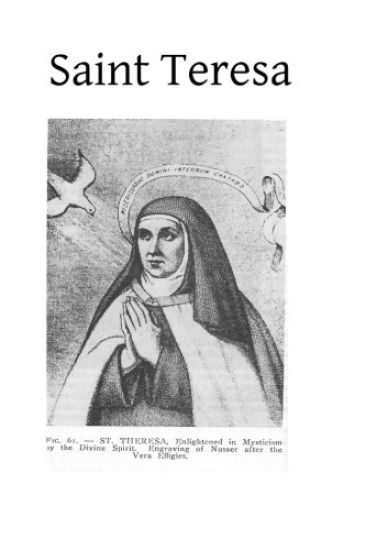
I must point out here the principal works of documents on which I have drawn for this book, and explain my manner of reference. I. First and foremost come the writings of the Saint herself: -Her Life; The Book of the Foundations; The Way of Perfection; The Interior Castle. These I quote from the translation by Pather Bouix (Librairie Lecoffre), and since the editions are numerous, and the pagination of them may differ, I refer as a rule to chapters. One of the most important sources is furnished us by her Letters. Of these the new edition of Father Gregoire de Saint-Joseph is that to which I refer. Beyond question. This valuable publication sets right many interesting points and gives us a very large number of fragments which, if not all hitherto unpublished, in the strict sense of the word, had never been translated into French. As often as possible have given the date of the letter: this gives facility. in certain cases, for referring to Pather Bouix's translation. Next come: The Manner of Visiting Convents, a pamphlet, Rules- and Constitutions of the Carmelites. II. General History of the Carnulite Friars and Nuns of the Reformed Order of St Teresa, compiled in Spain by Pather Prancisco de Santa Maria, new translation (with notes) by Pather Marie Rene. At present published 5 vols. 4to. Lerina Abbey. 1896 (not on sale). Memoir on the Foundation, Government and Rule of the Discalced Carmelite Nuns. published on behalf of the Carmelite Nuns of the first convent of Paris. 2 vols. large 8vo. Reims, 1894. Pather Ribera. Life of St Teresa in 2 vols. 8vo. Paris, Lecoffre. The Bollandists. The Spain of St Teresa, an album composed of plates representing all the Carmels of Spain and various memorials of the Saint, with explanatory letter-press, published at Ghent bJ Mr. Hye Hoys (1893). Finally, I cannot refrain from paying a debt of gratitude and of the highest esteem to the two volumes of the writer henceforth widely known under the humble name of the "Carmelite Nun of Caen". The fear of challenging too rashly a perilous comparison has been my chief reason for adopting in this work a less rigidly chronological order, in places where, in default of lengthy narrative. I have perhaps been able to bring into fuller light certain important passages in the life of the Saint.

No-great men and little, we are all of us formed out of the same clay and the same spirit is breathed into each one of us. We stand, as it were, on different steps of the same ladder, which springs from one and the same nature and reaches up to one and the same God.-We may aggravate the original weakness of our nature by yielding to it, or we may use the help offered to us and so develop all the potential strength and beauty it possesses, but whichever course we take, we can never completely destroy a single one of the features of our complex humanity. No matter how degenerate on the one hand, or perfect on the other, they may become, our fellow-men never fail to be objects of warning or encouragement to us. The resemblance we bear to one another affords us the means, while it teaches us the necessity, of applying the lesson to ourselves. It is under the influence of this conviction that the following essay has been written. One by one the strange facts recorded in saints' lives which were scouted by the hot-headed scepticism of a century ago and considered to discredit all hagiography, are now recognised as instances of well-known psychological manifestations. It is little to the purpose that they are explained as due to hypnosis, thought-transference, expectant attention, or other" word-causes"; the point is that, the philosophy which once denied these things as superstitions, is now convicted of superstition in that very denial. The tendency of this reaction to explain all the phenomena in question by purely physiological or psychological laws needs to be counteracted by a sounder criticism which shall fix the limits of what may be so explained, and shall assign to Nature the things that are Nature's and to God the things that are God's; and this is the task to which M. Joly addresses himself in the little volume which is here presented to the public in English dress. It will, however, serve a no less important end if it enables educated Catholics to approach the lives of the saints with a more intelligent sympathy. The spiritual benefit derived from that study depends obviously on the applicabiHty of their example to our own case; and this again, on the resemblance we see between their nature and circumstances and our own. It is this that spurs men to emulate their betters in the various walks of life, -a desire to equal or approach them, as well as a belief in the possibility of the enterprise. When the saints are set before us rather as wonderful than lovable; when we have no conception of the process of their spiritual evolution, how from rudiments of sanctity which are in us all, and by the aid of resources and faculties which we all possess, they obtained a result so different; until we have learnt to set aside all that is merely the clothing and expression of sanctity, and to find that the underlying substance is simply the love of God and of things Divine carried to an heroic degree; we cannot expect to gain much definite profit from the study of saints' lives. Nothing comes out more clearly in these pages than that the saints themselves have been careful to separate from the essence of sanctity those extraordinary gifts and" charismata" in which it is vulgarly supposed to consist; and to place its whole inner substance in an eminent or heroic degree of that charity which is possessed by every soul in grace, and which St Paul sets above tongues, above prophetic insight or foresight, above miracles, even above martyrdom and self-sacrifice when they are notthe fruits of charity


" Faire beaucoup parler de soi n'est pas toujours un bon signe. Il fut un temps o l'on dissertait peu sur la patrie, on la servait; on mourait pour elle. On ne chantait pas l'inqui tude religieuse, on ne scrutait pas la part de la subconscience dans la croyance: on croyait. On ne faisait ni l'histoire de la famille, ni l'analyse des facult s de l'enfant: on se mariait, on avait beaucoup d'enfants, et on les levait pour les marier leur tour le plus t t possible et avoir ainsi des petits-enfants. Aujourd'hui, il est bien craindre que ce ne soit l'inverse. Les diteurs, qui ne publiaient jusqu'ici que des livres de science et de libre pens e, nous disent en leur langage professionnel: La religion, c'est devenu tr s bon. Un livre qui est consacr la critique de l'id e religieuse, l'histoire des religions, aux rapports de la religion et de la m taphysique est s r de se vendre. Il n'est pas s r du tout que ses lecteurs pratiquent une religion quelconque. Tel homme qui se garderait bien d'ouvrir un livre de messe ach tera de grosses th ses de doctorat sur la croyance, sur le mysticisme, sur la pri re. De m me, alors que le nombre des enfants va tous les jours en d croissant, se multiplient les ouvrages les plus tudi s sur l' volution de l'enfant, sur l'enfant et la race, sur l'esprit et le coeur de l'enfant. Je ne crois pas qu'il y ait l de quoi justifier l'optimisme d'un certain auteur allant jusqu' d nommer le si cle de l'enfant une poque o on a des enfants le moins possible..."

" La vie de M. B renger a t longue, si toutefois, comme dit le po te, il y a quelque chose de long dans ce qui est mortel. En tout cas, il repr sente une poque dont les malheurs, les aspirations, les efforts et les regrets, dont les beaux exemples aussi donn s au monde tout entier, m riteront longtemps d' tre tudi s. Par ses souvenirs de famille, par sa pr coce autorit personnelle, relev e d'un vif sentiment de l'ind pendance, M. Ren B renger avait t de ceux qui eussent pu retenir le r gime imp rial dans la voie d'une r forme v ritable; puis il a fait partie de ces groupes qui, oblig s de renoncer une monarchie moderne, entreprirent avec sinc rit , sans arri re-pens e et sans faiblesse, sans concessions aucune passion suspecte, de faire au moins une r publique lib rale. Entr dans la vie publique au moment de la guerre de 1870, il avait donn spontan ment la preuve de cette vaillance dont on devait retrouver, un si haut degr , la tradition dans la guerre de 1914-1915. De cette derni re, il n'aura pas vu la fin. Pas plus que F lix Voisin et d'autres encore de ses amis, il ne sera entr dans ces terres promises qui s'appellent l'Alsace-Lorraine reconquise, l'Afrique fran aise du Nord d finitivement lib r e de tout p ril de partage et d'affaiblissement conomique, une moralit d fendue s rieusement contre toutes les formes de la d bauche, la nation, enfin, croissant dans le respect des familles saines et nombreuses..."

" Le mot d'anarchie qu'on vient de lire en t te de cette tude est-il excessif ? Ce mot d signe habituellement un tat de choses o il n'y a pour personne ni direction, ni s curit , o chacun est cens pouvoir faire tout ce qu'il veut et o nul ne voit quel fruit il est assur de retirer de ses tentatives: donc tout le monde marche l'aventure et se d courage; chacun se d fie de son voisin: il n'y a que les amateurs de choses louches qui aient lieu d' prouver quelque satisfaction. Notre tat scolaire offre-t-il l'exemple d'un pareil d sordre ? Beaucoup le pensent, et ce jugement ne date pas d'hier. Consultons l'enqu te de 1899, non pour abriter paresseusement nos opinions derri re celles d'autrui, mais pour reconstituer une suite historique et pour comparer ce qui tait demand ce qui a t fait. Voici comment parlait M. Lavisse: Nous sommes afflig s dans l'Universit d'un faux parlementarisme: ni autorit d'une part, ni libert d'autre part; c'est un r gime tout fait singulier, b tard, et qui suffirait lui seul pour cr er le malaise dont nous souffrons. Sans m me avoir eu le temps de lire dans la st nographie la d position de son coll gue, M. Alfred Croiset se plaignait, lui aussi, qu'il n'y e t plus dans les lyc es et les coll ges ni autorit , ni direction; et il ajoutait: Il me semble aussi, chose qui para t contradictoire et qui ne l'est pas du tout, qu'il y a un manque de libert , d'initiative. Cela m'a t dit de tous les c t s. Impossible d'avoir un avis plus net, man de plus hautes autorit s..."