Kirjojen hintavertailu. Mukana 11 244 527 kirjaa ja 12 kauppaa.

Kirjahaku

Etsi kirjoja tekijän nimen, kirjan nimen tai ISBN:n perusteella.

32 kirjaa tekijältä Henry Gee

The Accidental Species

The Accidental Species

Henry Gee

University of Chicago Press
2015
nidottu
The idea of a missing link between humanity and our animal ancestors predates evolution and popular science and actually has religious roots in the deist concept of the Great Chain of Being. Yet the metaphor has lodged itself in the contemporary imagination, and new fossil discoveries are often hailed in headlines as revealing the elusive transitional step, the moment when we stopped being "animal" and started being "human." In The Accidental Species, Henry Gee, longtime paleontology editor at Nature, takes aim at this misleading notion, arguing that it reflects a profound misunderstanding of how evolution works and, when applied to the evolution of our own species, supports mistaken ideas about our own place in the universe. Touring the many features of human beings that have recurrently been used to distinguish us from the rest of the animal world, Gee shows that our evolutionary outcome is one possibility among many, one that owes more to chance than to an organized progression to supremacy. The Accidental Species combines Gee's firsthand experience on the editorial side of many incredible paleontological findings with healthy skepticism and humor to create a book that aims to overturn popular thinking on human evolution - the key is not what's missing, but how we're linked.
The Accidental Species

The Accidental Species

Henry Gee

University of Chicago Press
2013
sidottu
The idea of a missing link between humanity and our animal ancestors predates evolution and popular science and actually has religious roots in the deist concept of the Great Chain of Being. Yet the metaphor has lodged itself in the contemporary imagination, and new fossil discoveries are often hailed in headlines as revealing the elusive transitional step, the moment when we stopped being "animal" and started being "human." In The Accidental Species, Henry Gee, longtime paleontology editor at Nature, takes aim at this misleading notion, arguing that it reflects a profound misunderstanding of how evolution works and, when applied to the evolution of our own species, supports mistaken ideas about our own place in the universe. Gee presents a robust and stark challenge to our tendency to see ourselves as the acme of creation. Human exceptionalism, Gee argues, is an error that can infect scientific thought. Touring the many features of human beings that have recurrently been used to distinguish us from the rest of the animal world, Gee shows that our evolutionary outcome is one possibility among many, one that owes more to chance than to an organized progression to supremacy. He starts with bipedality, which he shows could have arisen entirely by accident, as a by-product of sexual selection, moves on to technology, large brain size, intelligence, language, and, finally, sentience. He reveals each of these attributes to be alive and well throughout the animal world-they are not, indeed, unique to our species. The Accidental Species combines Gee's firsthand experience on the editorial side of many incredible paleontological findings with healthy skepticism and humor to create a book that aims to overturn popular thinking on human evolution-the key is not what's missing, but how we're linked.
Across the Bridge

Across the Bridge

Henry Gee

University of Chicago Press
2018
pokkari
Our understanding of vertebrate origins and the backbone of human history evolves with each new fossil find and DNA map. Many species have now had their genomes sequenced, and molecular techniques allow genetic inspection of even nonmodel organisms. But as longtime Nature editor Henry Gee argues in Across the Bridge, despite these giant strides and our deepening understanding of how vertebrates fit into the tree of life, the morphological chasm between vertebrates and invertebrates remains vast and enigmatic. As Gee shows, even as scientific advances have falsified a variety of theories linking these groups, the extant relatives of vertebrates are too few for effective genetic analysis. Moreover, the more we learn about the species that do remain--from seasquirts to starfish--the clearer it becomes that they are too far evolved along their own courses to be of much use in reconstructing what the latest invertebrate ancestors of vertebrates looked like. Fossils present yet further problems of interpretation. Tracing both the fast-changing science that has helped illuminate the intricacies of vertebrate evolution as well as the limits of that science, Across the Bridge helps us to see how far the field has come in crossing the invertebrate-to-vertebrate divide--and how far we still have to go.
Jacob's Ladder

Jacob's Ladder

Henry Gee

W. W. Norton Company
2004
pokkari
Jacob's Ladder delivers a remarkably lucid explanation of what the sequencing of the human genome really tells us. Decoding the sequence, evolutionary biologist Henry Gee shows, is just the beginning: seeing the letters and words. The next frontier is in understanding snatches of conversation between genes--how they interact to direct the growth of an organism. Gee takes us into the heart of that conversation, illuminating how genes govern a single egg cell's miraculous transformation into a human being, and how they continue to direct that person's day-by-day development throughout a lifetime. Gee tells the story of what we know about the genome today and what we are likely to discover tomorrow. As our knowledge advances, we will be able to direct with increasing authority the conversations between genes: not only performing medical interventions but also creating whole scripts directing birth, ancestry, and diversity in a brave new world.
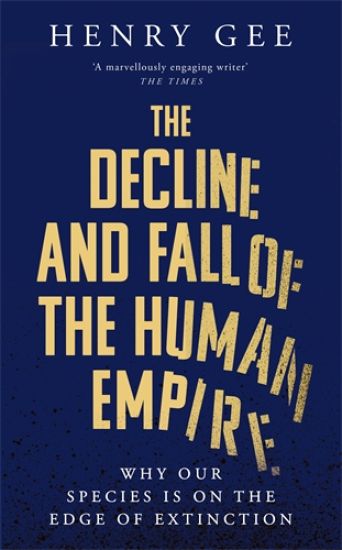
The Decline and Fall of the Human Empire
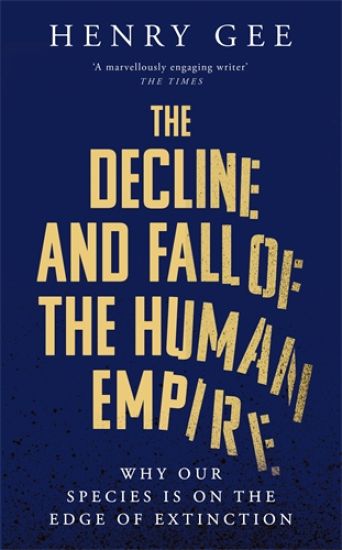
'Brilliant' – The Times'Hugely informative and entertaining' – New Scientist'Put this at the head of your reading lists immediately' – Eric IdleFrom the winner of the 2022 Royal Society Science Book Prize, a thrilling and thought-provoking account of the rise and fall of humankind.For the first time in over ten millennia, the rate of human population growth is slowing down. The global population is forecast to begin declining in the second half of this century, and in 10,000 years’ time our species will likely be extinct.In The Decline and Fall of the Human Empire, Henry Gee shows how we arrived at this crucial moment in history, beginning his story deep in the palaeolithic past and charting our dramatic rise from one species of human among many to the most dominant animal to ever live on Earth.But rapid climate change, a stagnating global economy, falling birth rates and an unexplainable decline in average human sperm count are combining to make our chances for longevity increasingly slim. There could be a way forward, but the launch window is narrow . . .Drawing on a dazzling array of the latest scientific research, Gee tells the extraordinary story of humanity with characteristic warmth and wit, and suggests how our exceptional species might avoid its tragic fate.'Like Jared Diamond meets Arthur C. Clarke with a dash of Douglas Adams' – Philip Ball, author of How Life Works
The Decline and Fall of the Human Empire
‘Brilliant’ The Times‘Hugely informative and entertaining’ New Scientist‘Put this at the head of your reading lists immediately’ Eric IdleFrom the winner of the 2022 Royal Society Science Book Prize, a thrilling and thought-provoking account of the rise and fall of humankind.For the first time in over ten millennia, the rate of human population growth is slowing down. The global population is forecast to begin declining in the second half of this century, and in 10,000 years’ time our species will likely be extinct.In The Decline and Fall of the Human Empire, Henry Gee shows how we arrived at this crucial moment in history, beginning his story deep in the palaeolithic past and charting our dramatic rise from one species of human among many to the most dominant animal ever to live on Earth.But rapid climate change, a stagnating global economy, falling birth rates and an unexplainable decline in average human sperm count are combining to make our chances for longevity increasingly slim. There could be a way forward, but the launch window is narrow . . .Drawing on a dazzling array of the latest scientific research, Gee tells the extraordinary story of humanity with characteristic warmth and wit, and suggests how our exceptional species might avoid its tragic fate.‘Like Jared Diamond meets Arthur C. Clarke with a dash of Douglas Adams’ Philip Ball, author of How Life Works
A (Very) Short History of Life on Earth: 4.6 Billion Years in 12 Pithy Chapters
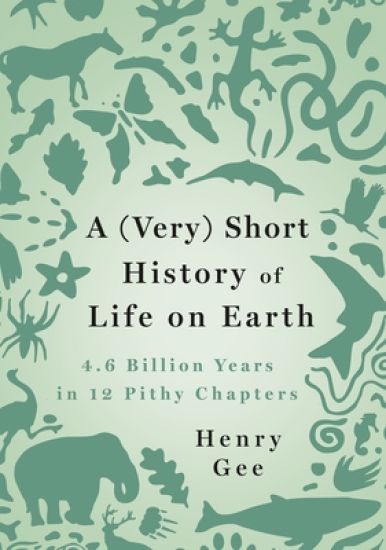
A]n exuberant romp through evolution, like a modern-day Willy Wonka of genetic space. Gee's grand tour enthusiastically details the narrative underlying life's erratic and often whimsical exploration of biological form and function." --Adrian Woolfson, The Washington PostIn the tradition of Richard Dawkins, Bill Bryson, and Simon Winchester--An entertaining and uniquely informed narration of Life's life story.In the beginning, Earth was an inhospitably alien place--in constant chemical flux, covered with churning seas, crafting its landscape through incessant volcanic eruptions. Amid all this tumult and disaster, life began. The earliest living things were no more than membranes stretched across microscopic gaps in rocks, where boiling hot jets of mineral-rich water gushed out from cracks in the ocean floor. Although these membranes were leaky, the environment within them became different from the raging maelstrom beyond. These havens of order slowly refined the generation of energy, using it to form membrane-bound bubbles that were mostly-faithful copies of their parents--a foamy lather of soap-bubble cells standing as tiny clenched fists, defiant against the lifeless world. Life on this planet has continued in much the same way for millennia, adapting to literally every conceivable setback that living organisms could encounter and thriving, from these humblest beginnings to the thrilling and unlikely story of ourselves. In A (Very) Short History of Life on Earth, Henry Gee zips through the last 4.6 billion years with infectious enthusiasm and intellectual rigor. Drawing on the very latest scientific understanding and writing in a clear, accessible style, he tells an enlightening tale of survival and persistence that illuminates the delicate balance within which life has always existed.
The Decline and Fall of the Human Empire: Why Our Species Is on the Edge of Extinction
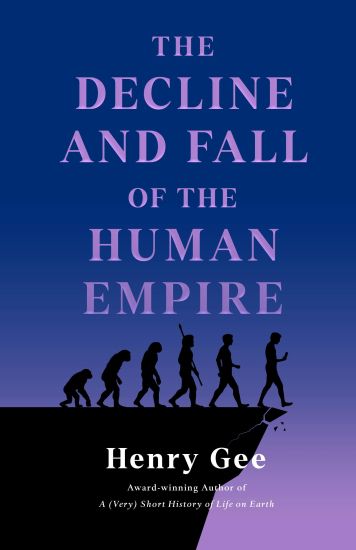
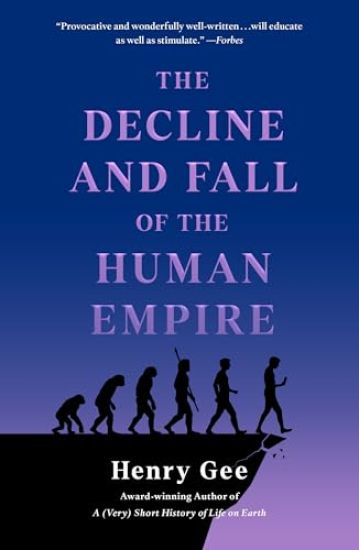
By the award-winning author of A (Very) Short History of Life on Earth: a history of humanity on the brink of decline.A Next Big Idea Club Must-Read Selection We are living through a period that is unique in human history. For the first time in more than ten thousand years, the rate of human population growth is slowing down. In the middle of this century population growth will stop, and the number of people on Earth will start to decline - fast. In this provocative book, award-winning science writer Henry Gee offers a concise, brilliantly-told history of our species--and argues that we are on a rapid, one-way trip to extinction. The Decline and Fall of the Human Empire narrates the dramatic rise of humanity, how a scattered range of small groups across several continents eventually inbred, interacted, fought, established stable communities and food supplies, and began the process of dominating the planet. The human story is relatively brief--the oldest fossils of H. Sapiens date to approximately 300,000 years ago--yet the spread of our species has been unstoppable...until recently. As Gee demonstrates, our population has peaked, and is declining; our environment is becoming inimical to human life in many locations; our core resources of water, arable land, and air are diminishing; and new diseases, simmering conflicts, and ambiguous technologies threaten our collective health. Can we still change our course? Or is our own extinction inevitable? There could be a way out, but the launch window is narrow. Unless Homo sapiens establishes successful colonies in space within the next two centuries, our species is likely to stay earthbound and will have vanished entirely within another ten thousand years, bringing the seven-million-year story of the human lineage to an end. With assured narration, dramatic stories, and his signature sprightly humor, Henry Gee envisions new opportunities for the future of humanity--a future that will reward facing challenges with ingenuity, foresight, and cooperation.
The Decline and Fall of the Human Empire: Why Our Species Is on the Edge of Extinction
By the award-winning author of A (Very) Short History of Life on Earth: a history of humanity on the brink of decline. We are living through a period that is unique in human history. For the first time in more than ten thousand years, the rate of human population growth is slowing down. In the middle of this century population growth will stop, and the number of people on Earth will start to decline - fast. In this provocative book, award-winning science writer Henry Gee offers a concise, brilliantly-told history of our species--and argues that we are on a rapid, one-way trip to extinction. The Decline and Fall of the Human Empire narrates the dramatic rise of humanity. The human story is relatively brief--the oldest fossils of H. Sapiens date to approximately 300,000 years ago--yet the spread of our species has been unstoppable...until recently. As Gee demonstrates, our environment is becoming inimical to human life in many locations; our core resources of water, arable land, and air are diminishing; and new diseases, simmering conflicts, and ambiguous technologies threaten our collective health. Can we still change our course? Or is our own extinction inevitable? With assured narration, dramatic stories, and his signature sprightly humor, Henry Gee envisions new opportunities for the future of humanity--a future that will reward facing challenges with ingenuity, foresight, and cooperation.
A (Very) Short History of Life on Earth: 4.6 Billion Years in 12 Pithy Chapters
A]n exuberant romp through evolution, like a modern-day Willy Wonka of genetic space. Gee's grand tour enthusiastically details the narrative underlying life's erratic and often whimsical exploration of biological form and function." --Adrian Woolfson, The Washington PostIn the tradition of Richard Dawkins, Bill Bryson, and Simon Winchester--An entertaining and uniquely informed narration of Life's life story.In the beginning, Earth was an inhospitably alien place--in constant chemical flux, covered with churning seas, crafting its landscape through incessant volcanic eruptions. Amid all this tumult and disaster, life began. The earliest living things were no more than membranes stretched across microscopic gaps in rocks, where boiling hot jets of mineral-rich water gushed out from cracks in the ocean floor. Although these membranes were leaky, the environment within them became different from the raging maelstrom beyond. These havens of order slowly refined the generation of energy, using it to form membrane-bound bubbles that were mostly-faithful copies of their parents--a foamy lather of soap-bubble cells standing as tiny clenched fists, defiant against the lifeless world. Life on this planet has continued in much the same way for millennia, adapting to literally every conceivable setback that living organisms could encounter and thriving, from these humblest beginnings to the thrilling and unlikely story of ourselves. In A (Very) Short History of Life on Earth, Henry Gee zips through the last 4.6 billion years with infectious enthusiasm and intellectual rigor. Drawing on the very latest scientific understanding and writing in a clear, accessible style, he tells an enlightening tale of survival and persistence that illuminates the delicate balance within which life has always existed.