Kirjojen hintavertailu. Mukana 11 342 296 kirjaa ja 12 kauppaa.

Kirjahaku

Etsi kirjoja tekijän nimen, kirjan nimen tai ISBN:n perusteella.

8 kirjaa tekijältä Howard E. McCurdy

Inside NASA

Inside NASA

Howard E. McCurdy

Johns Hopkins University Press
1994
pokkari
Inside NASA explores how an agency praised for its planetary probes and expeditions to the moon became notorious for the explosion of the space shuttle Challenger and a series of other malfunctions. Using archival evidence as well as in-depth interviews with space agency officials, Howard McCurdy investigates the relationship between the performance of the American space program and NASA's organizational culture. He begins by identifying the beliefs, norms, and practices that guided NASA's early successes. Originally, the agency was dominated by the strong technical culture rooted in the research-and-development organizations from which NASA was formed. To launch the expeditions to the moon, McCurdy explains, this technical culture was linked to an organizational structure borrowed from the Air Force ballistic-missile program. Changes imposed to accomplish the lunar landing-along with the normal aging process and increased bureaucracy in the government as a whole-gradually eroded NASA's original culture and reduced its technical strength.
Faster, Better, Cheaper

Faster, Better, Cheaper

Howard E. McCurdy

Johns Hopkins University Press
2002
sidottu
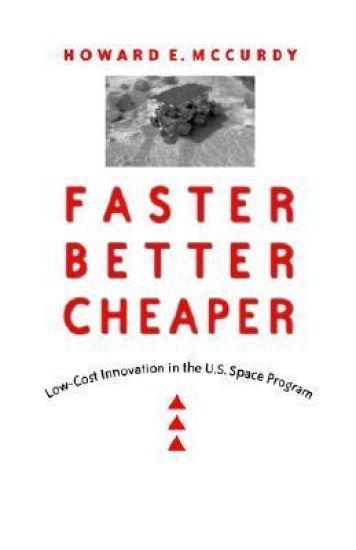
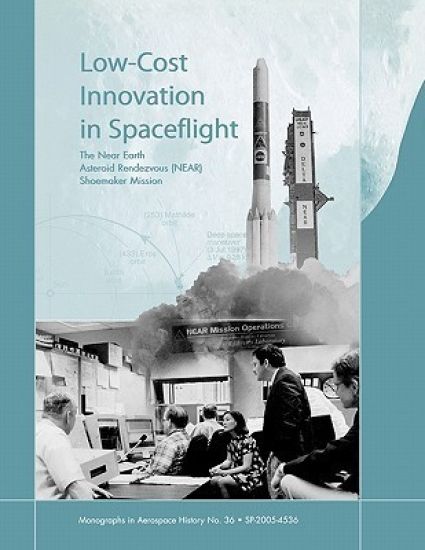
In Faster, Better, Cheaper: Low-Cost Innovation in the U.S. Space Program, Howard E. McCurdy examines NASA's recent efforts to save money while improving mission frequency and performance. McCurdy details the sixteen missions undertaken during the 1990s-including an orbit of the moon, deployment of three space telescopes, four Earth-orbiting satellites, two rendezvous with comets and asteroids, and a test of an ion propulsion engine-which cost less than the sum traditionally spent on a single, conventionally planned planetary mission. He shows how these missions employed smaller spacecraft and cheaper technology to undertake less complex and more specific tasks in outer space. While the technological innovation and space exploration approach that McCurdy describes is still controversial, the historical perspective on its disappointments and triumphs points to ways of developing "faster, better, and cheaper" as a management manifesto.
Faster, Better, Cheaper

Faster, Better, Cheaper

Howard E. McCurdy

Johns Hopkins University Press
2003
pokkari
In Faster, Better, Cheaper: Low-Cost Innovation in the U.S. Space Program, Howard E. McCurdy examines NASA's recent efforts to save money while improving mission frequency and performance. McCurdy details the sixteen missions undertaken during the 1990s-including an orbit of the moon, deployment of three space telescopes, four Earth-orbiting satellites, two rendezvous with comets and asteroids, and a test of an ion propulsion engine-which cost less than the sum traditionally spent on a single, conventionally planned planetary mission. He shows how these missions employed smaller spacecraft and cheaper technology to undertake less complex and more specific tasks in outer space. While the technological innovation and space exploration approach that McCurdy describes is still controversial, the historical perspective on its disappointments and triumphs points to ways of developing "faster, better, and cheaper" as a management manifesto.
The Space Station Decision

The Space Station Decision

Howard E. McCurdy

Johns Hopkins University Press
2008
pokkari
Outstanding Academic Title, 1991, Choice Magazine Although building a space station has been an extraordinary challenge for America's scientists and engineers, the securing and sustaining of presidential approval, congressional support, and long-term funding for the project was an enormous task for bureaucrats. The Space Station Decision examines the history of this controversial initiative and illustrates how bureaucracy shapes public policy. Using primary documents and interviews, Howard E. McCurdy describes the events that led up to the 1984 decision to build a permanently occupied, international space station in low Earth orbit. As he follows the trail of the space station proposal through the labyrinth of White House policy review, McCurdy explains the evolution of the presidential budget review process, the breakup of the cabinet system, the proliferation of subcabinets and Executive Office interagency, the involvement of White House staff in framing issues for presidential review, and the role of bureaucracy in advancing administration legislation on Capitol Hill. Comparing the space station decision to earlier decisions to go to the moon and to build the space shuttle, McCurdy shows how public officials responsible for long-term science and technology policy maneuvered in a political system that demanded short-term flexibility.
Space and the American Imagination

Space and the American Imagination

Howard E. McCurdy

Johns Hopkins University Press
2011
pokkari
People dreamed of cosmic exploration-winged spaceships and lunar voyages; space stations and robot astronauts-long before it actually happened. Space and the American Imagination traces the emergence of space travel in the popular mind, its expression in science fiction, and its influence on national space programs. Space exploration dramatically illustrates the power of imagination. Howard E. McCurdy shows how that power inspired people to attempt what they once deemed impossible. In a mere half-century since the launch of the first Earth-orbiting satellite in 1957, humans achieved much of what they had once only read about in the fiction of Jules Verne and H. G. Wells and the nonfiction of Willy Ley. Reaching these goals, however, required broad-based support, and McCurdy examines how advocates employed familiar metaphors to excite interest (promising, for example, that space exploration would recreate the American frontier experience) and prepare the public for daring missions into space. When unexpected realities and harsh obstacles threatened their progress, the space community intensified efforts to make their wildest dreams come true. This lively and important work remains relevant given contemporary questions about future plans at NASA. Fully revised and updated since its original publication in 1997, Space and the American Imagination includes a reworked introduction and conclusion and new chapters on robotics and space commerce.
Financing the New Space Industry

Financing the New Space Industry

Howard E. McCurdy

Springer Nature Switzerland AG
2019
sidottu
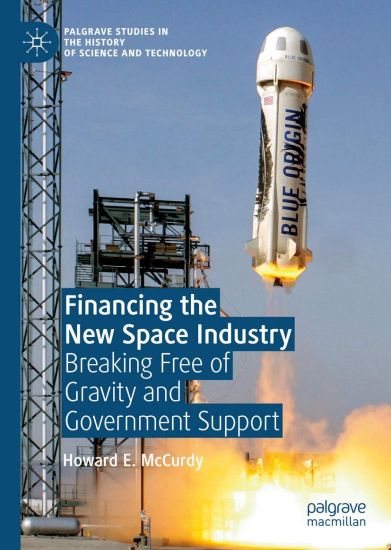
This Palgrave Pivot investigates the efforts of five aerospace companies—SpaceX, Blue Origin, Virgin Galactic, Orbital Sciences, and the Boeing Company—to launch their entry into the field of commercial space transportation. Can private sector firms raise enough capital to end the usual dependence on government funding? What can historical examples of other large-scale transportation initiatives, such as the first transcontinental railway and the first commercial jetliner, teach us about the prospects of commercial space flight? As Howard E. McCurdy shows, commercializing space is a great experiment, the outcome of which will depend on whether new space entrepreneurs can attract support from a variety of traditional and nontraditional sources.