Kirjojen hintavertailu. Mukana 11 699 587 kirjaa ja 12 kauppaa.

Kirjahaku

Etsi kirjoja tekijän nimen, kirjan nimen tai ISBN:n perusteella.

11 kirjaa tekijältä Howard Robinson

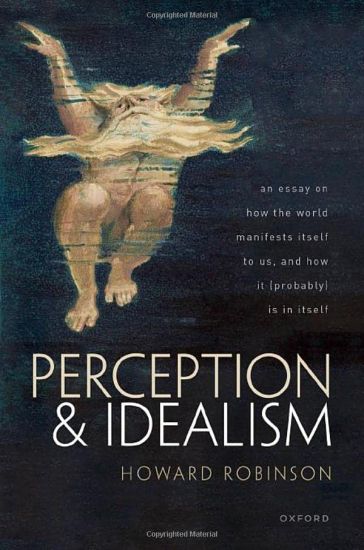
Perception and Idealism

Perception and Idealism

Howard Robinson

Oxford University Press
2022
sidottu
Perception and Idealism takes up two long-standing philosophical problems: how perception makes objects manifest to us, and what the world must be like for objects to be manifest in that way. Part I addresses the nature of perception. A detailed discussion of contemporary versions of naïve realist and of intentionalist theories is provided, and refutations offered of both. Robinson argues that sense-datum theory is not subject to any of the vices normally attributed to it, but in fact allows one to say that we directly perceive objects as being the way that they naturally manifest themselves to creatures like us. The sense-datum theory can be reconciled with a form of direct realism, once one understands properly the cognitive and the phenomenal components in perception, a relationship which intentionalist theories confuse. As perception makes us aware of objects as they manifest themselves to us, this leaves open the question of what they are like in themselves. This is the topic of Part II. A variety of realist conceptions of the material world are considered and found to be either empty or less plausible than idealism: the 'powers' conception of matter, Lewis's quiddities, Esfeld's 'matter points', and quantum theory. The problem of giving a realist account of space is also developed. Turning to mentalist options, simple phenomenalism and panpsychism are discussed and rejected. Robinson concludes that Berkeley's theistic phenomenalism, or idealism, is the most plausible account.

Perception

Perception

Howard Robinson

Routledge
1994
sidottu
Questions about perception remain some of the most difficult and insoluble in both epistemology and in the philosophy of mind. This controversial but highly accessible introduction to the area explores the philosophical importance of those questions by re-examining what had until recent times been the most popular theory of perception - the sense-datum theory. Howard Robinson surveys the history of the arguments for and against the theory from Descartes to Husserl. He then shows that the objections to the theory, particularly Wittgenstein's attack on privacy and those of the physicalists, have been unsuccessful. He argues that we should return to the theory sense-data in order to understand perception. In doing so he seeks to overturn a consensus that has dominated the philosophy of perception for nearly half a century.
Perception

Perception

Howard Robinson

Routledge
2001
nidottu
Questions about perception remain some of the most difficult and insoluble in both epistemology and in the philosophy of mind. This controversial but highly accessible introduction to the area explores the philosophical importance of those questions by re-examining what had until recent times been the most popular theory of perception - the sense-datum theory. Howard Robinson surveys the history of the arguments for and against the theory from Descartes to Husserl. He then shows that the objections to the theory, particularly Wittgenstein's attack on privacy and those of the physicalists, have been unsuccessful. He argues that we should return to the theory sense-data in order to understand perception. In doing so he seeks to overturn a consensus that has dominated the philosophy of perception for nearly half a century.
Matter and Sense

Matter and Sense

Howard Robinson

Cambridge University Press
2009
pokkari
The assumption of materialism (in its many forms) Howard Robinson believes is false. In his book he presents a very forceful critique of the modern forms that materialism has taken. In telling discussions of the theory of supervenience put forward by Davidson and Peacocke, the central state materialism attributable to Smart, Armstrong and others, Putnam's functionalism, and Rorty's disappearance theory, he shows that, whatever their local inconsistencies, these forms of materialism all overlook or quite inadequately explain elementary and unimpeachable intuitions about our own mental experiences. Robinson concludes with a consideration of the alternative views of the matter of which the mind is held to consist. These arguments will either serve to crystallise for the most part inchoate opposition to materialism among a number of philosophers, and will challenge its proponents to find a more secure defence for the basis of their view.
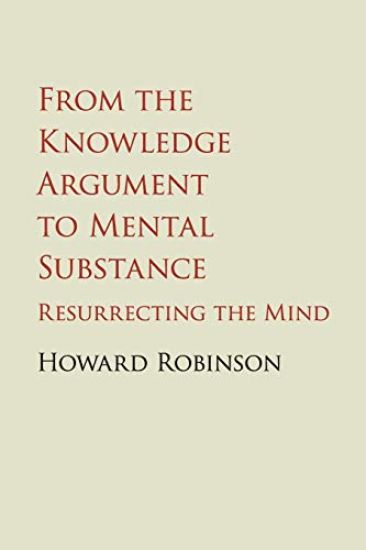
From the Knowledge Argument to Mental Substance

From the Knowledge Argument to Mental Substance

Howard Robinson

Cambridge University Press
2016
sidottu
This book presents a strong case for substance dualism and offers a comprehensive defense of the knowledge argument, showing that materialism cannot accommodate or explain the 'hard problem' of consciousness. Bringing together the discussion of reductionism and semantic vagueness in an original and illuminating way, Howard Robinson argues that non-fundamental levels of ontology are best treated by a conceptualist account, rather than a realist one. In addition to discussing the standard versions of physicalism, he examines physicalist theories such as those of McDowell and Price, and accounts of neutral monism and panpsychism from Strawson, McGinn and Stoljar. He also explores previously unnoticed historical parallels between Frege and Aristotle, and between Hume and Plotinus. His book will be a valuable resource for scholars and advanced students of philosophy of mind, in particular those looking at consciousness, dualism, and the mind-body problem.
From the Knowledge Argument to Mental Substance

From the Knowledge Argument to Mental Substance

Howard Robinson

Cambridge University Press
2017
pokkari
This book presents a strong case for substance dualism and offers a comprehensive defense of the knowledge argument, showing that materialism cannot accommodate or explain the 'hard problem' of consciousness. Bringing together the discussion of reductionism and semantic vagueness in an original and illuminating way, Howard Robinson argues that non-fundamental levels of ontology are best treated by a conceptualist account, rather than a realist one. In addition to discussing the standard versions of physicalism, he examines physicalist theories such as those of McDowell and Price, and accounts of neutral monism and panpsychism from Strawson, McGinn and Stoljar. He also explores previously unnoticed historical parallels between Frege and Aristotle, and between Hume and Plotinus. His book will be a valuable resource for scholars and advanced students of philosophy of mind, in particular those looking at consciousness, dualism, and the mind-body problem.
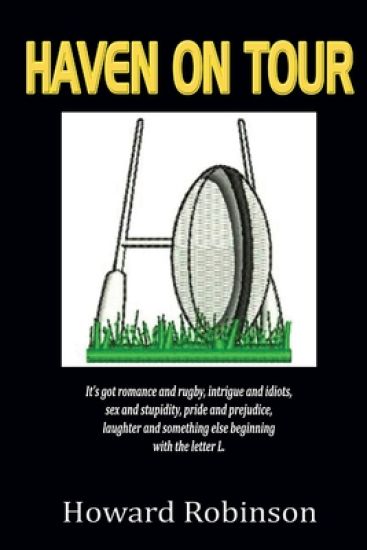
Haven on Tour

Haven on Tour

Howard Robinson

Lulu.com
2016
nidottu
A small time rugby club, Haven RUFC are going on tour. The story begins at the end of season, county cup final. Haven are the underdogs playing a Team from the biggest town in the county, Malvil Park. The Haven club are a mixture of has-beens and never-wasses. They have two decent players, a gifted scrum half, who only plays well when protected by his friend and village bobby, the club's powerful no 8. The ageing chairman of Haven is approached by the County Deputy Chief Constable, who also happens to chair the selection panel for the county team, informing him under strict secrecy that someone at the Haven club is suspected of drug smuggling. The policeman informs Haven's chairman that a drug squad officer has been playing for Haven for some time, under cover. Who is the secret policeman and who is bringing in the drugs? What goes on tour is supposed to stay on tour but follow the story of Haven RUFC and see if you can spot angels and devils.
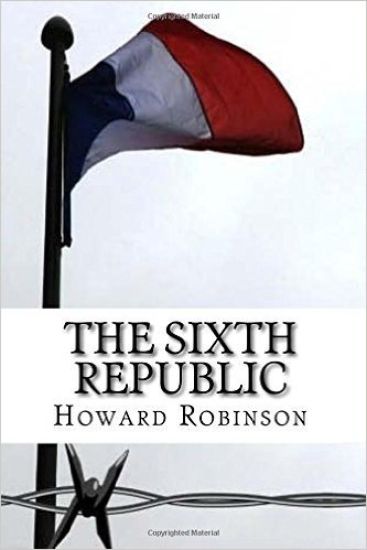
The Sixth Republic

The Sixth Republic

Howard Robinson

Createspace Independent Publishing Platform
2015
nidottu
What happens when the country you have always called home decides you're not welcome anymore? A new novel, which imagines what life might be like in France under a future Far Right President - as told through the stories of a series of different characters, The Sixth Republic is Howard Robinson's third novel. It begins with France having elected her first Far Right President, Marianne Mercier, who wastes no time in moving to create a nation only for those she deems to be "authentically French". This includes the closing of France's borders, the imposition of bans on ethnic minorities and the creation of guarded communes in remote parts of the country to which all members of ethnic communities must be sent. The novel explores the implications of such moves for those labelled the enemy within - people like young Muslim woman Inura Badour, her parents and her partner or Jewish teacher Andre Saloman and his family, including his grandmother Mathilde, who had been a member of the French Resistance during World War Two. The plot continues in the United Kingdom, where admirers of the new French President are poised to engineer a similar scenario. The rise of the National Independence Party and its leader Hugo Sherriden threatens anyone deemed undesirable by virtue of colour, religion or sexuality. But amid the darkness, there is always hope that tolerance can win out over extremism.