Kirjojen hintavertailu. Mukana 11 244 527 kirjaa ja 12 kauppaa.

Kirjahaku

Etsi kirjoja tekijän nimen, kirjan nimen tai ISBN:n perusteella.

3 kirjaa tekijältä Howard Singerman

Art Subjects

Art Subjects

Howard Singerman

University of California Press
1999
pokkari
Nearly every artist under the age of fifty in the United States today has a Master of Fine Arts degree. Howard Singerman's thoughtful study is the first to place that degree in its proper historical framework and ideological context. Arguing that where artists are trained makes a difference in the forms and meanings they produce, he shows how the university, with its disciplined organization of knowledge and demand for language, played a critical role in the production of modernism in the visual arts. Now it is shaping what we call postmodernism: like postmodernist art, the graduate university stresses theory and research over manual skills and traditional techniques of representation. Singerman, who holds an M.F.A. in sculpture as well as a Ph.D. in Visual and Cultural Studies, is interested in the question of the artist as a 'professional' and what that word means for and about the fashioning of artists. He begins by examining the first campus-based art schools in the 1870s and goes on to consider the structuring role of women art educators and women students; the shift from the 'fine arts' to the 'visual arts'; the fundamental grammar of art laid down in the schoolroom; and the development of professional art training in the American university. Singerman's book reveals the ways we have conceived of art in the past hundred years and have institutionalized that conception as atelier activity, as craft, and finally as theory and performance.
Art History, After Sherrie Levine

Art History, After Sherrie Levine

Howard Singerman

University of California Press
2011
pokkari
This book examines the career of New York-based artist Sherrie Levine, whose 1981 series of photographs "after Walker Evans" - taken not from life but from Evans's famous depression-era documents of rural Alabama - became central examples in theorizing postmodernism in the visual arts in the 1980s. For the first in-depth examination of Levine, Howard Singerman surveys a wide variety of sources, both historical and theoretical, to assess an artist whose work was understood from the outset to challenge both the label "artist" and the idea of oeuvre - and who has over the past three decades crafted a significant oeuvre of her own. Singerman addresses Levine's work after Evans, Brancusi, Malevich, and others as an experimental art historical practice - material reenactments of the way the work of art history is always doubled in and structured by language, and of the ways the art itself resists.
Sharon Lockhart

Sharon Lockhart

Howard Singerman

Afterall Publishing
2020
pokkari
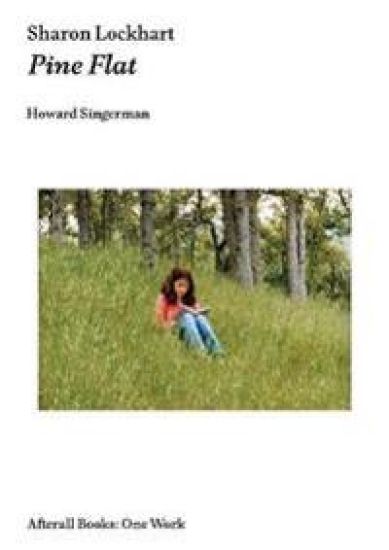
A nuanced reading of an artwork that explores a place, transitory and pastoral, where childhood might be lived and imagined differentlySharon Lockhart's Pine Flat (2006) takes its name from a small hamlet in the foothills of the western slope of the Sierra Nevadas, just inside the Giant Sequoia National Monument. The work itself comprises three distinct parts: a set of three photographs of landscapes; a larger set of posed studio portraits of children and young teenagers; and a 138-minute 16-millimeter film, which is itself assembled from twelve ten-minute scenes-each a single immobile take-divided in half by a ten-minute intermission. This volume in Afterall's One Work series offers a nuanced reading of Lockhart's work, with color illustrations from both series of photographs and the film. Art historian Howard Singerman sees in Pine Flat not a straightforward portrait of a community of children or ethnography of a place. Rather, the work explores the possibility of a space for childhood in which children have the right to intimacy, innocence, and interest outside adult narratives. The children in Pine Flat are posed formally and conventionally, but the space they occupy and the identities they construct are their own. Youth culture has long been exploited, to sell itself in order to be sold to; today, the rights of children to their own childhoods are constantly eroded. In Pine Flat, Singerman argues, Lockhart proposes a place, transitory and pastoral, "where childhood might be lived differently, imagined under a different order of power and possibility."