Kirjojen hintavertailu. Mukana 11 244 527 kirjaa ja 12 kauppaa.

Kirjahaku

Etsi kirjoja tekijän nimen, kirjan nimen tai ISBN:n perusteella.

3 kirjaa tekijältä Hyman Minsky

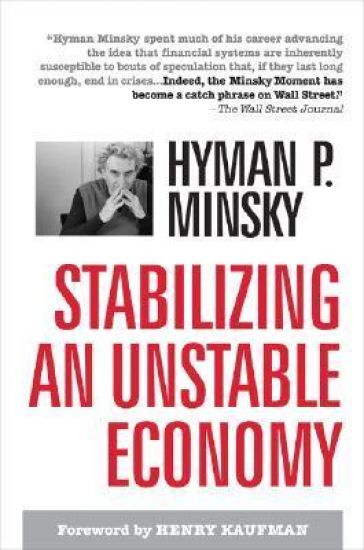
Stabilizing an Unstable Economy

Stabilizing an Unstable Economy

Hyman Minsky

McGraw-Hill Professional
2008
sidottu
“Mr. Minsky long argued markets were crisis prone. His 'moment' has arrived.” -The Wall Street JournalIn his seminal work, Minsky presents his groundbreaking financial theory of investment, one that is startlingly relevant today. He explains why the American economy has experienced periods of debilitating inflation, rising unemployment, and marked slowdowns-and why the economy is now undergoing a credit crisis that he foresaw. Stabilizing an Unstable Economy covers:The natural inclination of complex, capitalist economies toward instabilityBooms and busts as unavoidable results of high-risk lending practices “Speculative finance” and its effect on investment and asset prices Government's role in bolstering consumption during times of high unemploymentThe need to increase Federal Reserve oversight of banksHenry Kaufman, president, Henry Kaufman & Company, Inc., places Minsky's prescient ideas in the context of today's financial markets and institutions in a fascinating new preface. Two of Minsky's colleagues, Dimitri B. Papadimitriou, Ph.D. and president, The Levy Economics Institute of Bard College, and L. Randall Wray, Ph.D. and a senior scholar at the Institute, also weigh in on Minsky's present relevance in today's economic scene in a new introduction. A surge of interest in and respect for Hyman Minsky's ideas pervades Wall Street, as top economic thinkers and financial writers have started using the phrase “Minsky moment” to describe America's turbulent economy. There has never been a more appropriate time to read this classic of economic theory.
John Maynard Keynes

John Maynard Keynes

Hyman Minsky

McGraw-Hill Professional
2008
nidottu
“Today, Mr. Minsky's view [of economics] is more relevant than ever.”- The New York Times“Indeed, the Minsky moment has become a fashionable catch phrase on Wall Street.”-The Wall Street JournalJohn Maynard Keynes offers a timely reconsideration of the work of the revered economics icon. Hyman Minsky argues that what most economists consider Keynesian economics is at odds with the major points of Keynes's The General Theory of Employment, Interest, and Money. Keynes and Minsky refuse to ignore pervasive uncertainty. Once uncertainty is given center stage, recurring episodes of financial system crises are all but inescapable. As Robert Barbera notes in a new preface, “Benign economic circumstances…invite increasingly aggressive financial market wagers. Innovation in finance is a signature development in a capitalist economy. Once leveraged wagers are in place, small disappointments can have exaggerated consequences.” Thus for Minsky economic calm on Main Street engenders financial system fragility which, in turn, ensures a perpetuation of boom and bust cycles.Minsky colleagues Dimitri B. Papadimitriou and L. Randall Wray write in a new introduction, “We offer this new edition, in the hope that it will contribute to the reformation of economic theory so that it can address the world in which we actually live-the world that was always the topic of Minsky's analysis.”
Can It Happen Again?

Can It Happen Again?

Hyman Minsky

Routledge
2016
nidottu
In the winter of 1933, the American financial and economic system collapsed. Since then economists, policy makers and financial analysts throughout the world have been haunted by the question of whether "It" can happen again. In 2008 "It" very nearly happened again as banks and mortgage lenders in the USA and beyond collapsed. The disaster sent economists, bankers and policy makers back to the ideas of Hyman Minsky – whose celebrated 'Financial Instability Hypothesis' is widely regarded as predicting the crash of 2008 – and led Wall Street and beyond as to dub it as the 'Minsky Moment'. In this book Minsky presents some of his most important economic theories. He defines "It", determines whether or not "It" can happen again, and attempts to understand why, at the time of writing in the early 1980s, "It" had not happened again. He deals with microeconomic theory, the evolution of monetary institutions, and Federal Reserve policy. Minsky argues that any economic theory which separates what economists call the 'real' economy from the financial system is bound to fail. Whilst the processes that cause financial instability are an inescapable part of the capitalist economy, Minsky also argues that financial instability need not lead to a great depression.This Routledge Classics edition includes a new foreword by Jan Toporowski.