Kirjojen hintavertailu. Mukana 11 717 486 kirjaa ja 12 kauppaa.

Kirjahaku

Etsi kirjoja tekijän nimen, kirjan nimen tai ISBN:n perusteella.

8 kirjaa tekijältä Iain D. Craig

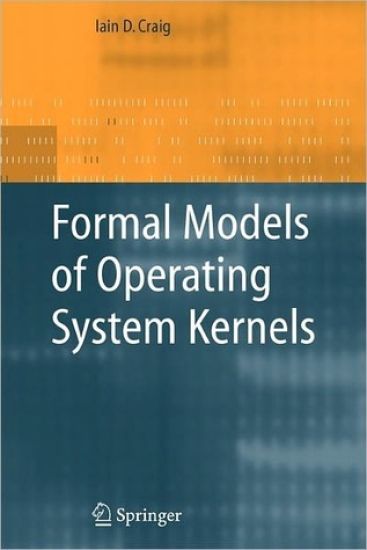
Formal Models of Operating System Kernels

Formal Models of Operating System Kernels

Iain D. Craig

Springer London Ltd
2006
sidottu
The work that this book represents is something I have wanted to do since 1979. While in Ireland, probably in 2001, I sketched some parts of a small operating system speci?cation in Z but left it because of other duties. In 2002, I worked on the sketches again but was interrupted. Finally, in April, 2005, I decided to devote some time to it and produced what amounted to a ?rst version of the kernel to be found in Chapter 3 of this book. I even produced a few proofs, just to show that I was not on a completely insane tack. I decided to suggest the material as the subject of a book to Beverley Ford. The material was sent on a Thursday (I think). The following Monday, I received an email from her saying that it had gone out for review. The review process took less than 2 weeks; the response was as surprising as it was encouraging: a de?nite acceptance. So I got on with it. This book is intended as a new way to approach operating systems - sign in general, and kernel design in particular. It was partly driven by the old ambition mentioned above, by the need for greater clarity where it comes to kernels and by the need, as I see it, for a better foundation for operating systemsdesign.Securityaspects,too,playedapart—asnotedintheintrod- tory chapter, if a system’s kernel is insecure or unreliable, it will undermine attemptstoconstructsecuresoftwareontopofit.Securitydoesnototherwise play a part in this book.
Object-Oriented Programming Languages: Interpretation
1.1 Introduction Object-oriented programming has opened a great many perspectives on the concept of software and has been hailed as part of the solution to the so-called “software crisis”. It has given the possibility that software components can be constructedandreusedwithconsiderablymorecredibility.Therearenowmany case studies in which the reuse of object-oriented components has been made and analysed. Object-oriented programming relates the programming activity to that of modelling or simulation; objects are identi?ed by a correspondence with the objects found in the application area of the program and are used to model those domain operations. Object-oriented programming also opens the prospect of more ?exible software that is able to respond dynamically to the needs of the application at runtime. It is very easy to think that object-oriented programming can be performed in only one way. The prevalence of C++ and Java suggests that they are the onlywaytoapproachtheproblemofwhatanobject-orientedprogrammingl- guage should look like. There are many approaches to this way of programming andC++andJavaexemplifyjustoneofthesedi?erentapproaches.Indeed,the wayinwhichtheconceptoftheobjectisinterpreteddi?ersbetweenapproaches and between languages. The two main approaches found in object-oriented programming languages are, respectively, class-based and prototype-based languages. Class-based l- guages are exempli?ed by Smalltalk [34], C++ [75, 74] and Java [47]. This 2 1. Introduction approach is based upon the identi?cation of common properties of objects and their description in terms of a de?nitional structure called a class. The objects manipulated by class-based programs are the result of instantiating classes.
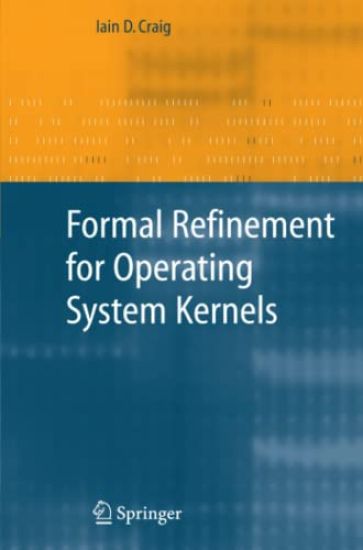
Formal Refinement for Operating System Kernels

Formal Refinement for Operating System Kernels

Iain D. Craig

Springer London Ltd
2007
sidottu
This book was written as a companion to my book on modelling operating system kernels. It is intended to demonstrate that the formal derivation of kernels is possible (and, actually, quite easy, or so I have found thus far). Itisimportantforthereadertounderstandthatthere?nementscontained in this book are not the only ones I have performed of microkernels. To date, I have re?ned four microkernels down to executable code and have now p- duced a kit of formally speci?ed components that can be composed to form kernels. The ?rst kernel included in this book is just one example of this work. The second kernel, the Separation Kernel, is new and was partly constructed out of the kit of parts (and the reader will see reuse in its speci?cation and re?nement) and was included for speci?c reasons that will become clear anon. Bothkernelstooklessthanthreemonths’workingtimetoproduce(theactual time is rather hard to calculate because of frequent interruptions). Previous experience in re?ning kernels also paid o? in the sense that there was l- tle revision involved in their speci?cation or re?nement; the usual process of yo-yoing between levels of the derivation was absent. This appears to be an inevitable consequence of experience.
Formal Models of Operating System Kernels

Formal Models of Operating System Kernels

Iain D. Craig

Springer London Ltd
2010
nidottu
The work that this book represents is something I have wanted to do since 1979. While in Ireland, probably in 2001, I sketched some parts of a small operating system speci?cation in Z but left it because of other duties. In 2002, I worked on the sketches again but was interrupted. Finally, in April, 2005, I decided to devote some time to it and produced what amounted to a ?rst version of the kernel to be found in Chapter 3 of this book. I even produced a few proofs, just to show that I was not on a completely insane tack. I decided to suggest the material as the subject of a book to Beverley Ford. The material was sent on a Thursday (I think). The following Monday, I received an email from her saying that it had gone out for review. The review process took less than 2 weeks; the response was as surprising as it was encouraging: a de?nite acceptance. So I got on with it. This book is intended as a new way to approach operating systems - sign in general, and kernel design in particular. It was partly driven by the old ambition mentioned above, by the need for greater clarity where it comes to kernels and by the need, as I see it, for a better foundation for operating systemsdesign.Securityaspects,too,playedapart—asnotedintheintrod- tory chapter, if a system’s kernel is insecure or unreliable, it will undermine attemptstoconstructsecuresoftwareontopofit.Securitydoesnototherwise play a part in this book.
Formal Refinement for Operating System Kernels

Formal Refinement for Operating System Kernels

Iain D. Craig

Springer London Ltd
2010
nidottu
This book was written as a companion to my book on modelling operating system kernels. It is intended to demonstrate that the formal derivation of kernels is possible (and, actually, quite easy, or so I have found thus far). Itisimportantforthereadertounderstandthatthere?nementscontained in this book are not the only ones I have performed of microkernels. To date, I have re?ned four microkernels down to executable code and have now p- duced a kit of formally speci?ed components that can be composed to form kernels. The ?rst kernel included in this book is just one example of this work. The second kernel, the Separation Kernel, is new and was partly constructed out of the kit of parts (and the reader will see reuse in its speci?cation and re?nement) and was included for speci?c reasons that will become clear anon. Bothkernelstooklessthanthreemonths’workingtimetoproduce(theactual time is rather hard to calculate because of frequent interruptions). Previous experience in re?ning kernels also paid o? in the sense that there was l- tle revision involved in their speci?cation or re?nement; the usual process of yo-yoing between levels of the derivation was absent. This appears to be an inevitable consequence of experience.
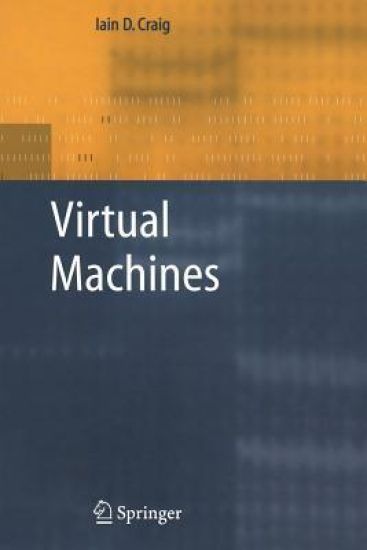
Virtual Machines

Virtual Machines

Iain D. Craig

Springer London Ltd
2013
nidottu
I love virtual machines (VMs) and I have done for a long time.If that makes me "sad" or an "anorak", so be it. I love them because they are so much fun, as well as being so useful. They have an element of original sin (writing assembly programs and being in control of an entire machine), while still being able to claim that one is being a respectable member of the community (being structured, modular, high-level, object-oriented, and so on). They also allow one to design machines of one's own, unencumbered by the restrictions of a starts optimising it for some physical particular processor (at least, until one processor or other). I have been building virtual machines, on and off, since 1980 or there­ abouts. It has always been something of a hobby for me; it has also turned out to be a technique of great power and applicability. I hope to continue working on them, perhaps on some of the ideas outlined in the last chapter (I certainly want to do some more work with register-based VMs and concur­ rency). I originally wanted to write the book from a purely semantic viewpoint.
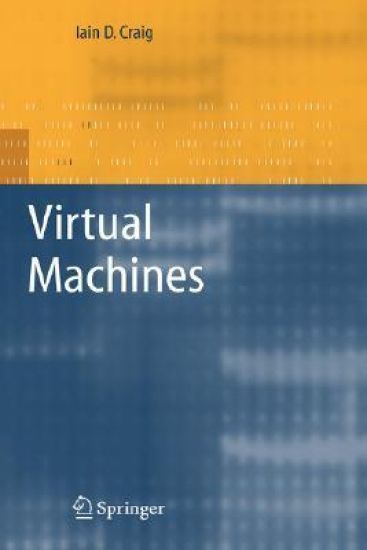
Virtual Machines

Virtual Machines

Iain D. Craig

Springer London Ltd
2005
sidottu
I love virtual machines (VMs) and I have done for a long time.If that makes me "sad" or an "anorak", so be it. I love them because they are so much fun, as well as being so useful. They have an element of original sin (writing assembly programs and being in control of an entire machine), while still being able to claim that one is being a respectable member of the community (being structured, modular, high-level, object-oriented, and so on). They also allow one to design machines of one's own, unencumbered by the restrictions of a starts optimising it for some physical particular processor (at least, until one processor or other). I have been building virtual machines, on and off, since 1980 or there­ abouts. It has always been something of a hobby for me; it has also turned out to be a technique of great power and applicability. I hope to continue working on them, perhaps on some of the ideas outlined in the last chapter (I certainly want to do some more work with register-based VMs and concur­ rency). I originally wanted to write the book from a purely semantic viewpoint.
Programming in Dylan

Programming in Dylan

Iain D. Craig

Springer-Verlag Berlin and Heidelberg GmbH Co. K
1996
nidottu
Programming in Dylan is aimed at programmers who are already familiar with languages such as Pascal or C but who, as yet, have no knowledge of object-oriented languages. The author takes the reader through the development of Dylan by Apple and introduces the concept of object oriented languages, comparing Dylan to other languages such as CLOS, Smalltalk and C++. The author looks at fundamental concepts of the Dylan language before moving on to present the basic types (Boolean, vectors, strings etc.). Variables, expressions and assignment, and functions (both named and anonymous) are covered in detail. The Dylan class is introduced in its simple form and generic functions and library classes are discussed in depth. The author shows how modularisation needs to be used if large applications are to be developed and illustrates how to construct program libraries. A simulation and modelling example runs through the book.