Kirjojen hintavertailu. Mukana 11 342 296 kirjaa ja 12 kauppaa.

Kirjahaku

Etsi kirjoja tekijän nimen, kirjan nimen tai ISBN:n perusteella.

8 kirjaa tekijältä Iain McLean

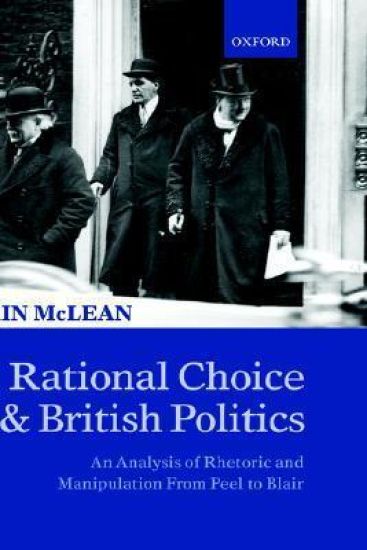
Rational Choice and British Politics

Rational Choice and British Politics

Iain McLean

Oxford University Press
2001
nidottu
This engaging and original study, by one of Britain's leading scholars of rational choice theory, explores the course of British parliamentary politics over the last 150 years. McLean marries an appealing combination of social science and analytical narrative history to the great turning points in British politics - the Repeal of the Corn Law; the Victorian crisis of the Liberal and Conservative Parties; the Irish Question and Lloyd George's solution to it; the New Liberal origins of the welfare state; the politics of race and empire under Chamberlain and Powell; and the politics of 'there is no alternative' under Margaret Thatcher.
Rational Choice and British Politics

Rational Choice and British Politics

Iain McLean

Oxford University Press
2001
sidottu
This engaging and original study, by one of Britain's leading scholars of rational choice theory, explores the course of British parliamentary politics over the last 150 years. McLean marries an appealing combination of social science and analytical narrative history to the great turning points in British politics - the Repeal of the Corn Law; the Victorian crisis of the Liberal and Conservative Parties; the Irish Question and Lloyd George's solution to it; the New Liberal origins of the welfare state; the politics of race and empire under Chamberlain and Powell; and the politics of 'there is no alternative' under Margaret Thatcher.
What's Wrong with the British Constitution?

What's Wrong with the British Constitution?

Iain McLean

Oxford University Press
2009
sidottu
In this provocative new study, Iain McLean argues that the traditional story of the British constitution does not make sense. It purports to be both positive and normative: that is, to describe both how people actually behave and how they ought to behave. In fact, it fails to do either; it is not a correct description and it has no persuasive force. The book goes on to offer a reasoned alternative. The position that still dominates the field of constitutional law is that of parliamentary sovereignty (or supremacy). According to this view, the supreme lawgiver in the United Kingdom is Parliament. Some writers in this tradition go on to insist that Parliament in turn derives its authority from the people, because the people elect Parliament. An obvious problem with this view is that Parliament, to a lawyer, comprises three houses: monarch, Lords, and Commons. The people elect only one of those three houses. This book aims to show, contrary to the prevailing view, that the UK exists by virtue of a constitutional contract between two previously independent states. Professor McLean argues that the work of the influential constitutional theorist A.V. Dicey has little to offer those who really want to understand the nature of the constitution. Instead, greater understanding can be gleaned from considering the 'veto plays' and 'credible threats' available to politicians since 1707. He suggests that the idea that the people are sovereign dates back to the 17th century (maybe the 14th in Scotland), but has gone underground in English constitutional writing. He goes on to show that devolution and the UK's relationship with the rest of Europe have taken the UK along a constitutionalist road since 1972, and perhaps since 1920. He concludes that no intellectually defensible case can be made for retaining an unelected house of Parliament, an unelected head of state, or an established church. The book will be essential reading for political scientists, constitutional lawyers, historians, and politicians alike.
What's Wrong with the British Constitution?

What's Wrong with the British Constitution?

Iain McLean

Oxford University Press
2012
nidottu
In this provocative new study, Iain McLean argues that the traditional story of the British constitution does not make sense. It purports to be both positive and normative: that is, to describe both how people actually behave and how they ought to behave. In fact, it fails to do either; it is not a correct description and it has no persuasive force. The book goes on to offer a reasoned alternative. The position that still dominates the field of constitutional law is that of parliamentary sovereignty (or supremacy). According to this view, the supreme lawgiver in the United Kingdom is Parliament. Some writers in this tradition go on to insist that Parliament in turn derives its authority from the people, because the people elect Parliament. An obvious problem with this view is that Parliament, to a lawyer, comprises three houses: monarch, Lords, and Commons. The people elect only one of those three houses. This book aims to show, contrary to the prevailing view, that the UK exists by virtue of a constitutional contract between two previously independent states. Professor McLean argues that the work of the influential constitutional theorist A.V. Dicey has little to offer those who really want to understand the nature of the constitution. Instead, greater understanding can be gleaned from considering the 'veto plays' and 'credible threats' available to politicians since 1707. He suggests that the idea that the people are sovereign dates back to the 17th century (maybe the 14th in Scotland), but has gone underground in English constitutional writing. He goes on to show that devolution and the UK's relationship with the rest of Europe have taken the UK along a constitutionalist road since 1972, and perhaps since 1920. He concludes that no intellectually defensible case can be made for retaining an unelected house of Parliament, an unelected head of state, or an established church. The book will be essential reading for political scientists, constitutional lawyers, historians, and politicians alike.
Public Choice

Public Choice

Iain McLean

Blackwell Publishers
1987
nidottu
The 1968 Nobel Prize for Economics was awarded to one of the founders of public choice theory, James Buchanan, yet many people have only the vaguest idea what public choice is. The book offers and unusually clear and accessible introduction to an important subject. McLean examines the workings of public choice from two related perspectives - collective action and the aggregation of individual preferences into social consensus. The book highlights the paradox at the heart of collective action- that self-interest in the public domain is frequently counterproductive. National defense and clean air are things we all benefit from - they are public goods - but we tend to resist contributing to them. The first part of this book examines how government choice in such areas is shaped, and by whom- political entrepreneurs, bureaucrats, interest groups and ordinary citizens. McLean uses the idea of a public market in which politicians sell what they hope voters will buy, and further considers how and when people (and animals) co-operate to produce public goods even without government coercion. In the second part of the book the author examines the consequences of combining individual preferences, arguing that there is no straightforward way of adding them up to form a 'social ordering' and assesing the implications of this both for electoral reform and for the status of 'the will of the people'.
Democracy and New Technology

Democracy and New Technology

Iain McLean

Polity Press
1989
sidottu
In this accessible new book, Iain McLean explores the impact of information technology on democracy. Combining democratic theory, social choice theory and description of new technology at work in Europe and the USA, McLean explores democracy as it is and as it could be. The author begins in ancient Athens and moves through Pliny, Rousseau, Madison and J S Mill to modern representatives and direct democracy. Introducing the theory of social choice, he argues that democracy is about procedures, not results, and sets out some criteria for fair aggregation of individuals' preferences to society's. Exploring the impact of new technology on these procedures, McLean shows how it can save time, and increase accuracy and accessibility, but also how it can lead to manipulation and come up against Arrow's, Gibbards' and McKelvey's impossibility theorems. In conclusion, McLean asks whether new technology widens or narrows our democratic horizons, and points to the technical and logical boundaries of democracy. Democracy and New Technology will be of great interest to students and researchers in politics, sociology, and media and communications studies. It is one of very few books to explain social choice theory in totally non-technical language and to explore what it means for democracy.
Adam Smith, Radical and Egalitarian

Adam Smith, Radical and Egalitarian

Iain McLean

Edinburgh University Press
2006
sidottu
Foreword by the Rt. Hon. Gordon Brown, Chancellor of the Exchequer This book aims to show that Adam Smith (1723-90), the author of The Wealth of Nations, was not the promoter of ruthless laissez-faire capitalism that is still frequently depicted. Smith's "right-wing" reputation was sealed after his death when it was not safe to claim that an author may have influenced the French revolutionaries. But as the author, also, of The Theory of Moral Sentiments, which he probably regarded as his more important book, Smith sought a non-religious grounding for morals, and found it in the principle of sympathy, which should lead an impartial spectator to understand others' problems. This book locates Smith in the Scottish Enlightenment; shows how the two books are perfectly consistent with one another; traces Smith's influence in France and the United States; and draws out the lessons that Adam Smith can teach policy makers in the 21st Century. Although Smith was not a religious man, he was a very acute sociologist of religion. The book accordingly explains the Scottish religious context of Smith's time, which was, as it remains, very different to the English religious context. The whole book is shot through with Iain McLean's love for the Edinburgh of his birth, and for the Scottish Enlightenment. It begins and ends with poems by Smith's great admirer Robert Burns.
Thomas Jefferson's Enlightenment

Thomas Jefferson's Enlightenment

Iain McLean

BLOOMSBURY PUBLISHING PLC
2024
sidottu
Thomas Jefferson’s Enlightenment: English, Scottish and French Influences on the Third US President retraces Jefferson’s intellectual history. His education in rural Virginia exposed him first to the Latin and Greek classics, then to the political and legal thought of opposition (‘country’) Whigs from 18th-century England. From his college days, he started to absorb the quite distinct views of the Scottish Enlightenment then the five years he spent in Paris (1784-1789), mostly as American Minister to France, broadened his horizons even more. An enthusiastic amateur scientist, he studied the latest science and liberal politics of his French circle, the most important being the Marquis de Condorcet, whose revolutionary ‘social mathematics’ was 200 years ahead of its time. The English, Scottish and French perspectives Jefferson was exposed to shaped his thinking in many ways on his return to the US, influencing his own promotion of science as president of the American Philosophical Society and agricultural improver. It shaped his unique views on religion and ethics, up to his very last published letter. However, it failed to eradicate his great blind spot in regard to slavery as the only enslaved people he freed were from his own family.