Kirjojen hintavertailu. Mukana 11 699 587 kirjaa ja 12 kauppaa.

Kirjahaku

Etsi kirjoja tekijän nimen, kirjan nimen tai ISBN:n perusteella.

5 kirjaa tekijältä Ian G. Barbour

When Science Meets Religion: Enemies, Strangers, or Partners?
The Definitive Introduction ToThe Relationship BetweenReligion And Science∗ In The Beginning: Why Did the Big Bang Occur?∗ Quantum Physics: A Challenge to Our Assumptions About Reality?∗ Darwin And Genesis: Is Evolution God′s Way of Creating?∗ Human Nature: Are We Determined by Our Genes?∗ God And Nature: Can God Act in a Law-Bound World?Over the centuries and into the new millennium, scientists, theologians, and the general public have shared many questions about the implications of scientific discoveries for religious faith. Nuclear physicist and theologian Ian Barbour, winner of the 1999 Templeton Prize for Progress in Religion for his pioneering role in advancing the study of religion and science, presents a clear, contemporary introduction to the essential issues, ideas, and solutions in the relationship between religion and science. In simple, straightforward language, Barbour explores the fascinating topics that illuminate the critical encounter of the spiritual and quantitative dimensions of life.
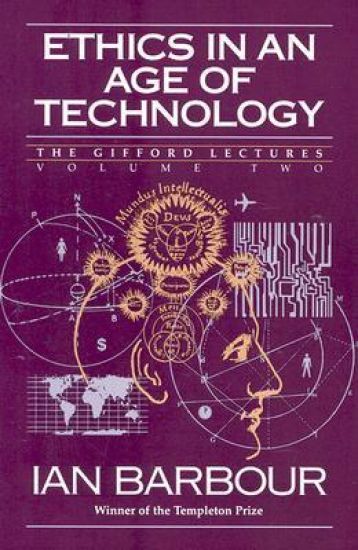
Ethics in an Age of Technology: Gifford Lectures, Volume Two
The Gifford Lectures have challenged our greatest thinkers to relate the worlds of religion, philosophy, and science. Now Ian Barbour has joined ranks with such Gifford lecturers as William James, Carl Jung, and Reinhold Neibuhr. In 1989 Barbour presented his first series of Gifford Lectures, published as Religion in an Age of Science. In 1990 he returned to Scotland to present his second series, dealing with ethical issues arising from technology and exploring the relationship of human and environmental values to science, philosophy, and religion and showing why these values are relevant to technological policy decisions.In examine the conflicting ethics and assumptions that lead to divergent views and technology, Barbour analyzes three social values: justice, participatory freedom, and economic development. He defends such environmental principles as resource sustainability, environmental protection, and respect for all forms of life. He present case studies in agriculture, energy policy, genetic engineering, and the use of computers. Finally, he concludes by focusing on appropriate technologies, individual life-styles, and sources of change: education, political action, response to crisis, and alternative visions of the good life.
Religion and Science

Religion and Science

Ian G. Barbour

SCM Press
1998
nidottu
"Religion and Science" is a definitive contemporary discussion of the many issues surrounding our understanding of God and religious truth and experience in our scientific age. This is a significantly expanded and freshly revised version of "Religion in an Age of Science," winner of the American Academy of Religion Award for Excellence and the Templeton Book Award. Ian G. Barbour - the premier scholar in the field - has added three crucial historical chapters on physics and metaphysics in the seventeenth century, nature and God in the eighteenth century, and biology and theology in the nineteenth century. He also added new sections on developments in nature-centered spirituality, information theory, and chaos and complexity theories.
Nature, Human Nature, and God

Nature, Human Nature, and God

Ian G. Barbour

Augsburg Fortress
2002
nidottu
In his latest work, the dean of religion and science tackles some of the thorniest issues posed by contemporary thought. Thoroughly conversant with current developments, Barbour offers astute analyses of the shape and import of evolutionary theory, indeterminacy, neuroscience, information theory, and artificial intelligence. He also addresses deeper philosophical issues and the idea of nature itself. Then with characteristic clarity and verve, Barbour advances to the interconnected religious questions at the core of contemporary debate: Are humans free? Does religion itself evolve? Are we immortal? Is God omnipotent? How does God act in nature? Barbour's creative and constructive work offers hope that newer religious insights and imperatives occasioned by deep interaction with science can address the environmental and global challenges posed by science's relentless advance.
Cosmology

Cosmology

Ian G. Barbour

Fortress Press,U.S.
2008
pokkari
In ten provocative chapters Russell explores such topics as: The Contingency of Creation and Big Bang Cosmology; Does 'The God Who Acts' Really Act?; New Approaches to Divine Action In Light of Contemporary Science; Entropy and Evil: The Role of Thermodynamics in the Ambiguity of Good and Evil in Nature; The Transfiguration of the Cosmos: A Fresh Exploration of the Symbol of a Cosmic Christ; and more.