Kirjojen hintavertailu. Mukana 12 390 323 kirjaa ja 12 kauppaa.

Kirjahaku

Etsi kirjoja tekijän nimen, kirjan nimen tai ISBN:n perusteella.

4 kirjaa tekijältä Ian Glynn

An Anatomy of Thought: The Origin and Machinery of the Mind
Drawing on a dazzling array of disciplines--physiology, neurology, psychology, anthropology, linguistics, and philosophy--Ian Glynn explains virtually every aspect of the workings of the brain, unlocking the mysteries of the mind. Glynn writes with exceptional clarity as he illuminates the mechanics of nerve messages; the functioning of sensory receptors; the processes by which the brain sees, tastes, and smells; the seats of language, memory, and emotions. The breadth of Glynn's erudition is astonishing, as he ranges from parallel processing in computers to the specialization of different regions of the brain (illustrated with fascinating instances of the bizarre effects of localized brain damage). He explains the different types of memory, traces the path of information that leads to emotional responses, and engages in a discussion of language that ranges from Noam Chomsky to Hawaiian pidgin. No other single volume has captured the full expanse of our knowledge of consciousness and the brain. A work of unequaled authority and eloquence, this book promises to be a new landmark of scientific writing. "Monumental."--The Observer "Glynn's erudition is astonishing...a hugely enjoyable intellectual journey."--Nature
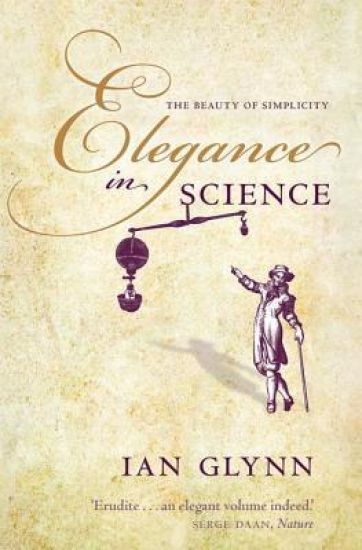
Elegance in Science

Elegance in Science

Ian Glynn

Oxford University Press
2010
sidottu
The idea of elegance in science is not necessarily a familiar one, but it is an important one. The use of the term is perhaps most clear-cut in mathematics - the elegant proof - and this is where Ian Glynn begins his exploration. Scientists often share a sense of admiration and excitement on hearing of an elegant solution to a problem, an elegant theory, or an elegant experiment. The idea of elegance may seem strange in a field of endeavour that prides itself in its objectivity, but only if science is regarded as a dull, dry activity of counting and measuring. It is, of course, far more than that, and elegance is a fundamental aspect of the beauty and imagination involved in scientific activity. Ian Glynn, a distinguished scientist, selects historical examples from a range of sciences to draw out the principles of science, including Kepler's Laws, the experiments that demonstrated the nature of heat, and the action of nerves, and of course the several extraordinary episodes that led to Watson and Crick's discovery of the structure of DNA. With a highly readable selection of inspiring episodes highlighting the role of beauty and simplicity in the sciences, the book also relates to important philosophical issues of inference, and Glynn ends by warning us not to rely on beauty and simplicity alone - even the most elegant explanation can be wrong.
Elegance in Science

Elegance in Science

Ian Glynn

Oxford University Press
2013
nidottu
The idea of elegance in science is not necessarily a familiar one, but it is an important one. The use of the term is perhaps most clear-cut in mathematics - the elegant proof - and this is where Ian Glynn begins his exploration. Scientists often share a sense of admiration and excitement on hearing of an elegant solution to a problem, an elegant theory, or an elegant experiment. The idea of elegance may seem strange in a field of endeavour that prides itself in its objectivity, but only if science is regarded as a dull, dry activity of counting and measuring. It is, of course, far more than that, and elegance is a fundamental aspect of the beauty and imagination involved in scientific activity. Ian Glynn, a distinguished scientist, selects historical examples from a range of sciences to draw out the principles of science, including Kepler's Laws, the experiments that demonstrated the nature of heat, and the action of nerves, and of course the several extraordinary episodes that led to Watson and Crick's discovery of the structure of DNA. With a highly readable selection of inspiring episodes highlighting the role of beauty and simplicity in the sciences, the book also relates to important philosophical issues of inference, and Glynn ends by warning us not to rely on beauty and simplicity alone - even the most elegant explanation can be wrong.
The Life And Death Of Smallpox.

The Life And Death Of Smallpox.

Ian Glynn; Jenifer Glynn

Cambridge University Press
2004
sidottu
This is an engaging and fascinating story of a conditional human success story. Smallpox has been one of the most devastating scourges of humanity throughout recorded history, and it is the only human illness to have been eradicated, though polio may soon follow it to official extinction through human agency. However, while smallpox is officially extinct in nature, literally tons of the virus remain in guarded storage in Russia and at Fort Detrick in the US. Our fears that smallpox may return as a weapon of bioterrorists have led to the stockpiling of vaccine, and continuing vigilance, even though the official victory over smallpox is now 15 years old. The Life and Death of Smallpox presents the entire engaging history of our struggle and ultimate (?) victory over one of our oldest and worst enemies. The story of the campaign to track down and eradicate the virus throughout the world - the difficulties, setbacks, and the challenges successfully met - is a highlight of a fascinating book, but we can’t be confident of the ending. The final chapter of the book clearly and authoritatively explains the current status of the threat, from the deliberate release of smallpox or other potential agents of biological terrorism.