Kirjojen hintavertailu. Mukana 11 244 527 kirjaa ja 12 kauppaa.

Kirjahaku

Etsi kirjoja tekijän nimen, kirjan nimen tai ISBN:n perusteella.

4 kirjaa tekijältä Ian H. Angus

Technique and Enlightenment

Technique and Enlightenment

Ian H. Angus

University Press of America
1984
sidottu
This volume, co-published with the Center for Advanced Research in Phenomenology, presents the argument that a philosophy of technology is a central component of a contemporary political philosophy. It provides a theoretical groundwork for the encounter of phenomenology and critical theory. Written for courses in social and political theory, phenomenology and critical theory.
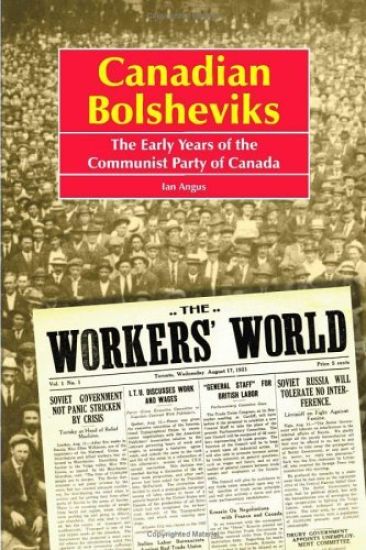
Canadian Bolsheviks

Canadian Bolsheviks

Ian H. Angus

Trafford Publishing
2004
nidottu
"Canadian Bolsheviks is a book that cannot be overlooked by anyone interested in Canadian labour history and part played in its development by Canadian Communists. It is a story too little known, and Angus, to his credit, has done much to rectify that imbalance."-William Rodney, author of Soldiers of the International, in The Globe & Mail Canadian communism did not spring out of the ground suddenly at the end of World War I, and it was not smuggled into the country by Russian agents. The men and women who built the new movement were long-time socialist and labour militants in Canada. Inspired by the Russian Revolution and by their own experiences as leaders of the post-war labour revolt in Canada, they set about to create a new kind of party, one that could lead the fight for workers' power. The new Communist Party, formed between 1919 and 1921, quickly became the largest party on the left, with strong roots and influence in the unions and basic industry. Its members led heroic strikes. They fought for labor unity, and engaged in united electoral activity with other currents in the workers movement. They were in the forefront of the struggle for democratic rights. Ten years later, the party was destroyed. Most of its founding leaders were expelled, and three quarters of its membership dropped out. The Communist Party abandoned the program it had adopted in its early years, and turned its back on its principles. The organization still called itself Communist, but it was now "Tim Buck's Party." It had been transformed from a revolutionary party into an agent of the new ruling caste in Moscow. In Canadian Bolsheviks, Ian Angus describes and explains the first attempt to build a Leninist party on Canadian soil, showing why it succeeded so well at first, and why it ultimately failed. The Second Edition of a book that has been widely hailed as a path breaking work, "the best yet to appear" on the origins of Canadian communism.
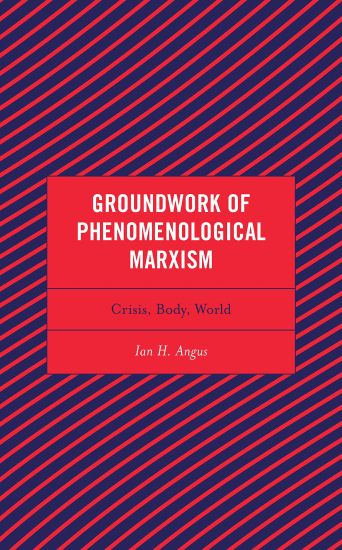
Groundwork of Phenomenological Marxism

Groundwork of Phenomenological Marxism

Ian H. Angus

Lexington Books
2021
sidottu
Beginning from the program for phenomenology set forth in Edmund Husserl’s The Crisis of the European Sciences and Transcendental Phenomenology, Ian H. Angus investigates the crisis of reason in a contemporary context. In Groundwork of Phenomenological Marxism: Crisis, Body, World, Angus connects the late work of Marx to human motility, natural fecundity (excess), and ecology. Angus’s overall conception of phenomenology is Socratic in that it is concerned with the presuppositions and application of knowledge-forms to their lifeworld grounding. He argues that the crisis produced by the formalization of reason creates an inability to foster differentiated community as expected by both Husserl and Marx and that the formalization of human motility by the regime of value reveals the ontological productivity of natural fecundity (excess) and shows the priority of ecology as the contemporary exemplary science. Husserl’s idea of Europe as the home for philosophy is surpassed. Angus further argues that the contemporary task for Socratic phenomenology is in the epochal confrontation between planetary technology and place-based Indigeneity. He demonstrates that community and labor depend upon natural fecundity (excess) and locates their realization in the dialogue between civilizational-cultural lifeworlds, especially with respect to their ecological formation and access to transcendentality. This book lays out the fundamental concepts of a systematic phenomenological Marxian philosophy.
Groundwork of Phenomenological Marxism

Groundwork of Phenomenological Marxism

Ian H. Angus

BLOOMSBURY PUBLISHING PLC
2023
nidottu
In Groundwork of Phenomenological Marxism: Crisis, Body, World, Ian H. Angus investigates the crisis of reason in a contemporary context. Beginning with Edmund Husserl’s The Crisis of the European Sciences and Transcendental Phenomenology, Angus connects the phenomenology of human motility to Marx’s ontology of labor in Capital and shows its basis in natural fecundity (excess). He argues that the formalization of reason creates an inability to foster differentiated community as expected by both Husserl and Marx and that the formalization of human motility by the regime of value reveals the ontological productivity of natural fecundity, showing that ecology is the contemporary exemplary science. Addressing the crisis requires a philosophy of technology (especially digital technology) and a dialogue between cultural-civilizational lifeworlds, which surpasses Husserl’s assumption that Europe is the home of reason. Angus’s overall conception of phenomenology is Socratic in that it is concerned with the presuppositions and applications of knowledge-forms in their lifeworld grounding. He further shows that the contemporary event is the epochal confrontation between planetary technology and place-based Indigeneity. This book lays out the fundamental concepts of a systematic phenomenological Marxian philosophy.