Kirjojen hintavertailu. Mukana 11 244 527 kirjaa ja 12 kauppaa.

Kirjahaku

Etsi kirjoja tekijän nimen, kirjan nimen tai ISBN:n perusteella.

28 kirjaa tekijältä Ian Mortimer

Perfect King

Perfect King

Ian Mortimer

Vintage
2008
pokkari
From the bestselling author of The Time Traveller's Guide to Medieval England, comes the story of King Edward III, who - like Elizabeth and Victoria after him - embodied the values of his age, forged a nation out of war and re-made England. He ordered his uncle to be beheaded;
Greatest Traitor

Greatest Traitor

Ian Mortimer

Random House Hardbacks
2010
pokkari
The first biography of the rebel baron who deposed and murdered Edward II. One night in August 1323 a captive rebel baron, Sir Roger Mortimer, drugged his guards and escaped from the Tower of London.
Human Race

Human Race

Ian Mortimer

Vintage
2015
pokkari
Sweeping through the last thousand years of human development, this book is a treasure chest of the lunar leaps and lightbulb moments that, for better or worse, have sent humanity swerving down a path that no one could ever have predicted.
The Time Traveler's Guide to Elizabethan England
An entertaining, accessible guide to Elizabethan England--the latest in the Time Traveler's Guide series Acclaimed historian Ian Mortimer shows readers that the past is not just something to be studied; it is also something to be lived. Using diaries, letters, books, and other writings of the day, Mortimer offers a masterful portrait of daily life in Elizabethan England, re-creating the sights, sounds, and customs of the sixteenth century from the perspective of both peasants and royals. Through this lens, we can begin to understand Queen Elizabeth's subjects not only as a people profoundly shaped by the time in which they lived, but also as the people who shaped the world we know and the people we are today.
The Dying and the Doctors

The Dying and the Doctors

Ian Mortimer

Royal Historical Society
2009
sidottu
A survey of the changes in medical care for those approaching death in the early modern period. From the sixteenth century onwards, medical strategies adopted by the seriously ill and dying changed radically, decade by decade, from the Elizabethan age of astrological medicine to the emergence of the general practitioner in the early eighteenth century. It is this profound revolution, in both medical and religious terms, as whole communities' hopes for physical survival shifted from God to the doctor, that this book charts. Drawing on more than eighteen thousand probate accounts, it identifies massive increases in the consumption of medicines and medical advice by all social groups and in almost all areas. Most importantly, it examines the role of the towns in providing medical services to rural areas and hinterlands [using the diocese of Canterbury as a particular focus], and demonstrates the extending ranges of physicians', surgeons' and apothecaries' businesses. It also identifies a comparable revolution in community nursing, from its unskilled status in 1600 to a more exclusive one by 1700. IAN MORTIMER is an independent historian and Honorary Research Fellow at the University of Exeter.
The Dying and the Doctors

The Dying and the Doctors

Ian Mortimer

Royal Historical Society
2015
pokkari
A survey of the changes in medical care for those approaching death in the early modern period. From the sixteenth century onwards, medical strategies adopted by the seriously ill and dying changed radically, decade by decade, from the Elizabethan age of astrological medicine to the emergence of the general practitioner in the early eighteenth century. It is this profound revolution, in both medical and religious terms, as whole communities' hopes for physical survival shifted from God to the doctor, that this book charts. Drawing on more than eighteen thousand probate accounts, it identifies massive increases in the consumption of medicines and medical advice by all social groups and in almost all areas. Most importantly, it examines the role of the towns in providing medical services to rural areas and hinterlands [using the diocese of Canterbury as a particular focus], and demonstrates the extending ranges of physicians', surgeons' and apothecaries' businesses. It also identifies a comparable revolution in community nursing, from its unskilled status in 1600 to a more exclusive one by 1700. IAN MORTIMER holds PhD and DLitt degrees from the University of Exeter. He was elected a Fellow of the Royal Historical Society in 1998.
Medieval Intrigue

Medieval Intrigue

Ian Mortimer

Continuum Publishing Corporation
2012
nidottu
In this important new work Ian Mortimer examines some of the most controversial questions in medieval history, including whether Edward II was murdered, his possible later life in Italy, the weakness of the Lancastrian claim to the throne in 1399 and the origins of the idea of the royal pretender. Central to this book is his ground-breaking approach to medieval evidence. He explains how an information-based method allows a more certain reading of a series of texts. He criticises existing modes of arriving at consensus and outlines a process of historical analysis that ultimately leads to questioning historical doubts as well as historical facts, with profound implications for what we can say about the past with certainty. This is an important work from one of the most original and popular medieval historians writing today.
Outcasts of Time

Outcasts of Time

Ian Mortimer

Simon Schuster Ltd
2018
pokkari
From the author described by The Times as â??the most remarkable historian of our timeâ??, the publication of Ian Mortimerâ??s first work of historical fiction is a hugely exciting event. A stunningly high-concept story that is both as daring as it is gripping, it is perfect for fans of Conn Iggulden, SJ Parris and Kate Mosse.
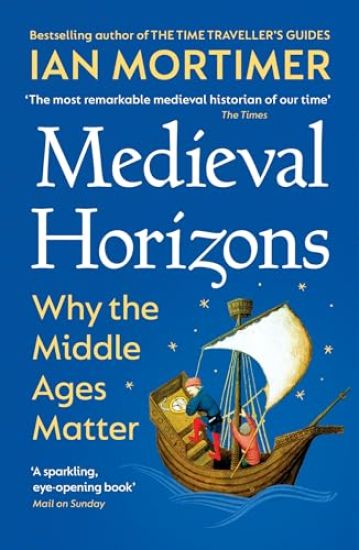
Medieval Horizons

Medieval Horizons

Ian Mortimer

Vintage Publishing
2024
pokkari
The essential introduction to the Middle Ages by the bestselling author of The Time Traveller's Guide to Medieval EnglandWe tend to think of the Middle Ages as a dark, backward and unchanging time characterised by violence, ignorance and superstition. By contrast we believe progress arose from science and technological innovation, and that inventions of recent centuries created the modern world.We couldn't be more wrong. As Ian Mortimer shows in this fascinating book, people's horizons - their knowledge, experience and understanding of the world - expanded dramatically. Life was utterly transformed between 1000 and 1600, marking the transition from a warrior-led society to that of Shakespeare.Just as The Time Traveller's Guide to Medieval England revealed what it was like to live in the fourteenth century, Medieval Horizons provides the perfect primer to the era as a whole. It outlines the enormous cultural changes that took place - from literacy to living standards, inequality and even the developing sense of self - thereby correcting misconceptions and presenting the period as a revolutionary age of fundamental importance in the development of the Western world.Praise for Ian Mortimer:'The endlessly inventive Ian Mortimer is the most remarkable medieval historian of our time' - The Times
The Time Traveler's Guide to Regency Britain: A Handbook for Visitors to 1789-1830
A vivid and immersive history of Georgian England that gives its reader a firsthand experience of life as it was truly lived during the era of Jane Austen, Percy Bysshe Shelley, and the Duke of Wellington. This is the age of Jane Austen and the Romantic poets; the paintings of John Constable and the gardens of Humphry Repton; the sartorial elegance of Beau Brummell and the poetic license of Lord Byron; Britain's military triumphs at Trafalgar and Waterloo; the threat of revolution and the Peterloo massacre. In the latest volume of his celebrated series of Time Traveler's Guides, Ian Mortimer turns to what is arguably the most-loved period in British history: the Regency, or Georgian England. A time of exuberance, thrills, frills and unchecked bad behavior, it was perhaps the last age of true freedom before the arrival of the stifling world of Victorian morality. At the same time, it was a period of transition that reflected unprecedented social, economic, and political change. And like all periods in history, it was an age of many contradictions--where Beethoven's thundering Fifth Symphony could premier in the same year that saw Jane Austen craft the delicate sensitivities of Persuasion. Once more, Ian Mortimer takes us on a thrilling journey to the past, revealing what people ate, drank, and wore; where they shopped and how they amused themselves; what they believed in, and what they feared. Conveying the sights, sounds, and smells of the Regency period, this is history at its most exciting, physical, visceral--the past not as something to be studied but as lived experience.
The Outcasts of Time

The Outcasts of Time

Ian Mortimer

Pegasus Books
2019
nidottu
December 1348. What if you had just six days to save your soul? With the country in the grip of the Black Death, brothers John and William fear that they will shortly die and suffer in the afterlife. But as the end draws near, they are given an unexpected choice: either to go home and spend their last six days in their familiar world, or to search for salvation across the forthcoming centuries, living each one of their remaining days ninety-nine years after the last. John and William choose the future and find themselves in 1447, ignorant of almost everything going on around them. The year 1546 brings no more comfort, and 1645 challenges them in further unexpected ways. It is not just that technology is changing; things they have taken for granted all their lives prove to be short-lived. As they find themselves in stranger and stranger times, the reader travels with them, seeing the world through their eyes as it shifts through disease, progress, enlightenment, and war. But their time is running out--can they do something to redeem themselves before the six days are up?
The Time Traveler's Guide to Regency Britain: A Handbook for Visitors to 1789-1830
A vivid and immersive history of Georgian England that gives its reader a firsthand experience of life as it was truly lived during the era of Jane Austen, Percy Bysshe Shelley, and the Duke of Wellington. This is the age of Jane Austen and the Romantic poets; the paintings of John Constable and the gardens of Humphry Repton; the sartorial elegance of Beau Brummell and the poetic license of Lord Byron; Britain's military triumphs at Trafalgar and Waterloo; the threat of revolution and the Peterloo massacre. In the latest volume of his celebrated series of Time Traveler's Guides, Ian Mortimer turns to what is arguably the most-loved period in British history: the Regency, or Georgian England. A time of exuberance, thrills, frills and unchecked bad behavior, it was perhaps the last age of true freedom before the arrival of the stifling world of Victorian morality. At the same time, it was a period of transition that reflected unprecedented social, economic, and political change. And like all periods in history, it was an age of many contradictions--where Beethoven's thundering Fifth Symphony could premier in the same year that saw Jane Austen craft the delicate sensitivities of Persuasion. Once more, Ian Mortimer takes us on a thrilling journey to the past, revealing what people ate, drank, and wore; where they shopped and how they amused themselves; what they believed in, and what they feared. Conveying the sights, sounds, and smells of the Regency period, this is history at its most exciting, physical, visceral--the past not as something to be studied but as lived experience.
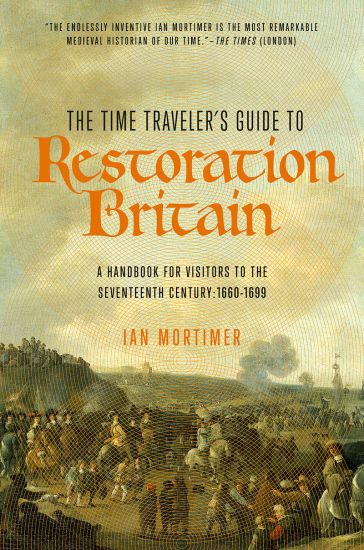
The Time Traveler's Guide to Restoration Britain
Imagine you could see the smiles of the people mentioned in Samuel Pepys's diary, hear the shouts of market traders, and touch their wares. How would you find your way around? Where would you stay? What would you wear? Where might you be suspected of witchcraft? Where would you be welcome? This is an up-close-and-personal look at Britain between the Restoration of King Charles II in 1660 and the end of the century. The last witch is sentenced to death just two years before Isaac Newton's Principia Mathematica, the bedrock of modern science, is published. Religion still has a severe grip on society and yet some--including the king--flout every moral convention they can find. There are great fires in London and Edinburgh; the plague disappears; a global trading empire develops.Over these four dynamic decades, the last vestiges of medievalism are swept away and replaced by a tremendous cultural flowering. Why are half the people you meet under the age of twenty-one? What is considered rude? And why is dueling so popular? Mortimer delves into the nuances of daily life to paint a vibrant and detailed picture of society at the dawn of the modern world as only he can.
The Time Traveller's Guide to Regency Britain
'Excellent... Mortimer's erudition is formidable' The TimesA time of exuberance, thrills, frills and unchecked bad behaviour...Ian Mortimer turns to what is arguably the most-loved period in British history - the Regency, or Georgian England.This is the age of Jane Austen and the Romantic poets; the paintings of John Constable and the gardens of Humphry Repton; Britain's military triumphs at Trafalgar and Waterloo. It was perhaps the last age of true freedom before the arrival of the stifling world of Victorian morality.And like all periods in history, it was an age of many contradictions - where Beethoven's thundering Fifth Symphony could premier in the same year that saw Jane Austen craft the delicate sensitivities of Persuasion.This is history at its most exciting, physical, visceral - the past not as something to be studied but as lived experience. This is Ian Mortimer at the height of his time-travelling prowess.'Ian Mortimer has made this kind of imaginative time travel his speciality' Daily Mail
Why Running Matters

Why Running Matters

Ian Mortimer

Summersdale Publishers
2019
nidottu
You might run for fitness. You might run for speed. But ultimately, running is about much more than the physical act itself. It is about the challenges we face in life, and how we measure up to them. It is about companionship, endurance, ambition, hope, conviction, determination, self-respect and inspiration. It is about how we choose to live our lives, and what it means to share our values with other people.In this year-long memoir, which might be described as a historian's take on Haruki Murakami's What I Talk About When I Talk About Running, the celebrated historian Ian Mortimer considers the meaning of running as he approaches his fiftieth birthday. From injuries and frustrated ambitions to exhilaration and empathy, it is a personal and yet universal account of what running means to people, and how it helps everyone focus on what really matters.
Fears of Henry IV

Fears of Henry IV

Ian Mortimer

Vintage
2008
pokkari
In June 1405, King Henry IV stopped at a small Yorkshire manor house to shelter from a storm. In 1399, at the age of thirty-two, he was enthusiastically greeted as the saviour of the realm when he ousted from power the insecure and tyrannical King Richard II. But therein lay Henry's weakness.