Kirjojen hintavertailu. Mukana 11 244 527 kirjaa ja 12 kauppaa.

Kirjahaku

Etsi kirjoja tekijän nimen, kirjan nimen tai ISBN:n perusteella.

4 kirjaa tekijältä Ian Mueller

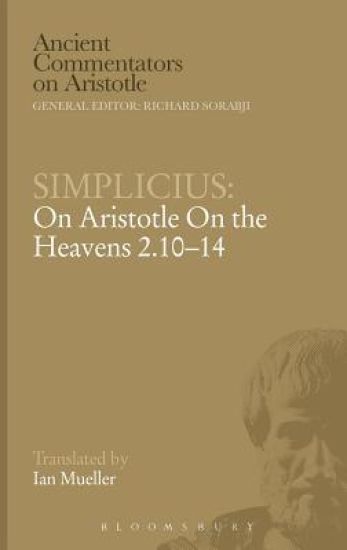
Simplicius Aristotle Heavens

Simplicius Aristotle Heavens

Ian Mueller

Bristol Classical Press
2005
sidottu
Aristotle believed that the outermost stars are carried round us on a transparent sphere. There are directions in the universe and a preferred direction of rotation. The sun moon and planets are carried on different revolving spheres. The spheres and celestial bodies are composed of an everlasting fifth element, which has none of the ordinary contrary properties like heat and cold which could destroy it, but only the facility for uniform rotation. But this creates problems as to how the heavenly bodies create light, and, in the case of the sun, heat. The topics covered in this part of Simplicius' commentary are the speeds and distances of the stars; that the stars are spherical; why the sun and moon have fewer motions than the other five planets; why the sphere of the fixed stars contains so many stars whereas the other heavenly spheres contain no more than one (Simplicius has a long excursus on planetary theory in his commentary on this chapter); discussion of people's views on the position, motion or rest, shape, and size of the earth; that the earth is a relatively small sphere at rest in the centre of the cosmos.
Alexander Aphrodisias Analytics

Alexander Aphrodisias Analytics

Ian Mueller

Bristol Classical Press
2006
sidottu
Until the launch of this series over fifteen years ago, the 15,000 volumes of the ancient Greek commentators on Aristotle, written mainly between 200 and 600 AD, constituted the largest corpus of extant Greek philosophical writings not translated into English or other European languages. Over 40 volumes have now appeared in the series, which is planned in some 80 volumes altogether. In the second half of book 1 of the "Prior Analytics", Aristotle reflects on the application of the formalized logic he has developed in the first half, focusing particularly on the non-modal or assertoric syllogistic developed in the first seven chapters. These reflections lead Alexander of Aphrodisias, the great late second-century AD exponent of Aristotelianism, to explain and sometimes argue against subsequent developments of Aristotle's logic and alternatives and objections to it, ideas associated mainly with his colleague Theophrastus and with the Stoics. The other main topic of this part of the "Prior Analytics" is the specification of a method for discovering true premises needed to prove a given proposition. Aristotle's presentation is sometimes difficult to follow, and Alexander's discussion is extremely helpful to the uninitiated reader. In his commentary on the final chapter translated in this volume, Alexander provides an insightful account of Aristotle's criticism of Plato's method of division.
Alexander of  Aphrodisias

Alexander of Aphrodisias

Ian Mueller

Bristol Classical Press
2006
sidottu
Until the launch of this series over fifteen years ago, the 15,000 volumes of the ancient Greek commentators on Aristotle, written mainly between 200 and 600 AD, constituted the largest corpus of extant Greek philosophical writings not translated into English or other European languages. Over 40 volumes have now appeared in the series, which is planned in some 80 volumes altogether. The last 14 chapters of book 1 of Aristotle's "Prior Analytics" are concerned with the representation in the formal language of syllogistic of propositions and arguments expressed in more or less everyday Greek. In his commentary on those chapters, "Alexander of Aphrodisias" explains some of Aristotle's more opaque assertions and discusses post-Aristotelian ideas in semantics and the philosophy of language. In doing so he provides an unusual insight into the way in which these disciplines developed in the Hellenistic era. He also shows a more sophisticated understanding of these fields than Aristotle himself, while remaining a staunch defender of Aristotle's emphasis on meaning as opposed to Stoics concern with verbal formulation. In his commentary on the final chapter of book 1 Alexander offers a thorough discussion of Aristotle's distinction between denying that something is, e.g., white and asserting that it is non-white.
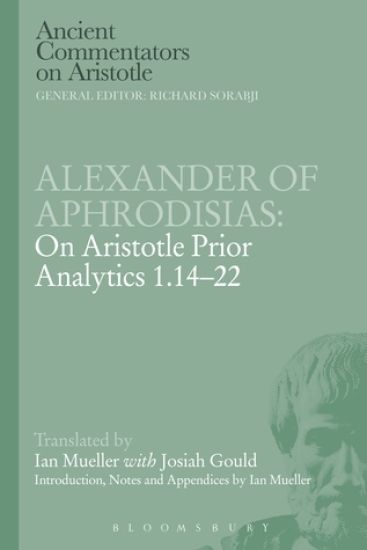
Alexander of Aphrodisias: On Aristotle Prior Analytics 1.14-22
The commentary of Alexander of Aphrodisias on Aristotle's Prior Analytics 1.8-22 is a very important text, being the main ancient commentary with chapters in which Aristotle invented modal logic - the logic of propositions about what is necessary or contingent (possible). The first volume of Ian Mueller's translation covered chapters 1.8-13, and reached as far as the chapter in which Aristotle discussed the notion of contingency. In this, the second volume, the 'greatest' commentator, Alexander, concludes his discussion of Aristotle's modal logic. Aristotle also invented the syllogism, a style of argument involving two premises and a conclusion. Modal propositions can be deployed in syllogisms, and in the chapters included in this volume Aristotle discusses all the syllogisms containing at least one contingent premiss. In each volume, Ian Mueller provides a comprehensive explanation of Alexander's commentary on modal logic as a whole.