Kirjojen hintavertailu. Mukana 12 405 607 kirjaa ja 12 kauppaa.

Kirjahaku

Etsi kirjoja tekijän nimen, kirjan nimen tai ISBN:n perusteella.

38 kirjaa tekijältä Ian Parker

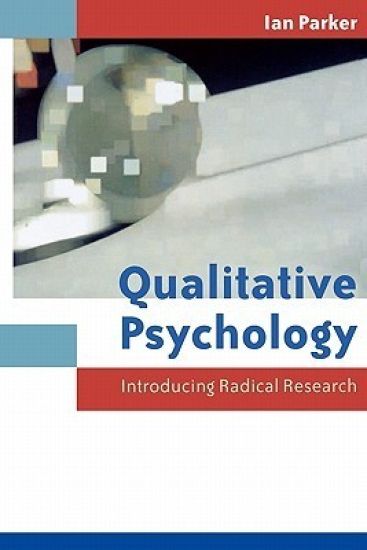
Qualitative Psychology

Qualitative Psychology

Ian Parker

Open University Press
2004
nidottu
“An introduction to the varieties of qualitative research in psychology is long overdue, and Parker’s book should with its broad scope, accessible style, and controversial viewpoints on trends of the current qualitative wave, have a wide audience.” Steinar Kvale, Aarhus University, Denmark“This is a wonderful, insightful and necessary book…It takes students through this complex terrain in a clear, readable and yet challenging way.”Bronwyn Davies, University of Western Sydney, Australia“This book makes important contributions to theoretical, political and methodological debates on qualitative and action oriented research.”Bernardo Jiménez-Domínguez, Universidad de Guadalajara, Mexico"For me personally, the book worked very well, I very much appreciated the fact that the book went beyond a presentation of 'the state of the art', and that it offered new ideas and suggestions about how to take qualitative research further."Qualitative Research in PsychologyThis book is designed as a practical guide for students that is also grounded in the latest developments in theory in psychology. Readers are introduced to theoretical approaches to ethnography, interviewing, narrative, discourse and psychoanalysis, with each chapter on these approaches including worked examples clearly structured around methodological stages. A case is made for new practical procedures that encourage students to question the limits of mainstream psychological research methods. Resource links guide students to theoretical debates and to ways of making these debates relevant to a psychology genuinely concerned with critical reflection and social change. The book includes numerous boxes that clearly outline:Key issues in the development, application and assessment of qualitative research methodsCurrent debates and problems with particular qualitative methods taught in psychology Summaries of methodological stages and points to be aware of in the marking of practical reports in relation to specific methodsCoverage of ethical issues, reflexivity and good report writingQualitative Psychology is essential reading for students of psychology and other related social sciences who want a polemical account that will also serve as a well-balanced and rigorous introduction to current debates in qualitative psychology.

Psychoanalysis, Clinic and Context
Psychoanalysis is a strange and mysterious practice. In his new book, Ian Parker offers insights into his own experiences, first as trainee then as analyst, the common assumptions about psychoanalysis which can be so misleading, as well as a map of the key debates in the field today. Beginning with his own history, at first avoiding psychoanalysis before training as a Lacanian, Parker moves on to explore the wider historical development of clinical practice, making an argument for the importance of language, culture and history in this process. The book offers commentary on the key schools of thought, and how they manifest in the practice of psychoanalysis in different regions around the world.Psychoanalysis, Clinic and Context will be of great value to practitioners and social theorists who want to know how psychoanalytic ideas play out in training and the clinic, for trainees and students of psychoanalysis or psychoanalytic psychotherapy, and for the general reader who wants to know what psychoanalysis is and how it works.
Psychoanalysis, Clinic and Context
Psychoanalysis is a strange and mysterious practice. In his new book, Ian Parker offers insights into his own experiences, first as trainee then as analyst, the common assumptions about psychoanalysis which can be so misleading, as well as a map of the key debates in the field today. Beginning with his own history, at first avoiding psychoanalysis before training as a Lacanian, Parker moves on to explore the wider historical development of clinical practice, making an argument for the importance of language, culture and history in this process. The book offers commentary on the key schools of thought, and how they manifest in the practice of psychoanalysis in different regions around the world.Psychoanalysis, Clinic and Context will be of great value to practitioners and social theorists who want to know how psychoanalytic ideas play out in training and the clinic, for trainees and students of psychoanalysis or psychoanalytic psychotherapy, and for the general reader who wants to know what psychoanalysis is and how it works.
Psychology through Critical Auto-Ethnography
This unique book is an insider account about the discipline of psychology and its limits, introducing key debates in the field of psychology around the world today by closely examining the problematic role the discipline plays as a global phenomenon.Ian Parker traces the development of ‘critical psychology’ through an auto-ethnographic narrative in which the author is implicated in what he describes, laying bare the nature of contemporary psychology. In five parts, each comprising four chapters, the book explores the student experience, the world of psychological research, how psychology is taught, how alternative critical movements have emerged inside the discipline, and the role of psychology in coercive management practices. Providing a detailed account of how psychology actually operates as an academic discipline, it shows what teaching in higher education and immersion in research communities around the world looks like, and it culminates in an analytic description of institutional crises which psychology provokes. A reflexive history of psychology’s recent past as a discipline and as a cultural force, this book is an invaluable resource for anyone thinking of taking up a career in psychology, and for those reflecting critically on the role the discipline plays in people’s lives.
Psychology through Critical Auto-Ethnography
This unique book is an insider account about the discipline of psychology and its limits, introducing key debates in the field of psychology around the world today by closely examining the problematic role the discipline plays as a global phenomenon.Ian Parker traces the development of ‘critical psychology’ through an auto-ethnographic narrative in which the author is implicated in what he describes, laying bare the nature of contemporary psychology. In five parts, each comprising four chapters, the book explores the student experience, the world of psychological research, how psychology is taught, how alternative critical movements have emerged inside the discipline, and the role of psychology in coercive management practices. Providing a detailed account of how psychology actually operates as an academic discipline, it shows what teaching in higher education and immersion in research communities around the world looks like, and it culminates in an analytic description of institutional crises which psychology provokes. A reflexive history of psychology’s recent past as a discipline and as a cultural force, this book is an invaluable resource for anyone thinking of taking up a career in psychology, and for those reflecting critically on the role the discipline plays in people’s lives.
Lacanian Psychoanalysis

Lacanian Psychoanalysis

Ian Parker

Routledge
2010
nidottu
Jacques Lacan's impact upon the theory and practice of psychoanalysis worldwide cannot be underestimated. Lacanian Psychoanalysis looks at the current debates surrounding Lacanian practice and explores its place within historical, social and political contexts. The book argues that Lacan’s elaboration of psychoanalytic theory is grounded in clinical practice and needs to be defined in relation to the four main traditions: psychiatry, psychology, psychotherapy and spirituality. As such topics of discussion include: the intersection between psychoanalysis and social transformationa new way through deadlocks of current Lacanian debatea new approach to ‘clinical structures’ of neurosis, perversion and psychosis Lacanian Psychoanalysis draws on Lacan's work to shed light on issues relevant to current therapeutic practice and as such it will be of great interest to students, trainees and practitioners of psychoanalysis, psychotherapy, counselling and other domains of personal and social change.
Discourse Dynamics (Psychology Revivals)
What are discourses? Are discourses ‘real’, and what is real outside language?In this book, originally published in 1992, Ian Parker provides one of the clearest and most systematic introductions to discourse research and the essential theoretical debates in the area. At the time it was one of the few texts to defend a realist position, discuss accounts of postmodernity and set out criteria for the identification of discourses.Discourse Dynamics is essential reading to anyone interested in project research and an understanding of the theoretical issues involved in discourse analysis. The book will also be of use to students other than those studying psychology. It addresses the concerns of all those looking at qualitative textual research in the human sciences and is still very much relevant today.
Discourse Dynamics (Psychology Revivals)
What are discourses? Are discourses ‘real’, and what is real outside language?Originally published in 1992, Ian Parker provides one of the clearest and most systematic introductions to discourse research and the essential theoretical debates in the area. At the time it was one of the few texts to defend a realist position, discuss accounts of postmodernity and set out criteria for the identification of discourses.Discourse Dynamics is essential reading to anyone interested in project research and an understanding of the theoretical issues involved in discourse analysis. The book will also be of use to students other than those studying psychology. It addresses the concerns of all those looking at qualitative textual research in the human sciences and is still very much relevant today.
The Crisis in Modern Social Psychology (Psychology Revivals)
In the late 1960s a ‘crisis’ erupted in social psychology, with many social psychologists highly critical of the ‘old paradigm’, laboratory-experimental approach. Originally published in 1989, The Crisis in Modern Social Psychology was the first book to provide a clear account of the complex body of work that is critical of traditional social psychological approaches. Ian Parker insisted that the ‘crisis’ was not over, showing how attempts to improve social psychology had failed, and explaining why we need instead a political understanding of social interaction which links research with change.Modern social psychology reflects the impact of structuralist and post-structuralist conceptual crises in other academic disciplines, and Parker describes the work of Foucault and Derrida sympathetically and lucidly, making these important debates accessible to the student and discussing their influence. He assesses the responses from both mainstream social psychology and from avant-garde textual social psychology to the influx of these radical ideas, and discusses the promises and pitfalls of a post-modern view of social action.
The Crisis in Modern Social Psychology (Psychology Revivals)
In the late 1960s a ‘crisis’ erupted in social psychology, with many social psychologists highly critical of the ‘old paradigm’, laboratory-experimental approach. Originally published in 1989 The Crisis in Modern Social Psychology was the first book to provide a clear account of the complex body of work that is critical of traditional social psychological approaches. Ian Parker insisted that the ‘crisis’ was not over, showing how attempts to improve social psychology had failed, and explaining why we need instead a political understanding of social interaction which links research with change.Modern social psychology reflects the impact of structuralist and post-structuralist conceptual crises in other academic disciplines, and Parker describes the work of Foucault and Derrida sympathetically and lucidly, making these important debates accessible to the student and discussing their influence. He assesses the responses from both mainstream social psychology and from avant-garde textual social psychology to the influx of these radical ideas, and discusses the promises and pitfalls of a post-modern view of social action.
Slavoj Zizek

Slavoj Zizek

Ian Parker

Pluto Press
2004
pokkari
'When I read Ian Parker's manuscript, I experienced an underlying solidarity: despite obvious differences, we share the same basic political concerns and visions. And this makes his critical remarks always pertinent!' Slavoj Zizek 'This is not simply the best critical introduction to Zizek – in a much more radical sense, this is the only critical introduction to Zizek. Parker's study is much more than an important contribution to the ongoing debate: it redefines its very terms.' Yannis Stavrakakis, author of 'Lacan and the Political' 'A sharp, clear and radical analysis.' Christian Ingo Lenz Dunker, Professor of Psychoanalytic Theory and Lacanian Psychoanalyst, Sao Paulo, Brazil. Since the publication of his first book in English in 1989, Slavoj Zizek has quickly become one of the most widely read and contentious intellectuals alive today. With dazzling wit and tremendous creativity he has produced innovative and challenging explorations of Lacan, Hegel and Marx, and used his insights to exhilarating effect in analyses of popular culture. While Zizek is always engaging, he is also elusive and even contradictory. It can be very hard to finally determine where he stands on a particular issue. Is Zizek Marxist or Post-Marxist? How seriously should we take his recent turn to Christianity? Slavoj Zizek: A Critical Introduction shows the reader a clear path through the twists and turns of Zizek's writings. Ian Parker takes Zizek's treatment of Hegel, Lacan and Marx in turn and outlines and assesses Zizek's interpretation and extension of these thinkers' theories. While Parker is never hastily dismissive of Zizek's innovations, he remains critical throughout, aware that the energy of Zizek's writing can be bewitching and beguiling as well as engaging and profound.
Revolution in Psychology

Revolution in Psychology

Ian Parker

Pluto Press
2007
pokkari
"A radical methodological approach to psychology that is open to social change - in an anti-capitalist, anti-racist and feminist politics." Antonio Negri Psychology is meant to help people cope with the afflictions of modern society. But how useful is it? Ian Parker argues that current psychological practice has become part of the problem, rather than the solution. Ideal for undergraduates, this book deconstructs the discipline to reveal the neoliberal sensitivities that underlie its theory and practice. Psychology focuses on the happiness of 'the individual'. Yet it neglects the fact that the happiness of the individual depends on their social and political surroundings. Ian Parker argues that a new approach to psychology is needed. He offers an alternative vision, outlining how the discipline can be linked to political practice and how it can help people as part of a wider progressive agenda. This groundbreaking book is at the cutting edge of current thinking on the discipline and should be required reading on all psychology courses.
Psychoanalytic Mythologies

Psychoanalytic Mythologies

Ian Parker

Anthem Press
2011
nidottu
‘Psychoanalytic Mythologies’ presents a collection of essays on the theme of what it is to be a human subject in a culture permeated by psychoanalytic imagery. The author’s attempt to disturb the strongly-held belief of those in thrall to psychoanalysis that it is universally true forms the recurrent motif that binds these essays together.
Mapping the English left through film
Ian Parker's Mapping the English Left through Film: Twenty Five Uneasy Pieces is a block-buster of a book, mercilessly unpicking the cinematic narratives that infuse twenty-five organisations. Key elements of plot and production are used to tell the story of purges and splits and cult-favourites in this innovative history of Trotskyist groups in England. This is the place where revolutionary Marxism goes to the movies.
Revolutionary Keywords for a New Left

Revolutionary Keywords for a New Left

Ian Parker

John Hunt Publishing
2017
nidottu
Revolutionary Keywords for a New Left comprises short essays on fifty revolutionary keywords, each word being put to work on a contemporary political issue. With keywords ranging from academicisation to neoliberalism, from postcolonial to Zionism and with subjects including, Badiou, North Korea, sexual violence and Zizek, the book concludes with an essay mapping the development of progressive keywords before our century of revolution, which began in 1917, keywords that emerged in the fifty years of struggle between 1917 and 1967, and revolutionary keywords for the new left today.
Psy–Complex in Question – Critical Review in Psychology, Psychoanalysis and Social Theory
Psy-Complex in Question traces a series of key debates in and against the psy-complex through critical reviews of twenty-five key texts over the last twenty-five years, with an emphasis on recent critical psychological, psychoanalytic and critical social theory contributions to how we think about human agency and subjectivity. The reviews together set out the unfolding context for the debate, and situate the texts under discussion in the cross-cutting debates that define critical psychology today. It also provides an accessible introduction to how psychoanalysis and social theory, with a particular focus on the work of Jacques Lacan and Slavoj Zizek, bears upon work carried out by a new generation of researchers. Ian Parker's book is written from the perspective of a critical insider to the discipline of psychology, psychoanalysis and social theory, and it will serve as a primer for those new to the ideas searching for compass points and radical arguments, as well as examples of how to write and how not to write a book review.
Psychoanalytic Mythologies

Psychoanalytic Mythologies

Ian Parker

Anthem Press
2009
sidottu
‘Psychoanalytic Mythologies’ presents a collection of essays on the theme of what it is to be a human subject in a culture permeated by psychoanalytic imagery. The author’s attempt to disturb the strongly-held belief of those in thrall to psychoanalysis that it is universally true forms the recurrent motif that binds these essays together.