Kirjojen hintavertailu. Mukana 11 244 527 kirjaa ja 12 kauppaa.

Kirjahaku

Etsi kirjoja tekijän nimen, kirjan nimen tai ISBN:n perusteella.

68 kirjaa tekijältä Ian Stewart

Professor Stewart's Cabinet of Mathematical Curiosities
Knowing that the most exciting math is not taught in school, Professor Ian Stewart has spent years filling his cabinet with intriguing mathematical games, puzzles, stories, and factoids intended for the adventurous mind. This book reveals the most exhilarating oddities from Professor Stewart's legendary cabinet. Inside, you will find hidden gems of logic, geometry, and probability--like how to extract a cherry from a cocktail glass (harder than you think), a pop-up dodecahedron, and the real reason why you can't divide anything by zero. Scattered among these are keys to Fermat's last theorem, the Poincare conjecture, chaos theory, and the P=NP problem (you'll win a million dollars if you solve it). You never know what enigmas you'll find in the Stewart cabinet, but they're sure to be clever, mind-expanding, and delightfully fun.
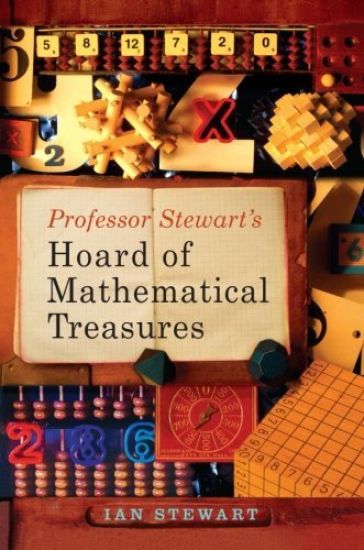
Professor Stewart's Hoard of Mathematical Treasures
Opening another drawer in his Cabinet of Curiosities, renowned mathematics professor Ian Stewart presents a new medley of games, paradoxes, and riddles in Professor Stewart's Hoard of Mathematical Treasures . With wit and aplomb, Stewart mingles casual puzzles with grander forays into ancient and modern mathematical thought. Amongst a host of arcane and astonishing facts about every kind of number from irrational and imaginary to complex and cuneiform, we learn: - How to organize chaos - How matter balances anti-matter - How to turn a sphere inside out (without creasing it) - How to calculate pi by observing the stars - ...and why you can't comb a hairy ball. Along the way Stewart offers the reader tantalizing glimpses of the mathematics underlying life and the universe. Mind-stretching, enlightening, and endlessly amusing, Professor Stewart's Hoard of Mathematical Treasures will stimulate, delight, and enthrall.
Professor Stewart's Incredible Numbers
Renowned mathematician Ian Stewart uses remarkable (and some unremarkable) numbers to introduce readers to the beauty of mathematics. At its heart, mathematics is about numbers, our fundamental tools for understanding the world. In Professor Stewart's Incredible Numbers, Ian Stewart offers a delightful introduction to the numbers that surround us, from the common (Pi and 2) to the uncommon but no less consequential (1.059463 and 43,252,003,274,489,856,000). Along the way, Stewart takes us through prime numbers, cubic equations, the concept of zero, the possible positions on the Rubik's Cube, the role of numbers in human history, and beyond An unfailingly genial guide, Stewart brings his characteristic wit and erudition to bear on these incredible numbers, offering an engaging primer on the principles and power of math.
Professor Stewart's Incredible Numbers

Professor Stewart's Incredible Numbers

Ian Stewart

Profile Books Ltd
2016
pokkari
Ian Stewart explores the astonishing properties of numbers from 1 to10 to zero and infinity, including one figure that, if you wrote it out, would span the universe. He looks at every kind of number you can think of -- real, imaginary, rational, irrational, positive and negative -- along with several you might have thought you couldn't think of. He explains the insights of the ancient mathematicians, shows how numbers have evolved through the ages, and reveals the way numerical theory enables everyday life. Under Professor Stewart's guidance you will discover the mathematics of codes, Sudoku, Rubik's cube, music, primes and pi. You may be surprised to find you live in eleven-dimensional space, that of the twenty-three people on a football pitch two are more likely than not to share the same birthday, and that forty-two is a very interesting number. Professor Stewart's Incredible Numbers will delight everyone who loves numbers -- including those who currently think they don't.
Professor Stewart's Cabinet of Mathematical Curiosities
School maths is not the interesting part. The real fun is elsewhere. Like a magpie, Ian Stewart has collected the most enlightening, entertaining and vexing 'curiosities' of maths over the years... Now, the private collection is displayed in his cabinet. There are some hidden gems of logic, geometry and probability -- like how to extract a cherry from a cocktail glass (harder than you think), a pop up dodecahedron, the real reason why you can't divide anything by zero and some tips for making money by proving the obvious. Scattered among these are keys to unlocking the mysteries of Fermat's last theorem, the Poincaré Conjecture, chaos theory, and the P/NP problem for which a million dollar prize is on offer. There are beguiling secrets about familiar names like Pythagoras or prime numbers, as well as anecdotes about great mathematicians. Pull out the drawers of the Professor's cabinet and who knows what could happen...
Professor Stewart's Hoard of Mathematical Treasures
Ian Stewart, author of the bestselling Professor Stewart's Cabinet of Mathematical Curiosities, presents a new and magical mix of games, puzzles, paradoxes, brainteasers, and riddles. He mingles these with forays into ancient and modern mathematical thought, appallingly hilarious mathematical jokes, and enquiries into the great mathematical challenges of the present and past. Amongst a host of arcane and astonishing facts about every kind of number from irrational or imaginary to complex or cuneiform, we find out: how to organise chaos; how matter balances anti-matter; how to turn a sphere inside out (without creasing it...); why you can't comb a hairy ball; how to calculate pi by observing the stars. And we get some tantalising glimpses of the maths of life and the universe.Mind-stretching, enlightening and endlessly amusing, Professor Stewart's new entertainment will stimulate, delight, and enthral.
Professor Stewart's Casebook of Mathematical Mysteries
Like its wildly popular predecessors Cabinet of Mathematical Curiosities and Hoard of Mathematical Treasures, Professor Stewart's brand-new book is a miscellany of over 150 mathematical curios and conundrums, packed with trademark humour and numerous illustrations.In addition to the fascinating formulae and thrilling theorems familiar to Professor Stewart's fans, the Casebook follows the adventures of the not-so-great detective Hemlock Soames and his sidekick Dr John Watsup (immortalised in the phrase 'Watsup, Doc?'). By a remarkable coincidence they live at 222B Baker Street, just across the road from their more illustrious neighbour who, for reasons known only to Dr Watsup, is never mentioned by name. A typical item is 'The Case of the Face-Down Aces', a mathematical magic trick of quite devilish cunning... Ranging from one-liners to four-page investigations from the frontiers of mathematical research, the Casebook reveals Professor Stewart at his challenging and entertaining best.
Professor Stewart's Casebook of Mathematical Mysteries
In Professor Stewart's Casebook of Mathematical Mysteries , acclaimed mathematician Ian Stewart presents an enticing collection of mathematical curios and conundrums. With a new puzzle on each page, this compendium of brainteasers will both teach and delight. Guided by stalwart detective Hemlock Soames and his sidekick, Dr. John Watsup, readers will delve into almost two hundred mathematical problems, puzzles, and facts. Tackling subjects from mathematical dates (such as Pi Day), what we don't know about primes, and why the Earth is round, this clever, mind-expanding book demonstrates the power and fun inherent in mathematics.
Does God Play Dice?

Does God Play Dice?

Ian Stewart

Penguin Books Ltd
1997
pokkari
Since the dramatic discovery of the mathematical concept of chaos in 1989, the controversy of its contents has settled down. This revised edition of Does God Play Dice? takes a fresh look at its achievements and potential. With a new preface and three completely new chapters, it includes the latest practical applications of chaos theory, such as developing intelligent heart pacemakers. All this provides a fascinating new answer to Einstien's question which provided the title of this book.
From Here to Infinity

From Here to Infinity

Ian Stewart

Oxford University Press
1996
nidottu
A retitled and revised edition of Ian Stewart's The Problem of Mathematics, this is the perfect guide to today's mathematics. Read about the latest discoveries, including Andrew Wile's amazing proof of Fermat's Last Theorem, the newest advances in knot theory, the Four Colour Theorem, Chaos Theory, and fake four-dimensial spaces. See how simple concepts from probability theory shed light on the National Lottery and tell you how to maximize your winnings. Discover how infinitesimals become respectable, why there are different kinds of infinity, and how to square the circle with the mathematical equivalent of a pair of scissors.
Math Hysteria

Math Hysteria

Ian Stewart

Oxford University Press
2004
nidottu
Welcome to Ian Stewart's strange and magical world of mathematics! In Math Hysteria, Professor Stewart presents us with a wealth of magical puzzles, each one spun around an amazing tale: Counting the Cattle of the Sun; The Great Drain Robbery; and Preposterous Piratical Predicaments; to name but a few. Along the way, we also meet many curious characters: in short, these stories are engaging, challenging, and lots of fun!
Infinity

Infinity

Ian Stewart

Oxford University Press
2017
nidottu
Infinity is an intriguing topic, with connections to religion, philosophy, metaphysics, logic, and physics as well as mathematics. Its history goes back to ancient times, with especially important contributions from Euclid, Aristotle, Eudoxus, and Archimedes. The infinitely large (infinite) is intimately related to the infinitely small (infinitesimal). Cosmologists consider sweeping questions about whether space and time are infinite. Philosophers and mathematicians ranging from Zeno to Russell have posed numerous paradoxes about infinity and infinitesimals. Many vital areas of mathematics rest upon some version of infinity. The most obvious, and the first context in which major new techniques depended on formulating infinite processes, is calculus. But there are many others, for example Fourier analysis and fractals. In this Very Short Introduction, Ian Stewart discusses infinity in mathematics while also drawing in the various other aspects of infinity and explaining some of the major problems and insights arising from this concept. He argues that working with infinity is not just an abstract, intellectual exercise but that it is instead a concept with important practical everyday applications, and considers how mathematicians use infinity and infinitesimals to answer questions or supply techniques that do not appear to involve the infinite. ABOUT THE SERIES: The Very Short Introductions series from Oxford University Press contains hundreds of titles in almost every subject area. These pocket-sized books are the perfect way to get ahead in a new subject quickly. Our expert authors combine facts, analysis, perspective, new ideas, and enthusiasm to make interesting and challenging topics highly readable.
How to Cut a Cake

How to Cut a Cake

Ian Stewart

Oxford University Press
2006
nidottu
Welcome back to Ian Stewart's magical world of mathematics! This is a strange world of never-ending chess games, empires on the moon, furious fireflies, and, of course, disputes over how best to cut a cake. Each quirky tale presents a fascinating mathematical puzzle -- challenging, fun, and also introducing the reader to a significant mathematical problem in an engaging and witty way.
Symmetry

Symmetry

Ian Stewart

Oxford University Press
2013
nidottu
In the 1800s mathematicians introduced a formal theory of symmetry: group theory. Now a branch of abstract algebra, this subject first arose in the theory of equations. Symmetry is an immensely important concept in mathematics and throughout the sciences, and its applications range across the entire subject. Symmetry governs the structure of crystals, innumerable types of pattern formation, how systems change their state as parameters vary; and fundamental physics is governed by symmetries in the laws of nature. It is highly visual, with applications that include animal markings, locomotion, evolutionary biology, elastic buckling, waves, the shape of the Earth, and the form of galaxies. In this Very Short Introduction, Ian Stewart demonstrates its deep implications, and shows how it plays a major role in the current search to unify relativity and quantum theory. ABOUT THE SERIES: The Very Short Introductions series from Oxford University Press contains hundreds of titles in almost every subject area. These pocket-sized books are the perfect way to get ahead in a new subject quickly. Our expert authors combine facts, analysis, perspective, new ideas, and enthusiasm to make interesting and challenging topics highly readable.
The Annotated Flatland

The Annotated Flatland

Ian Stewart

Basic Books
2008
pokkari
Flatland is a unique, delightful satire that has charmed readers for over a century. Published in 1884 by the English clergyman and headmaster Edwin A. Abbott, it is the fanciful tale of A. Square, a two-dimensional being who is whisked away by a mysterious visitor to The Land of Three Dimensions, an experience that forever alters his worldview. Like the original, Ian Stewart's commentary takes readers on a strange and wonderful journey. With clarity and wit, Stewart illuminates Abbott's numerous Victorian references and touches on such diverse topics as ancient Babylon, Karl Marx, Mary Shelley's Frankenstein , Mt. Everest, H.G. Wells, and phrenology. The Annotated Flatland makes fascinating connections between Flatland and Abbott's era, resulting in a classic to rival Abbott's own, and a book that will inspire and delight curious readers for generations to come.
The Mathematics of Life

The Mathematics of Life

Ian Stewart

BASIC BOOKS
2013
nidottu
Biologists have long dismissed mathematics as being unable to meaningfully contribute to our understanding of living beings. Within the past ten years, however, mathematicians have proven that they hold the key to unlocking the mysteries of our world -- and ourselves. In The Mathematics of Life, Ian Stewart provides a fascinating overview of the vital but little-recognized role mathematics has played in pulling back the curtain on the hidden complexities of the natural world -- and how its contribution will be even more vital in the years ahead. In his characteristically clear and entertaining fashion, Stewart explains how mathematicians and biologists have come to work together on some of the most difficult scientific problems that the human race has ever tackled, including the nature and origin of life itself.
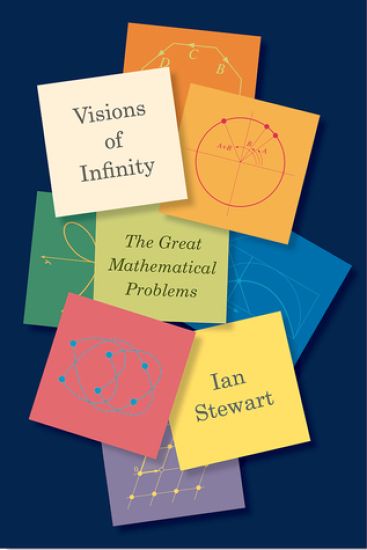
Visions of Infinity: The Great Mathematical Problems
It is one of the wonders of mathematics that, for every problem mathematicians solve, another awaits to perplex and galvanize them. Some of these problems are new, while others have puzzled and bewitched thinkers across the ages. Such challenges offer a tantalizing glimpse of the field's unlimited potential, and keep mathematicians looking toward the horizons of intellectual possibility. In Visions of Infinity, celebrated mathematician Ian Stewart provides a fascinating overview of the most formidable problems mathematicians have vanquished, and those that vex them still. He explains why these problems exist, what drives mathematicians to solve them, and why their efforts matter in the context of science as a whole. The three-century effort to prove Fermat's last theorem -- first posited in 1630, and finally solved by Andrew Wiles in 1995 -- led to the creation of algebraic number theory and complex analysis. The Poincare conjecture, which was cracked in 2002 by the eccentric genius Grigori Perelman, has become fundamental to mathematicians' understanding of three-dimensional shapes. But while mathematicians have made enormous advances in recent years, some problems continue to baffle us. Indeed, the Riemann hypothesis, which Stewart refers to as the "Holy Grail of pure mathematics," and the P/NP problem, which straddles mathematics and computer science, could easily remain unproved for another hundred years. An approachable and illuminating history of mathematics as told through fourteen of its greatest problems, Visions of Infinity reveals how mathematicians the world over are rising to the challenges set by their predecessors -- and how the enigmas of the past inevitably surrender to the powerful techniques of the present.
Nature's Numbers

Nature's Numbers

Ian Stewart

Basic Books
1997
pokkari
"It appears to us that the universe is structured in a deeply mathematical way. Falling bodies fall with predictable accelerations. Eclipses can be accurately forecast centuries in advance. Nuclear power plants generate electricity according to well-known formulas. But those examples are the tip of the iceberg. In Nature's Numbers , Ian Stewart presents many more, each charming in its own way.. Stewart admirably captures compelling and accessible mathematical ideas along with the pleasure of thinking of them. He writes with clarity and precision. Those who enjoy this sort of thing will love this book."- Los Angeles Times
Letters to a Young Mathematician

Letters to a Young Mathematician

Ian Stewart

Basic Books
2007
pokkari
Mathematician Ian Stewart tells readers what he wishes he had known when he was a student. He takes up subjects ranging from the philosophical to the practical-what mathematics is and why it's worth doing, the relationship between logic and proof, the role of beauty in mathematical thinking, the future of mathematics, how to deal with the peculiarities of the mathematical community, and many others.