Kirjojen hintavertailu. Mukana 11 342 296 kirjaa ja 12 kauppaa.

Kirjahaku

Etsi kirjoja tekijän nimen, kirjan nimen tai ISBN:n perusteella.

11 kirjaa tekijältä Ian Tattersall

Becoming Human: Evolution and Human Uniqueness
In Becoming Human, noted anthropologist and renaissance man Ian Tattersall explores what makes us uniquely human, the qualities that set us apart from our ancestors, and the significance of our knowledge. A worldwide tour of discovery, Tattersall takes the reader from 30,000-year-old cave paintings in France and anthropological digs in Africa, to examining human behavior in a New York restaurant. And by offering wisdom gleaned from fossil remains, primate behavior, prehistoric art, and archaeology, Tattersall presents a stunning picture of where humankind evolved, how Darwin's theories have changed, and what we reliably know about modern-day human's capacity for love, language, and thought. Widely praised in the media, and an Amazon.com Top-10 bestseller, Becoming Human is an amazing trip into the past and into the future.
Becoming Human

Becoming Human

Ian Tattersall

Oxford University Press
2000
nidottu
One of the traits that distinguishes us from our nearest relatives is our curiosity about the origins of our species. In this new paperback, Ian Tattersall (author of The Fossil Trail) discusses human uniqueness, investigating the origins of those characteristics and processes that so clearly distinguish human beings, such as creativity, language, and consciousness. Taking the reader around the world, stopping in France to examine 30,000-year-old cave paintings, in Africa to see where our earliest ancestors left their bones, and in remote forests to spy on our closest living relatives, the great apes, Tattersall uncovers what it is that makes us really different and what the future might hold for our species.
The World from Beginnings to 4000 BCE

The World from Beginnings to 4000 BCE

Ian Tattersall

Oxford University Press Inc
2008
sidottu
To be human is to be curious. And one of the things we are most curious about is how we came to be who we are-how we evolved over millions of years to become creatures capable of inquiring into our own evolution.In this lively and readable introduction, renowned anthropologist Ian Tattersall thoroughly examines both the fossil and archeological records to trace human evolution from the earliest beginnings of our zoological family Hominidae, through the emergence of Homo sapiens, to the Agricultural Revolution. He begins with an accessible overview of evolutionary theory and then explores the major turning points in human evolution: the emergence of the genus Homo, the advantages ofbipedalism-the trait that most strongly distinguishes humans from other primates-the birth of the big brain and symbolic thinking, Paleolithic and Neolithic tool-making, and finally the enormously consequential shift from hunter-gatherer to agricultural societies 10,000 years ago in the Fertile Crescent and elsewhere.Focusing particularly on the pattern of events and innovations in human biological and cultural evolution, Tattersall offers illuminating commentary on a wide range of topics, from early intimations of symbolism in Africa to our earliest known artistic expressions-the exquisite Cro-Magnon cave paintings and 30,000 year-old flutes made from vulture bones-to ancient burial rites, the beginnings of language, the likely causes of Neanderthal extinction, the relationship between agriculture andChristianity, and the still unsolved mysteries of human consciousness.Complemented by a wealth of illustrations and written with the grace and accessibility for which Tattersall is widely admired,The World from Beginnings to 4000 BCE invites us to take a closer look at the strange and distant beings who, over the course of millions of years, would become us.
The World from Beginnings to 4000 BCE

The World from Beginnings to 4000 BCE

Ian Tattersall

Oxford University Press Inc
2008
nidottu
This book narrates the story of human biological and cultural evolution, from the earliest beginnings of our zoological family Hominidae, through the emergence of Homo sapiens, to the Agricultural Revolution. It concludes with a brief overview of the subsequent diversification of cultural and technological traditions in all the areas our species inhabits. A particular focus is on the pattern of events/innovations in human biological and cultural evolution, which have tended not to proceed in lockstep. Prior to the emergence of Homo sapiens innovations of this kind were generally sporadic, and rare; since that event their frequency has been steadily increasing. Tattersall draws on his own research to demonstrate that the history of humankind has not been one of a singleminded struggle from primitiveness to perfection, but has rather been one of trial and error, of evolutionary experimentation that as often ended in failure as in success. In the process he thoroughly examines both the fossil and the archaeological records that document our human prehistory. All human beings have a thirst to know where they came from, whether as individuals or as a species. This book responds to this desire for knowledge, whether in the classroom where the subject has a place in history as well as in science curricula or in more informal contexts. There currently exist no high school texts or supplemental readings that treat this subject in an authoritative manner, written by a practicing scientist in the field. This volume will have the advantage of being written by one whose opinions are first hand, and conditioned by direct familiarity with the original evidence.
The Fossil Trail

The Fossil Trail

Ian Tattersall

Oxford University Press Inc
2008
nidottu
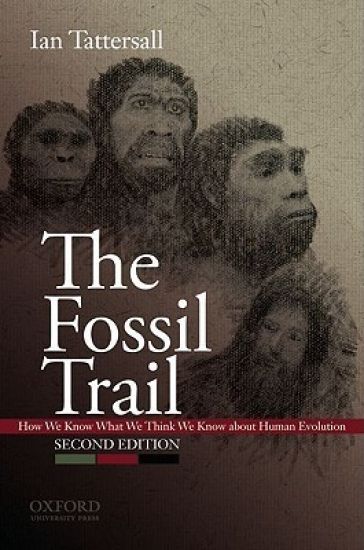
Ideal for courses in Human Evolution, History of Paleoanthropology, and as a supplement for Introduction to Biological Anthropology, The Fossil Trail is a history of paleoanthropological thought and discovery. Ian Tattersall's account of the study of human evolution offers a colorful history of fossil discoveries and a revealing insider's look at how these finds have been interpreted-and misinterpreted-through time. The second edition of The Fossil Trail brings the text up-to-date with a look at what has happened in paleoanthropology in the thirteen intervening years since the first edition's publication. There has been not only a dramatic increase in the size and scope of the human fossil record, but the introduction of new techniques of analysis and of ways of interpreting that record. Through it all, Tattersall discusses the great researchers and discoveries within the context of their social and scientific milieu to reveal the many forces that shape how we interpret fossil findings, and to give a picture of what lies ahead for the field. The Second Edition updates the original first fifteen chapters with the most recent research.The new edition also features a substantially revised Chapter 16, which provides a bridge to later developments about the Neanderthals and their precursors. Tattersall has also added two new chapters that cover the discoveries published over the past thirteen years. Chapter 17 launches a discussion of the state of paleoanthropology at the turn of the 21st Century, and Chapter 18 ties our most recent knowledge back to the beginning to look at where we've been and where we're headed. The author has also added a new gallery of maps of fossil sites-including Western Europe, Central Europe, The Caucuses and Near East, East Asia, Northern Africa, and Southern Africa-and updated the opening timeline to include the discovery of nearly 20 new species.
The Monkey in the Mirror

The Monkey in the Mirror

Ian Tattersall

Oxford University Press
2002
sidottu
Widely regarded as one of the rare eminent scientists who is also a graceful writer, Ian Tattersall here takes up some of the most controversial questions in evolutionary history in this superb collection of essays. Tattersall stresses that living creatures, including humans, are not finely engineered organisms with every component perfectly adapted to their function. We are - on the contrary - jury-rigged, improvised beings, owing as much to chance as to adaptation. And this is true of all living creatures. Leading the reader around the world and into the far reaches of the past, Tattersall shows us what the science of human evolution is about and what it is up against - from the sparsity of evidence to the pressures of religious fundamentalism. The fundamental questions of our origins - and our evolutionary future - find new life in this extraordinary book, full of delightful stories, scientific wisdom, and fresh insight
Understanding Human Evolution

Understanding Human Evolution

Ian Tattersall

Cambridge University Press
2022
sidottu
Human life, and how we came to be, is one of the greatest scientific and philosophical questions of our time. This compact and accessible book presents a modern view of human evolution. Written by a leading authority, it lucidly and engagingly explains not only the evolutionary process, but the technologies currently used to unravel the evolutionary past and emergence of Homo sapiens. By separating the history of palaeoanthropology from current interpretation of the human fossil record, it lays numerous misconceptions to rest, and demonstrates that human evolution has been far from the linear struggle from primitiveness to perfection that we've been led to believe. It also presents a coherent scenario for how Homo sapiens contrived to cross a formidable cognitive barrier to become an extraordinary and unprecedented thinking creature. Elegantly illustrated, Understanding Human Evolution is for anyone interested in the complex and tangled story of how we came to be.
Understanding Human Evolution

Understanding Human Evolution

Ian Tattersall

Cambridge University Press
2022
pokkari
Human life, and how we came to be, is one of the greatest scientific and philosophical questions of our time. This compact and accessible book presents a modern view of human evolution. Written by a leading authority, it lucidly and engagingly explains not only the evolutionary process, but the technologies currently used to unravel the evolutionary past and emergence of Homo sapiens. By separating the history of palaeoanthropology from current interpretation of the human fossil record, it lays numerous misconceptions to rest, and demonstrates that human evolution has been far from the linear struggle from primitiveness to perfection that we've been led to believe. It also presents a coherent scenario for how Homo sapiens contrived to cross a formidable cognitive barrier to become an extraordinary and unprecedented thinking creature. Elegantly illustrated, Understanding Human Evolution is for anyone interested in the complex and tangled story of how we came to be.
Masters of the Planet

Masters of the Planet

Ian Tattersall

Palgrave Macmillan
2015
nidottu
Fifty thousand years ago - merely a blip in evolutionary time - our Homo sapiens ancestors were competing for existence with several other human species, just as their precursors had done for millions of years. Yet something about our species distinguished it from the pack, and ultimately led to its survival while the rest became extinct. Just what was it that allowed Homo sapiens to become masters of the planet? Ian Tattersall, curator emeritus at the American Museum of Natural History, takes us deep into the fossil record to uncover what made humans so special. Surveying a vast field from initial bipedality to language and intelligence, Tattersall argues that Homo sapiens acquired a winning combination of traits that was not the result of long-term evolutionary refinement. Instead, the final result emerged quickly, shocking our world and changing it forever.
Paleontology

Paleontology

Ian Tattersall

Templeton Foundation Press,U.S.
2010
pokkari
"Endlessly absorbing and informative. It would be hard to imagine a better introduction to this most important and fascinating field.”-Bill Bryson, author of A Short History of Nearly EverythingPaleontology: A Brief History of Life is the fifth title published in the Templeton Science and Religion Series, in which scientists from a wide range of fields distill their experience and knowledge into brief tours of their respective specialties. In this volume, Ian Tattersall, a highly esteemed figure in the fields of anthropology, archaeology, and paleontology, leads a fascinating tour of the history of life and the evolution of human beings. Starting at the very beginning, Tattersall examines patterns of change in the biosphere over time, and the correlations of biological events with physical changes in the Earth’s environment. He introduces the complex of evolutionary processes, situates human beings in the luxuriant diversity of Life (demonstrating that however remarkable we may legitimately find ourselves to be, we are the product of the same basic forces and processes that have driven the evolutionary histories of all other creatures), and he places the origin of our extraordinary spiritual sensibilities in the context of the exaptational and emergent acquisition of symbolic cognition and thought. Concise and yet comprehensive, historically penetrating and yet up-to-date, responsibly factual and yet engaging, Paleontology serves as the perfect entrÉe to science's greatest story.
Neandertaler

Neandertaler

Ian Tattersall

Springer Basel
2014
nidottu
Die Entdeckung der Neandertaler vor rund 150 Jahren hat immer wieder für aufgeregte Diskussionen in Archäologie und Anthropologie gesorgt. Die Fragen, welchen genetischen Beitrag sie zur Entwicklung des heutigen Menschen geleistet haben oder warum die Neandertaler letztendlich ausstarben, sind bis heute ungeklärt. Dieser Streit in der Wissenschaft, die unterschiedlichen Interpretationen der Fossilien gestern und heute sowie die Evolution und Kultur des Neandertalers werden erstmalig vollständig und mit attraktivem Bildmaterial dargestellt. In einem aktuellen Anhang des Neanderthal Museums wird über die spektatkulären Neufunde im Neandertal und von anderen Orten Deutschlands berichtet.