Kirjojen hintavertailu. Mukana 11 244 527 kirjaa ja 12 kauppaa.

Kirjahaku

Etsi kirjoja tekijän nimen, kirjan nimen tai ISBN:n perusteella.

8 kirjaa tekijältä Igor R. Shafarevich

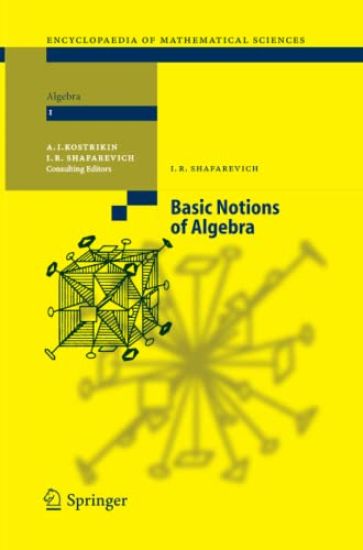
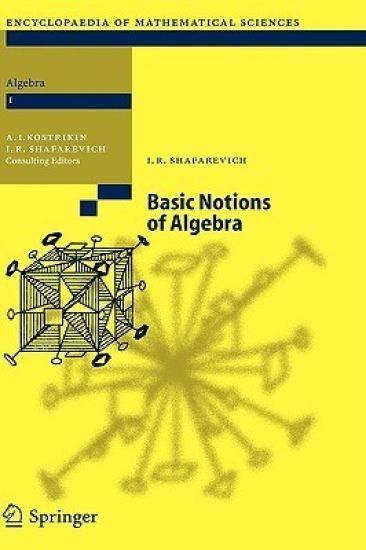
Basic Notions of Algebra

Basic Notions of Algebra

Igor R. Shafarevich

Springer-Verlag Berlin and Heidelberg GmbH Co. K
2005
sidottu
§22. K-theory 230 A. Topological X-theory 230 Vector bundles and the functor Vec(X). Periodicity and the functors KJX). K(X) and t the infinite-dimensional linear group. The symbol of an elliptic differential operator. The index theorem. B. Algebraic K-theory 234 The group of classes of projective modules. K , K and K of a ring. K of a field and o l n 2 its relations with the Brauer group. K-theory and arithmetic. Comments on the Literature 239 References 244 Index of Names 249 Subject Index 251 Preface This book aims to present a general survey of algebra, of its basic notions and main branches. Now what language should we choose for this? In reply to the question 'What does mathematics study?', it is hardly acceptable to answer 'structures' or 'sets with specified relations'; for among the myriad conceivable structures or sets with specified relations, only a very small discrete subset is of real interest to mathematicians, and the whole point of the question is to understand the special value of this infinitesimal fraction dotted among the amorphous masses. In the same way, the meaning of a mathematical notion is by no means confined to its formal definition; in fact, it may be rather better expressed by a (generally fairly small) sample of the basic examples, which serve the mathematician as the motivation and the substantive definition, and at the same time as the real meaning of the notion.
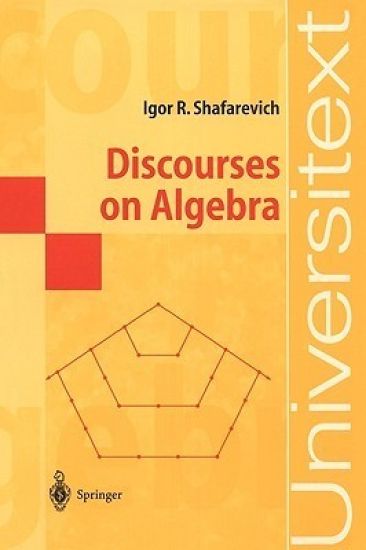
Discourses on Algebra

Discourses on Algebra

Igor R. Shafarevich

Springer-Verlag Berlin and Heidelberg GmbH Co. K
2002
nidottu
I wish that algebra would be the Cinderella ofour story. In the math­ ematics program in schools, geometry has often been the favorite daugh­ ter. The amount of geometric knowledge studied in schools is approx­ imately equal to the level achieved in ancient Greece and summarized by Euclid in his Elements (third century B. C. ). For a long time, geom­ etry was taught according to Euclid; simplified variants have recently appeared. In spite of all the changes introduced in geometry cours­ es, geometry retains the influence of Euclid and the inclination of the grandiose scientific revolution that occurred in Greece. More than once I have met a person who said, "I didn't choose math as my profession, but I'll never forget the beauty of the elegant edifice built in geometry with its strict deduction of more and more complicated propositions, all beginning from the very simplest, most obvious statements!" Unfortunately, I have never heard a similar assessment concerning al­ gebra. Algebra courses in schools comprise a strange mixture of useful rules, logical judgments, and exercises in using aids such as tables of log­ arithms and pocket calculators. Such a course is closer in spirit to the brand of mathematics developed in ancient Egypt and Babylon than to the line of development that appeared in ancient Greece and then con­ tinued from the Renaissance in western Europe. Nevertheless, algebra is just as fundamental, just as deep, and just as beautiful as geometry.
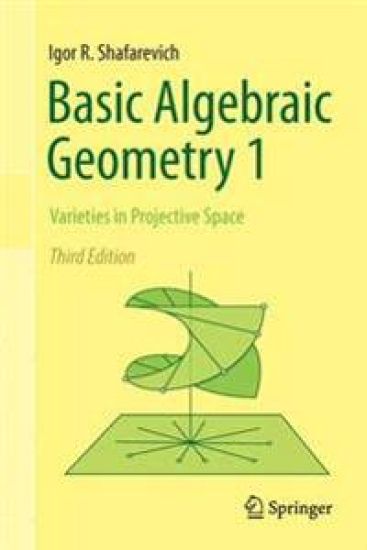
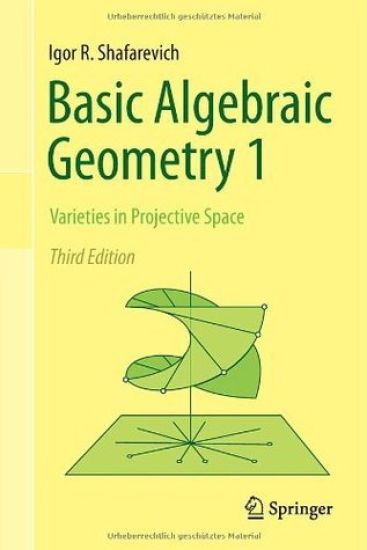
Basic Algebraic Geometry 1

Basic Algebraic Geometry 1

Igor R. Shafarevich

Springer-Verlag Berlin and Heidelberg GmbH Co. K
2013
sidottu
Shafarevich's Basic Algebraic Geometry has been a classic and universally used introduction to the subject since its first appearance over 40 years ago. As the translator writes in a prefatory note, ``For all [advanced undergraduate and beginning graduate] students, and for the many specialists in other branches of math who need a liberal education in algebraic geometry, Shafarevich’s book is a must.'' The third edition, in addition to some minor corrections, now offers a new treatment of the Riemann--Roch theorem for curves, including a proof from first principles.Shafarevich's book is an attractive and accessible introduction to algebraic geometry, suitable for beginning students and nonspecialists, and the new edition is set to remain a popular introduction to the field.
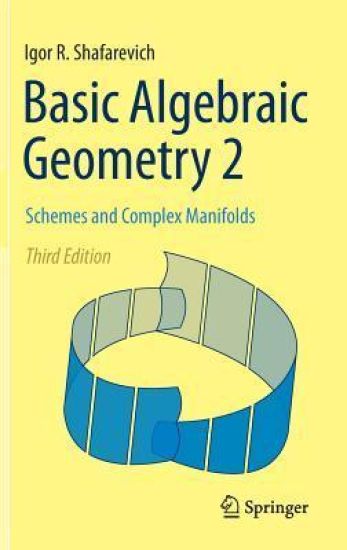
Basic Algebraic Geometry 2

Basic Algebraic Geometry 2

Igor R. Shafarevich

Springer-Verlag Berlin and Heidelberg GmbH Co. K
2013
sidottu
Shafarevich's Basic Algebraic Geometry has been a classic and universally used introduction to the subject since its first appearance over 40 years ago. As the translator writes in a prefatory note, ``For all [advanced undergraduate and beginning graduate] students, and for the many specialists in other branches of math who need a liberal education in algebraic geometry, Shafarevich’s book is a must.''The second volume is in two parts: Book II is a gentle cultural introduction to scheme theory, with the first aim of putting abstract algebraic varieties on a firm foundation; a second aim is to introduce Hilbert schemes and moduli spaces, that serve as parameter spaces for other geometric constructions. Book III discusses complex manifolds and their relation with algebraic varieties, Kähler geometry and Hodge theory. The final section raises an important problem in uniformising higher dimensional varieties that has been widely studied as the ``Shafarevich conjecture''.The style of Basic Algebraic Geometry 2 and its minimal prerequisites make it to a large extent independent of Basic Algebraic Geometry 1, and accessible to beginning graduate students in mathematics and in theoretical physics.
Basic Notions of Algebra

Basic Notions of Algebra

Igor R. Shafarevich

Springer-Verlag Berlin and Heidelberg GmbH Co. K
2014
nidottu
§22. K-theory 230 A. Topological X-theory 230 Vector bundles and the functor Vec(X). Periodicity and the functors KJX). K(X) and t the infinite-dimensional linear group. The symbol of an elliptic differential operator. The index theorem. B. Algebraic K-theory 234 The group of classes of projective modules. K , K and K of a ring. K of a field and o l n 2 its relations with the Brauer group. K-theory and arithmetic. Comments on the Literature 239 References 244 Index of Names 249 Subject Index 251 Preface This book aims to present a general survey of algebra, of its basic notions and main branches. Now what language should we choose for this? In reply to the question 'What does mathematics study?', it is hardly acceptable to answer 'structures' or 'sets with specified relations'; for among the myriad conceivable structures or sets with specified relations, only a very small discrete subset is of real interest to mathematicians, and the whole point of the question is to understand the special value of this infinitesimal fraction dotted among the amorphous masses. In the same way, the meaning of a mathematical notion is by no means confined to its formal definition; in fact, it may be rather better expressed by a (generally fairly small) sample of the basic examples, which serve the mathematician as the motivation and the substantive definition, and at the same time as the real meaning of the notion.
Basic Algebraic Geometry 1

Basic Algebraic Geometry 1

Igor R. Shafarevich

Springer-Verlag Berlin and Heidelberg GmbH Co. K
2015
nidottu
Shafarevich's Basic Algebraic Geometry has been a classic and universally used introduction to the subject since its first appearance over 40 years ago. As the translator writes in a prefatory note, ``For all [advanced undergraduate and beginning graduate] students, and for the many specialists in other branches of math who need a liberal education in algebraic geometry, Shafarevich’s book is a must.'' The third edition, in addition to some minor corrections, now offers a new treatment of the Riemann--Roch theorem for curves, including a proof from first principles.Shafarevich's book is an attractive and accessible introduction to algebraic geometry, suitable for beginning students and nonspecialists, and the new edition is set to remain a popular introduction to the field.
Collected Mathematical Papers

Collected Mathematical Papers

Igor R. Shafarevich

Springer-Verlag Berlin and Heidelberg GmbH Co. K
2015
nidottu
This volume contains almost all mathematical papers published between 1943 and 1984 of Igor R. Shafarevich. They appear in English translations (with two exceptions, which are in French and German), some of the papers have been translated into English especially for this edition. Notes by Shafarevich at the end of the volume contain corrections and remarks on the subsequent development of the subjects considered in the papers. Igor R. Shafarevich has made a big impact on mathematics. He has worked in the fields of algebra, algebraic number theory, algebraic geometry and arithmetic algebraic geometry. His papers reflect his broad interests and include topics such as the proof of the general reciprocity law, the realization of groups as Galois groups of number fields, class field towers, algebraic surfaces (in particular K3 surfaces), elliptic curves, and finiteness results on abelian varieties, algebraic curves over number fields and lie algebras.
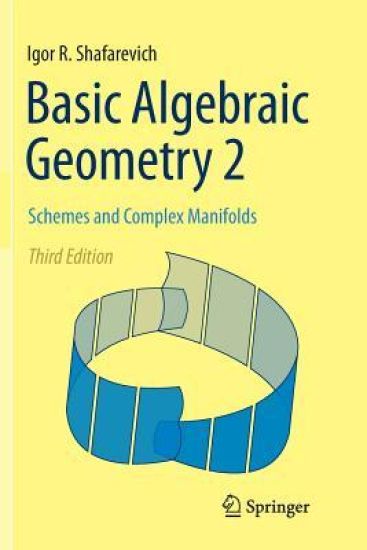
Basic Algebraic Geometry 2

Basic Algebraic Geometry 2

Igor R. Shafarevich

Springer-Verlag Berlin and Heidelberg GmbH Co. K
2016
nidottu
Shafarevich's Basic Algebraic Geometry has been a classic and universally used introduction to the subject since its first appearance over 40 years ago. As the translator writes in a prefatory note, ``For all [advanced undergraduate and beginning graduate] students, and for the many specialists in other branches of math who need a liberal education in algebraic geometry, Shafarevich’s book is a must.''The second volume is in two parts: Book II is a gentle cultural introduction to scheme theory, with the first aim of putting abstract algebraic varieties on a firm foundation; a second aim is to introduce Hilbert schemes and moduli spaces, that serve as parameter spaces for other geometric constructions. Book III discusses complex manifolds and their relation with algebraic varieties, Kähler geometry and Hodge theory. The final section raises an important problem in uniformising higher dimensional varieties that has been widely studied as the ``Shafarevich conjecture''.The style of Basic Algebraic Geometry 2 and its minimal prerequisites make it to a large extent independent of Basic Algebraic Geometry 1, and accessible to beginning graduate students in mathematics and in theoretical physics.