Kirjojen hintavertailu. Mukana 11 244 527 kirjaa ja 12 kauppaa.

Kirjahaku

Etsi kirjoja tekijän nimen, kirjan nimen tai ISBN:n perusteella.

11 kirjaa tekijältä Ingmar Persson

Morality from Compassion

Morality from Compassion

Ingmar Persson

Oxford University Press
2021
sidottu
According to Arthur Schopenhauer, compassion is the basis of morality. He sees concern for justice as a negative form of compassion, directed at not harming anyone, as opposed to the more far-reaching, positive form of benefiting. He thinks a higher degree of compassion involves realizing that the spatio-temporal separation of individuals is illusory and that in reality they are all identical. Such compassion is impartial and all-encompassing. Compassion is suited to be the centre of morality because its object are negative feelings, and only these are real. Contrary to these Schopenhauerian claims, it is here argued that compassion must be supplemented with attitudes like sympathy and benevolence because positive feelings exist alongside negative feelings; that a concern for justice, though morally essential, is independent of these attitudes which are based on empathy; that these attitudes involve not identifying oneself with others, but taking personal identity as insignificant in empathically imagining how others feel. Schopenhauer is however right that, though these attitudes are spontaneously partial, this can be corrected. His morality is also interesting in raising the question rarely discussed in philosophical ethics of how moral virtue relates to ascetic self-renunciation. Both of these ideals are highly demanding, but the book ends by arguing that this is no objection to their validity.
Inclusive Ethics

Inclusive Ethics

Ingmar Persson

Oxford University Press
2017
sidottu
Inclusive Ethics begins from two ideas which are part of our everyday morality, namely that we have a moral reason to benefit or do good to other beings, and that justice requires these benefits to be distributed equally. A morality comprising these two general principles will be exceedingly hard to apply as these principles will have to be balanced against each in an intuitive fashion, but also because the notion of what benefits beings is quite complex, comprising both experiential components of pleasure and successful exercises of autonomy. Ingmar Persson argues that, on philosophical reflection, these ideas turn out to be more far-reaching than we imagine. In particular, the reason to benefit commits us to benefit beings by bringing them into existence. Further, since grounds that are commonly used to justify that some are better off than others - such as their being more deserving or having rights to more - are untenable, justice requires a more extensive equality. The book concludes by reflecting on the problems of getting people to accept a morality which differs markedly from the morality with which they have grown up.
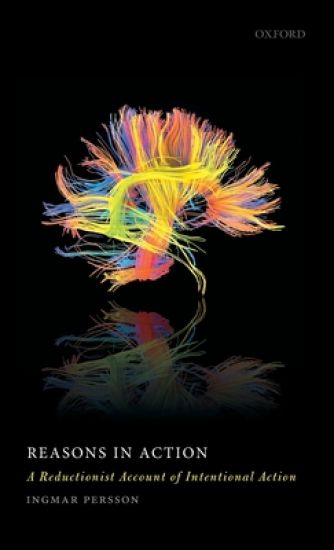
Reasons in Action

Reasons in Action

Ingmar Persson

Oxford University Press
2019
sidottu
Ingmar Persson offers an original view of the processes of human action: deliberating on the basis of reasons for and against actions, making a decision about what to do, and from there implementing the decision in action in a way that makes the action intentional. Persson's analysis is mainly developed to suit physical actions, though how it needs to be modified to cover mental acts is also discussed. The interpretation of intentional action that is presented is reductionist in the sense that it does not appeal to any concepts that are distinctive of the domain of action theory, such as a unique type of agent-causation, or irreducible mental acts, like acts of will, volitions, decisions, or tryings. Nor does it appeal to any unanalyzed attitudes or states essentially related to intentional action, like intentions and desires to act. Instead, the intentionality of actions is construed as springing from desires conceived as physical states of agents which cause facts because of the way agents think of them. A sense of our having responsibility that is sufficient for our acting for reasons is also sketched out.
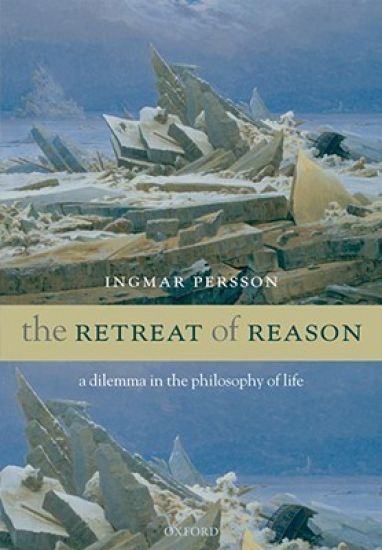
The Retreat of Reason

The Retreat of Reason

Ingmar Persson

Clarendon Press
2005
sidottu
One of the main original aims of philosophy was to give us guidance about how to live our lives. The ancient Greeks typically assumed that a life led in accordance with reason, a rational life, would also be the happiest or most fulfilling. Ingmar Persson's book resumes this project, which has been largely neglected in contemporary philosophy. But his conclusions are very different; by exploring the irrationality of our attitudes to time, our identity, and our responsibility, Persson shows that the aim of living rationally conflicts not only with the aim of leading the most fulfilling life, but also with the moral aim of promoting the maximization and just distribution of fulfilment for all. Persson also argues that neither the aim of living rationally nor any of the fulfilment aims can be rejected as less rational than any other. We thus face a dilemma of either having to enter a retreat of reason, insulated from everyday attitudes, or making reason retreat from its aspiration to be the sole controller of our attitudes. The Retreat of Reason explores three areas in which there is a conflict between the rational life and a life dedicated to maximization of fulfilment. Persson contends that living rationally requires us to give up, first, our temporal biases; secondly, our bias towards ourselves; and, thirdly, our responsibility to the extent that it involves the notion of desert and desert-entailing notions. But giving up these attitudes is so overwhelmingly hard that the effort to do so not only makes our own lives less fulfilling, but also obstructs our efficient pursuit of the moral aim of promoting a maximum of justly distributed fulfilment. Ingmar Persson brings back to philosophy the ambition of offering a broad vision of the human condition. The Retreat of Reason challenges and disturbs some of our most fundamental ideas about ourselves.
The Retreat of Reason

The Retreat of Reason

Ingmar Persson

Oxford University Press
2008
nidottu
One of the main original aims of philosophy was to give us guidance about how to live our lives. The ancient Greeks typically assumed that a life led in accordance with reason, a rational life, would also be the happiest or most fulfilling. Ingmar Persson's book resumes this project, which has been largely neglected in contemporary philosophy. But his conclusions are very different; by exploring the irrationality of our attitudes to time, our identity, and our responsibility, Persson shows that the aim of living rationally conflicts not only with the aim of leading the most fulfilling life, but also with the moral aim of promoting the maximization and just distribution of fulfilment for all. Persson also argues that neither the aim of living rationally nor any of the fulfilment aims can be rejected as less rational than any other. We thus face a dilemma of either having to enter a retreat of reason, insulated from everyday attitudes, or making reason retreat from its aspiration to be the sole controller of our attitudes. The Retreat of Reason explores three areas in which there is a conflict between the rational life and a life dedicated to maximization of fulfilment. Persson contends that living rationally requires us to give up, first, our temporal biases; secondly, our bias towards ourselves; and, thirdly, our responsibility to the extent that it involves the notion of desert and desert-entailing notions. But giving up these attitudes is so overwhelmingly hard that the effort to do so not only makes our own lives less fulfilling, but also obstructs our efficient pursuit of the moral aim of promoting a maximum of justly distributed fulfilment. Ingmar Persson brings back to philosophy the ambition of offering a broad vision of the human condition. The Retreat of Reason challenges and disturbs some of our most fundamental ideas about ourselves.
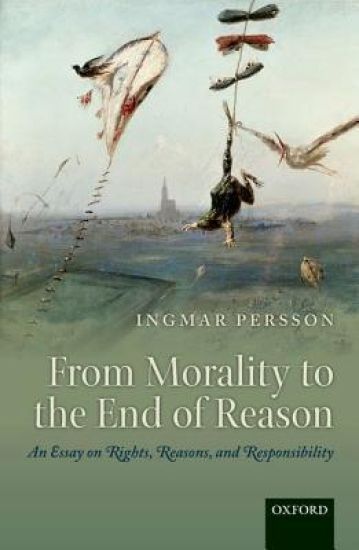
From Morality to the End of Reason

From Morality to the End of Reason

Ingmar Persson

Oxford University Press
2013
sidottu
Many philosophers think that if you're morally responsible for a state of affairs, you must be a cause of it. Ingmar Persson argues that this strand of common sense morality is asymmetrical, in that it features the act-omission doctrine, according to which there are stronger reasons against performing some harmful actions than in favour of performing any beneficial actions. He analyses the act-omission doctrine as consisting in a theory of negative rights, according to which there are rights not to have one's life, body, and property interfered with, and a conception of responsibility as being based on causality. This conception of responsibility is also found to be involved in the doctrine of double effect. The outcome of Persson's critical examination of these ideas is that reasons of rights are replaced by reasons of beneficence, and we are made responsible for what is under the influence of our practical reasons. The argument gives rise to a symmetrical, consequentialist morality which is more demanding but less authoritative than common sense morality, because reasons of beneficence are weaker than reasons of rights. It is also argued that there are no non-naturalist external practical reasons, and all practical reasons are desire-dependent: so practical reasons cannot be universally binding. The question is whether such a morality possesses enough authority to command our compliance. This seems necessary in order for us to cope with the greatest moral problems of our time, such as aid to developing countries and anthropogenic climate change.
Out of the world : on the point of doing philosophy
It seems plausible that the point of doing philosophy is to arrive at a rational consensus about the true answers to philosophical problems. But then it appears clear that doing philosophy is bound to be pointless because it will fail to produce such a consensus. A main reason for this is that philosophical problems often take the form of firmly entrenched commonsensical intuitions being opposed by powerful philosophical arguments. Examples are issues such as whether physical things, some of which have minds, exist inde­pendently of our perception, whether our inductive and memory beliefs are justifiable, whether we have free will and responsibility, whether we have reason to be especially concerned about ourselves, and whether there are moral norms that are objectively valid. This book suggests that what side we land on in such disputes is ulti­mately due to features of our personality. But if this is true, the point of philosophizing could be to work out a philosophy that articulates our personality. If our philosophy has a broad scope, it will enable a fuller articulation of our personality. Moreover, it is more likely to carry implications about how to live, which provides philosophizing with a further possible point. The author sketches how his personality has shaped his views on the issues mentioned and their implications for living. Ingmar Persson is Emeritus Professor of Practical Philosophy at the University of Gothenburg, and Distinguished Research Fellow of the Oxford Uehiro Centre for Practical Ethics, Oxford University. Among his publications are six books on Oxford University Press.
The Primacy of Perception Revisited

The Primacy of Perception Revisited

Ingmar Persson

Bokförlaget Thales
2023
nidottu
The objects of perception are primary in relation to both physical objects and sensuous representations like images, which are ultimately derived from the perceptual objects they resemble. The existence of perceptual objects is dependent on the bodies of percipients, and states of consciousness in general must have physical subjects. Pre-reflectively these states are ascribed to the whole body but, strictly speaking, they are dependent only on the brain or parts of it. In the end, it turns out to be impossible to identify these parts. This fact in combination with the fact that it is impossible to pick out any psychological relations that are essential for our identity over time shows that there is nothing this identity could consist in. Physical reality is as contemporary physics rather than as common sense conceives it and, thus, so different from what we directly perceive that it cannot be said to be perceived even indirectly. Ingmar Persson is Emeritus Professor of Practical Philosophy at the University of Gothenburg, and Distinguished Research Fellow at the Oxford Uehiro Centre for Practical Ethics, Oxford University. Among his publications are six books on Oxford University Press. The Primacy of Perception Revisited revises the theory of perception originally presented in his The Primacy of Perception also published in Library of Theoria.Library of Theoria, no 29.