
Kirjahaku
Etsi kirjoja tekijän nimen, kirjan nimen tai ISBN:n perusteella.
27 kirjaa tekijältä Internal Revenue Service
Virtually all gasoline stations fall into one of two broad categories: majors and independents. Gasoline stations that sell branded gasoline (those who operate under the major brand names, such as Mobil, Shell, etc.), usually have signed agreements which restrict them from buying from anyone other than their respective major Oil Company. However, experience shows that some major retailers do buy additional gasoline or diesel fuel from independent distributors. The major Oil Company(ies) can operate branded locations. The dealer may own the property (-open dealer") or may lease the station from the Oil Company(ies) (-dealer operated"). Sometimes diesel fuel can be purchased from independent suppliers; however, the pumps need to be clearly marked to indicate the diesel fuel product is not the major oil company's diesel fuel being sold. Independents are stations that go by any name other than those listed below. Independents are also referred to as "unbranded" stations.
This guide addresses the mortuary and the cemetery businesses as separate entities, although a single business enterprise may be involved in the mortuary as well as the cemetery business. The mortuary business is that which entails the preparation of the human remains for interment and the orchestration of the funeral. The cemetery business is that of providing the final resting place for the remains. Each section covered attempts first to familiarize the agent with the general structure and operation of each part of the industry and then offers discussion and audit suggestions on particular issues relating to them.
A project was conducted by the Providence District on the pizza industry. Because pizza restaurants are basically cash businesses, the potential for skimming exists. The type of entities discussed in this guide are the family owned mom and pop types of establish- ments. The "chain" or "franchise" types of pizza parlors are not addressed in this guide due to the nature of their operations, that is, the close control maintained by the franchise of these establishments does not lend itself to the approaches discussed in this guide. Overall, documentation of income and expenses in this industry has been found to be lacking. In most instances, the cash register tapes are not retained and income is not deposited intact. There is generally little or no documentation to verify the gross receipts reported on the tax return. Purchases are often paid in cash and the purchase invoices are not kept. Employees are often paid in cash, sometimes, in order to avoid the payroll taxes.
Bars and restaurants generally maintain inventories of perishable goods and, therefore, have been required the use of the accrual method of accounting. For taxable years ending after December 17, 2000, Revenue Procedure 2000-22, 2000-1 CB. 1008, provides that a qualifying small business with average sales of $1 million or less for 3 years may use the cash method of accounting. The Revenue Procedure provides that if a taxpayer does not want to account for inventories, it must treat inventoriable items like non-incidental materials and supplies under Treas. Reg. section 1.162-3. For purposes of the revenue procedure, inventoriable items that are treated as non-incidental materials and supplies are considered consumed and used in the year in which the taxpayers sells the items, or, if later, when the taxpayer pays for the items. An accrual basis taxpayer can elect the cash method after 1999. Form 3115, "Change of Accounting Method" is required to be filed with the return.
This audit technique guide was written and compiled, by and for Internal Revenue agents, to be used in the examinations of returns of the scrap metal industry. These examinations include returns for both purchasers and sellers of scrap metal. The purpose of the guide is to promote uniformity and consistency in examinations and in the application of tax laws. While the information compiled in the guide sets forth a general overview of the industry, it is not intended to be all-inclusive, and agents should consider any local information that pertains to their examinations. We want to acknowledge our appreciation to the Institute of Scrap Recycling Industries, Inc. (ISRI) for providing us with background information about the industry and allowing us to use excerpts from their publications.
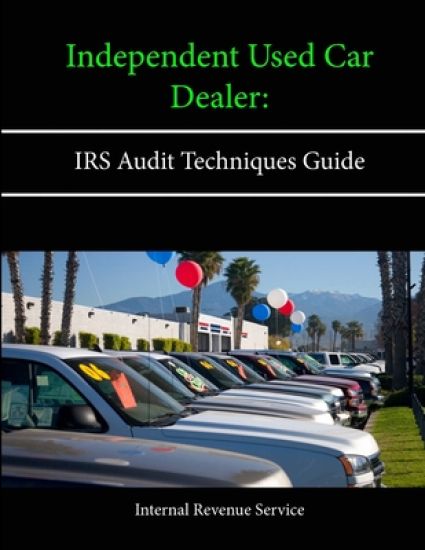
Independent Used Car Dealer: Irs Audit Techniques Guide
Internal Revenue Service
Lulu.com
2013
nidottu
The used car industry, as with any industry has certain business practices that are used throughout the industry. A key to a successful examination of a used car dealer is an understanding of these basic common practices. Certain jargon is widely used in the industry. The terms defined in Exhibit 1-1 are the most commonly found terms. However, even these terms may vary from region to region. Nevertheless, the list may be useful in understanding how the industry operates. Become familiar with these terms as many of the terms listed here are used throughout the Audit Technique Guide. The used car industry is comprised of two major segments. The first segment is made up of the new car dealers who accept trade-ins on the sale of new automobiles; or purchase used cars from customers, used car dealers, or wholesale auto auctions. The new car dealers then sell the used cars either to wholesalers, directly to used car dealers, through auctions, or to other miscellaneous customers.
IRS Exempt Organizations Colleges and Universities Compliance Project
Internal Revenue Service
Createspace Independent Publishing Platform
2015
nidottu
1040 Instructions 2015
Internal Revenue Service
Createspace Independent Publishing Platform
2016
nidottu
1040EZ Instructions 2015
Internal Revenue Service
Createspace Independent Publishing Platform
2016
nidottu
The United States Internal Revenue Service's manual for Form 1040EZ, a common form used for personal tax returns.