Kirjojen hintavertailu. Mukana 11 342 296 kirjaa ja 12 kauppaa.

Kirjahaku

Etsi kirjoja tekijän nimen, kirjan nimen tai ISBN:n perusteella.

3 kirjaa tekijältä Irigaray Luce

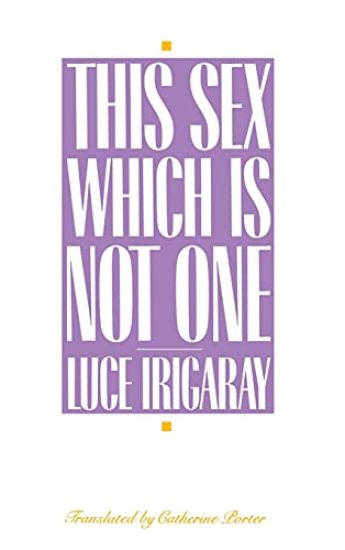
This Sex Which Is Not One

This Sex Which Is Not One

Irigaray Luce

CORNELL UNIVERSITY PRESS
1985
sidottu
In This Sex Which Is Not One, Luce Irigaray elaborates on some of the major themes of Speculum of the Other Woman, her landmark work on the status of woman in Western philosophical discourse and in psychoanalytic theory, In eleven acute and widely ranging essays, Irigaray reconsiders the question of female sexuality in a variety of contexts that are relevant to current discussion of feminist theory and practice. Among the topics she treats are the implications of the thought of Freud and Lacan for understanding womanhood and articulating a feminine discourse; classic views on the significance of the difference between male and female sex organs; and the experience of erotic pleasure in men and in women. She also takes up explicitly the question of economic exploitation of women; in an astute reading of Marx she shows that the subjection of woman has been institutionalized by her reduction to an object of economic exchange. Throughout Irigaray seeks to dispute and displace male-centered structures of language and thought through a challenging writing practice that takes a first step toward a woman's discourse, a discourse that would put an end to Western culture's enduring phallocentrism.Making more direct and accessible the subversive challenge of Speculum of the Other Woman, this volume—skillfully translated by Catherine Porter (with Carolyn Burke)—will be essential reading for anyone seriously concerned with contemporary feminist issues.
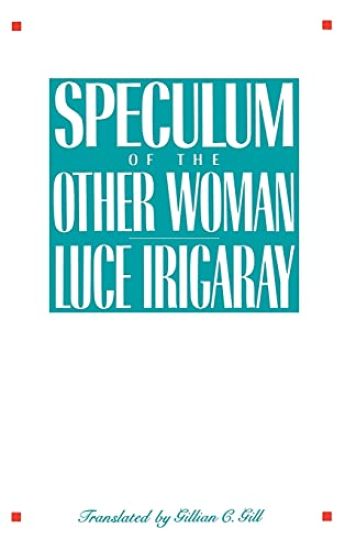
Speculum of the Other Woman

Speculum of the Other Woman

Irigaray Luce

CORNELL UNIVERSITY PRESS
1985
sidottu
Speculum of the Other Woman by Luce Irigaray is incontestably one of the most important works in feminist theory to have been published in this generation. For the profession of psychoanalysis, Irigaray believes, female sexuality has remained a "dark continent," unfathomable and unapproachable; its nature can only be misunderstood by those who continue to regard women in masculine terms. In the first section of the book, "The Blind Spot of an Old Dream of Symmetry," Irigaray rereads Freud's essay "Femininity," and his other writings on women, bringing to the fore the masculine ideology implicit in psychoanalytic theory and in Western discourse in general: woman is defined as a disadvantaged man, a male construct with no status of her own. In the last section, "Plato's Hystera," Irigaray reinterprets Plato's myth of the cave, of the womb, in an attempt to discover the origins of that ideology, to ascertain precisely the way in which metaphors were fathered that henceforth became vehicles of meaning, to trace how woman came to be excluded from the production of discourse. Between these two sections is "Speculum"—ten meditative, widely ranging, and freely associational essays, each concerned with an aspect of the history of Western philosophy in its relation to woman, in which Irigaray explores woman's essential difference from man.