Kirjojen hintavertailu. Mukana 12 402 010 kirjaa ja 12 kauppaa.

Kirjahaku

Etsi kirjoja tekijän nimen, kirjan nimen tai ISBN:n perusteella.

10 kirjaa tekijältä Ivor Grattan-Guinness

The Search for Mathematical Roots, 1870-1940

The Search for Mathematical Roots, 1870-1940

Ivor Grattan-Guinness

Princeton University Press
2000
pokkari
While many books have been written about Bertrand Russell's philosophy and some on his logic, I. Grattan-Guinness has written the first comprehensive history of the mathematical background, content, and impact of the mathematical logic and philosophy of mathematics that Russell developed with A. N. Whitehead in their Principia mathematica (1910-1913). This definitive history of a critical period in mathematics includes detailed accounts of the two principal influences upon Russell around 1900: the set theory of Cantor and the mathematical logic of Peano and his followers. Substantial surveys are provided of many related topics and figures of the late nineteenth century: the foundations of mathematical analysis under Weierstrass; the creation of algebraic logic by De Morgan, Boole, Peirce, Schroder, and Jevons; the contributions of Dedekind and Frege; the phenomenology of Husserl; and the proof theory of Hilbert. The many-sided story of the reception is recorded up to 1940, including the rise of logic in Poland and the impact on Vienna Circle philosophers Carnap and Godel. A strong American theme runs though the story, beginning with the mathematician E. H. Moore and the philosopher Josiah Royce, and stretching through the emergence of Church and Quine, and the 1930s immigration of Carnap and GodeI. Grattan-Guinness draws on around fifty manuscript collections, including the Russell Archives, as well as many original reviews. The bibliography comprises around 1,900 items, bringing to light a wealth of primary materials. Written for mathematicians, logicians, historians, and philosophers--especially those interested in the historical interaction between these disciplines--this authoritative account tells an important story from its most neglected point of view. Whitehead and Russell hoped to show that (much of) mathematics was expressible within their logic; they failed in various ways, but no definitive alternative position emerged then or since.
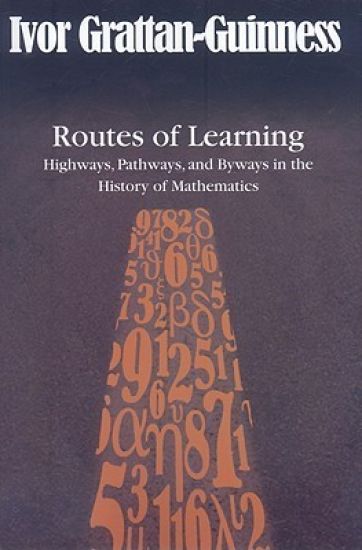
Routes of Learning

Routes of Learning

Ivor Grattan-Guinness

Johns Hopkins University Press
2010
sidottu
This seminal collection gathers together many general writings of one of the world's leading historians of mathematics. Organized thematically, these essays ponder the intellectual underpinnings of the field, examine the major topics in the history of mathematics, and recount the bizarre history of pseudomath. Ivor Grattan-Guinness explores how people understand mathematics-the routes of learning they take as they make important discoveries and study mathematical concepts and theories. The essays in the first part of the book discuss the history of mathematics as a field and its central philosophical issues. Those in the next part address the history of mathematics education and its importance to current modes of teaching. In the last section Grattan-Guinness investigates various understudied aspects of math, including numerology, Masonic symbols in classical music, and the links between mathematics and Christianity. This collection includes several essays that are difficult to find anywhere else. All historians of mathematics and students of the field will want a copy of this remarkable resource on their bookshelves.
Routes of Learning

Routes of Learning

Ivor Grattan-Guinness

Johns Hopkins University Press
2010
pokkari
This seminal collection gathers together many general writings of one of the world's leading historians of mathematics. Organized thematically, these essays ponder the intellectual underpinnings of the field, examine the major topics in the history of mathematics, and recount the bizarre history of pseudomath. Ivor Grattan-Guinness explores how people understand mathematics-the routes of learning they take as they make important discoveries and study mathematical concepts and theories. The essays in the first part of the book discuss the history of mathematics as a field and its central philosophical issues. Those in the next part address the history of mathematics education and its importance to current modes of teaching. In the last section Grattan-Guinness investigates various understudied aspects of math, including numerology, Masonic symbols in classical music, and the links between mathematics and Christianity. This collection includes several essays that are difficult to find anywhere else. All historians of mathematics and students of the field will want a copy of this remarkable resource on their bookshelves.
Alfred Tarski

Alfred Tarski

Ivor Grattan-Guinness

Springer-Verlag New York Inc.
2014
sidottu
Alfred Tarski (1901–1983) was a renowned Polish/American mathematician, a giant of the twentieth century, who helped establish the foundations of geometry, set theory, model theory, algebraic logic and universal algebra. Throughout his career, he taught mathematics and logic at universities and sometimes in secondary schools. Many of his writings before 1939 were in Polish and remained inaccessible to most mathematicians and historians until now.This self-contained book focuses on Tarski’s early contributions to geometry and mathematics education, including the famous Banach–Tarski paradoxical decomposition of a sphere as well as high-school mathematical topics and pedagogy. These themes are significant since Tarski’s later research on geometry and its foundations stemmed in part from his early employment as a high-school mathematics teacher and teacher-trainer. The book contains careful translations and much newly uncovered social background of these works written during Tarski’s years in Poland.Alfred Tarski: Early Work in Poland serves the mathematical, educational, philosophical and historical communities by publishing Tarski’s early writings in a broadly accessible form, providing background from archival work in Poland and updating Tarski’s bibliography.A list of errata can be found on the author Smith’s personal webpage.
Alfred Tarski

Alfred Tarski

Ivor Grattan-Guinness

Birkhauser Boston Inc
2016
nidottu
Alfred Tarski (1901–1983) was a renowned Polish/American mathematician, a giant of the twentieth century, who helped establish the foundations of geometry, set theory, model theory, algebraic logic and universal algebra. Throughout his career, he taught mathematics and logic at universities and sometimes in secondary schools. Many of his writings before 1939 were in Polish and remained inaccessible to most mathematicians and historians until now.This self-contained book focuses on Tarski’s early contributions to geometry and mathematics education, including the famous Banach–Tarski paradoxical decomposition of a sphere as well as high-school mathematical topics and pedagogy. These themes are significant since Tarski’s later research on geometry and its foundations stemmed in part from his early employment as a high-school mathematics teacher and teacher-trainer. The book contains careful translations and much newly uncovered social background of these works written during Tarski’s years in Poland.Alfred Tarski: Early Work in Poland serves the mathematical, educational, philosophical and historical communities by publishing Tarski’s early writings in a broadly accessible form, providing background from archival work in Poland and updating Tarski’s bibliography.A list of errata can be found on the author Smith’s personal webpage.
The Rainbow of Mathematics

The Rainbow of Mathematics

Ivor Grattan-Guinness; I Grattan-Guinness

W. W. Norton Company
2000
pokkari
Beginning with the Babylonian and Egyptian mathematicians of antiquity, IvorGrattan-Guinness "succeeds masterfully in viewing the history of mathematics from a new perspective." (Professor Karen Hunger Parshall, editor of Historia Mathematica). He charts the growth of mathematics through its refinement by ancient Greeks and then medieval Arabs, to its systematic development by Europeans from the Middle Ages to the early twentieth century. This book describes the evolution of arithmetic and geometry, trigonometry and algebra; the interplay between mathematics, physics, and mathematical astronomy; and "new" branches such as probability and statistics. Authoritative and comprehensive, The Rainbow of Mathematics is a unique account of the development of the science that is at the heart of so many other sciences. Originally published under the title The Norton History of the Mathematical Sciences.