Kirjojen hintavertailu. Mukana 11 244 527 kirjaa ja 12 kauppaa.

Kirjahaku

Etsi kirjoja tekijän nimen, kirjan nimen tai ISBN:n perusteella.

7 kirjaa tekijältä J. David Logan

A First Course in Differential Equations

A First Course in Differential Equations

J. David Logan

Springer-Verlag New York Inc.
2005
nidottu
Therearemanyexcellenttextsonelementarydi?erentialequationsdesignedfor the standard sophomore course. However, in spite of the fact that most courses are one semester in length, the texts have evolved into calculus-like pres- tations that include a large collection of methods and applications, packaged with student manuals, and Web-based notes, projects, and supplements. All of this comes in several hundred pages of text with busy formats. Most students do not have the time or desire to read voluminous texts and explore internet supplements. The format of this di?erential equations book is di?erent; it is a one-semester, brief treatment of the basic ideas, models, and solution methods. Itslimitedcoverageplacesitsomewherebetweenanoutlineandadetailedte- book. I have tried to write concisely, to the point, and in plain language. Many worked examples and exercises are included. A student who works through this primer will have the tools to go to the next level in applying di?erential eq- tions to problems in engineering, science, and applied mathematics. It can give some instructors, who want more concise coverage, an alternative to existing texts.
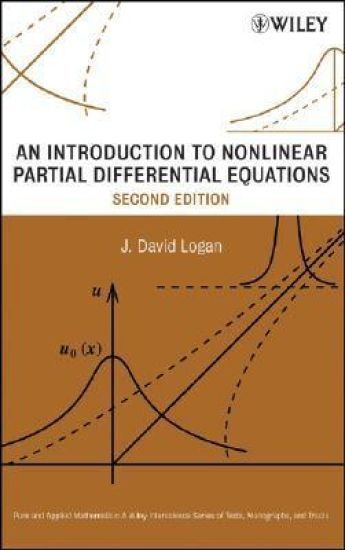
An Introduction to Nonlinear Partial Differential Equations
Praise for the First Edition: "This book is well conceived and well written. The author has succeeded in producing a text on nonlinear PDEs that is not only quite readable but also accessible to students from diverse backgrounds." —SIAM Review A practical introduction to nonlinear PDEs and their real-world applications Now in a Second Edition, this popular book on nonlinear partial differential equations (PDEs) contains expanded coverage on the central topics of applied mathematics in an elementary, highly readable format and is accessible to students and researchers in the field of pure and applied mathematics. This book provides a new focus on the increasing use of mathematical applications in the life sciences, while also addressing key topics such as linear PDEs, first-order nonlinear PDEs, classical and weak solutions, shocks, hyperbolic systems, nonlinear diffusion, and elliptic equations. Unlike comparable books that typically only use formal proofs and theory to demonstrate results, An Introduction to Nonlinear Partial Differential Equations, Second Edition takes a more practical approach to nonlinear PDEs by emphasizing how the results are used, why they are important, and how they are applied to real problems. The intertwining relationship between mathematics and physical phenomena is discovered using detailed examples of applications across various areas such as biology, combustion, traffic flow, heat transfer, fluid mechanics, quantum mechanics, and the chemical reactor theory. New features of the Second Edition also include: Additional intermediate-level exercises that facilitate the development of advanced problem-solving skills New applications in the biological sciences, including age-structure, pattern formation, and the propagation of diseases An expanded bibliography that facilitates further investigation into specialized topics With individual, self-contained chapters and a broad scope of coverage that offers instructors the flexibility to design courses to meet specific objectives, An Introduction to Nonlinear Partial Differential Equations, Second Edition is an ideal text for applied mathematics courses at the upper-undergraduate and graduate levels. It also serves as a valuable resource for researchers and professionals in the fields of mathematics, biology, engineering, and physics who would like to further their knowledge of PDEs.
Applied Mathematics

Applied Mathematics

J. David Logan

John Wiley Sons Inc
2013
sidottu
Praise for the Third Edition “Future mathematicians, scientists, and engineers should find the book to be an excellent introductory text for coursework or self-study as well as worth its shelf space for reference.” —MAA Reviews Applied Mathematics, Fourth Edition is a thoroughly updated and revised edition on the applications of modeling and analyzing natural, social, and technological processes. The book covers a wide range of key topics in mathematical methods and modeling and highlights the connections between mathematics and the applied and natural sciences. The Fourth Edition covers both standard and modern topics, including scaling and dimensional analysis; regular and singular perturbation; calculus of variations; Green’s functions and integral equations; nonlinear wave propagation; and stability and bifurcation. The book provides extended coverage of mathematical biology, including biochemical kinetics, epidemiology, viral dynamics, and parasitic disease. In addition, the new edition features: Expanded coverage on orthogonality, boundary value problems, and distributions, all of which are motivated by solvability and eigenvalue problems in elementary linear algebraAdditional MATLAB® applications for computer algebra system calculationsOver 300 exercises and 100 illustrations that demonstrate important conceptsNew examples of dimensional analysis and scaling along with new tables of dimensions and units for easy referenceReview material, theory, and examples of ordinary differential equationsNew material on applications to quantum mechanics, chemical kinetics, and modeling diseases and viruses Written at an accessible level for readers in a wide range of scientific fields, Applied Mathematics, Fourth Edition is an ideal text for introducing modern and advanced techniques of applied mathematics to upper-undergraduate and graduate-level students in mathematics, science, and engineering. The book is also a valuable reference for engineers and scientists in government and industry.
Applied Partial Differential Equations

Applied Partial Differential Equations

J. David Logan

Springer International Publishing AG
2014
sidottu
This textbook is for the standard, one-semester, junior-senior course that often goes by the title "Elementary Partial Differential Equations" or "Boundary Value Problems". The audience consists of students in mathematics, engineering, and the sciences. The topics include derivations of some of the standard models of mathematical physics and methods for solving those equations on unbounded and bounded domains, and applications of PDE's to biology. The text differs from other texts in its brevity; yet it provides coverage of the main topics usually studied in the standard course, as well as an introduction to using computer algebra packages to solve and understand partial differential equations.For the 3rd edition the section on numerical methods has been considerably expanded to reflect their central role in PDE's. A treatment of the finite element method has been included and the code for numerical calculations is now written for MATLAB. Nonetheless the brevity of the text has been maintained. To further aid the reader in mastering the material and using the book, the clarity of the exercises has been improved, more routine exercises have been included, and the entire text has been visually reformatted to improve readability.
A First Course in Differential Equations

A First Course in Differential Equations

J. David Logan

Springer International Publishing AG
2015
sidottu
The third edition of this concise, popular textbook on elementary differential equations gives instructors an alternative to the many voluminous texts on the market. It presents a thorough treatment of the standard topics in an accessible, easy-to-read, format. The overarching perspective of the text conveys that differential equations are about applications. This book illuminates the mathematical theory in the text with a wide variety of applications that will appeal to students in physics, engineering, the biosciences, economics and mathematics. Instructors are likely to find that the first four or five chapters are suitable for a first course in the subject.This edition contains a healthy increase over earlier editions in the number of worked examples and exercises, particularly those routine in nature. Two appendices include a review with practice problems, and a MATLAB® supplement that gives basic codes and commands for solving differential equations. MATLAB® is not required; students are encouraged to utilize available software to plot many of their solutions. Solutions to even-numbered problems are available on springer.com.
Applied Partial Differential Equations

Applied Partial Differential Equations

J. David Logan

Springer International Publishing AG
2014
nidottu
This textbook is for the standard, one-semester, junior-senior course that often goes by the title "Elementary Partial Differential Equations" or "Boundary Value Problems". The audience consists of students in mathematics, engineering, and the sciences. The topics include derivations of some of the standard models of mathematical physics and methods for solving those equations on unbounded and bounded domains, and applications of PDE's to biology. The text differs from other texts in its brevity; yet it provides coverage of the main topics usually studied in the standard course, as well as an introduction to using computer algebra packages to solve and understand partial differential equations.For the 3rd edition the section on numerical methods has been considerably expanded to reflect their central role in PDE's. A treatment of the finite element method has been included and the code for numerical calculations is now written for MATLAB. Nonetheless the brevity of the text has been maintained. To further aid the reader in mastering the material and using the book, the clarity of the exercises has been improved, more routine exercises have been included, and the entire text has been visually reformatted to improve readability.
A First Course in Differential Equations

A First Course in Differential Equations

J. David Logan

Springer International Publishing AG
2016
nidottu
The third edition of this concise, popular textbook on elementary differential equations gives instructors an alternative to the many voluminous texts on the market. It presents a thorough treatment of the standard topics in an accessible, easy-to-read, format. The overarching perspective of the text conveys that differential equations are about applications. This book illuminates the mathematical theory in the text with a wide variety of applications that will appeal to students in physics, engineering, the biosciences, economics and mathematics. Instructors are likely to find that the first four or five chapters are suitable for a first course in the subject.This edition contains a healthy increase over earlier editions in the number of worked examples and exercises, particularly those routine in nature. Two appendices include a review with practice problems, and a MATLAB® supplement that gives basic codes and commands for solving differential equations. MATLAB® is not required; students are encouraged to utilize available software to plot many of their solutions. Solutions to even-numbered problems are available on springer.com.