Kirjojen hintavertailu. Mukana 11 342 296 kirjaa ja 12 kauppaa.

Kirjahaku

Etsi kirjoja tekijän nimen, kirjan nimen tai ISBN:n perusteella.

10 kirjaa tekijältä J. H. Elliott

Spain and Its World, 1500-1700

Spain and Its World, 1500-1700

J. H. Elliott

Yale University Press
1990
pokkari
It used to be said that the sun never set on the empire of the King of Spain. It was therefore appropriate that Emperor Charles V should have commissioned from Battista Agnese in 1543 a world map as a birthday present for his sixteen-year-old son, the future Philip II. This was the world as Charles V and his successors of the House of Austria knew it, a world crossed by the golden path of the treasure fleets that linked Spain to the riches of the Indies. It is this world, with Spain at its center, that forms the subject of this book. J.H. Elliott, the pre-eminent historian of early modern Spain and its world, originally published these essays in a variety of books and journals. They have here been grouped into four sections, each with an introduction outlining the circumstances in which they were written and offering additional reflections. The first section, on the American world, explores the links between Spain and its American possessions. The second section, "The European World," extends beyond the Castilian center of the Iberian peninsula and its Catalan periphery to embrace sixteenth- and seventeenth-century Europe as a whole. In "The World of the Court," the author looks at the character of the court of the Spanish Habsburgs and the perennially uneasy relationship between the world of political power and the world of arts and letters. The final section is devoted to the great historical question of the decline of Spain, a question that continues to resonate in the Anglo-American world of today.
Spain, Europe and the Wider World 1500-1800

Spain, Europe and the Wider World 1500-1800

J. H. Elliott

Yale University Press
2009
sidottu
A vivid and extraordinarily wide-ranging collection of writings by an eminent historian of Spain and its empire When J. H. Elliott published Spain and Its World, 1500–1700 some twenty years ago, one of many enthusiasts declared, “For anyone interested in the history of empire, of Europe and of Spain, here is a book to keep within reach, to read, to study and to enjoy" (Times Literary Supplement). Since then Elliott has continued to explore the history of Spain and the Hispanic world with originality and insight, producing some of the most influential work in the field. In this new volume he gathers writings that reflect his recent research and thinking on politics, art, culture, and ideas in Europe and the colonial worlds between 1500 and 1800.The volume includes fourteen essays, lectures, and articles of remarkable breadth and freshness, written with Elliott’s characteristic brio. It includes an unpublished lecture in honor of the late Hugh Trevor-Roper. Organized around three themes—early modern Europe, European overseas expansion, and the works and historical context of El Greco, Velázquez, Rubens, and Van Dyck—the book offers a rich survey of the themes at the heart of Elliott’s interests throughout a career distinguished by excellence and innovation.
Scots and Catalans

Scots and Catalans

J. H. Elliott

Yale University Press
2020
pokkari
A landmark account that reveals the long history behind the current Catalan and Scottish independence movements A distinguished historian of Spain and Europe provides an enlightening account of the development of nationalist and separatist movements in contemporary Catalonia and Scotland. This first sustained comparative study uncovers the similarities and the contrasts between the Scottish and Catalan experiences across a five-hundred-year period, beginning with the royal marriages that brought about union with their more powerful neighbors, England and Castile respectively, and following the story through the centuries from the end of the Middle Ages until today’s dramatic events. J. H. Elliott examines the political, economic, social, cultural, and emotional factors that divide Scots and Catalans from the larger nations to which their fortunes were joined. He offers new insights into the highly topical subject of the character and development of European nationalism, the nature of separatism, and the sense of grievance underlying the secessionist aspirations that led to the Scottish referendum of 2014, the illegal Catalan referendum of October 2017, and the resulting proclamation of an independent Catalan republic.
Empires of the Atlantic World

Empires of the Atlantic World

J. H. Elliott

Yale University Press
2020
pokkari
This epic history compares the empires built by Spain and Britain in the Americas, from Columbus’s arrival in the New World to the end of Spanish colonial rule in the early nineteenth century. J. H. Elliott, one of the most distinguished and versatile historians working today, offers us history on a grand scale, contrasting the worlds built by Britain and by Spain on the ruins of the civilizations they encountered and destroyed in North and South America.Elliott identifies and explains both the similarities and differences in the two empires’ processes of colonization, the character of their colonial societies, their distinctive styles of imperial government, and the independence movements mounted against them. Based on wide reading in the history of the two great Atlantic civilizations, the book sets the Spanish and British colonial empires in the context of their own times and offers us insights into aspects of this dual history that still influence the Americas.
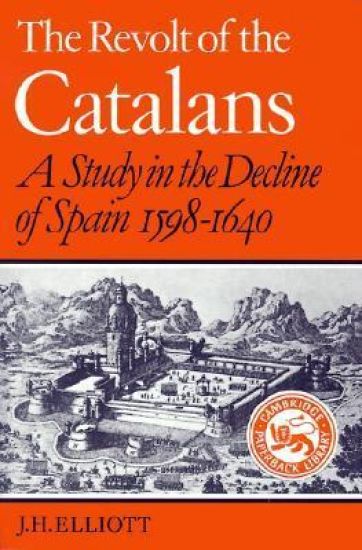
The Revolt of the Catalans

The Revolt of the Catalans

J. H. Elliott

Cambridge University Press
1984
pokkari
The revolution of Catalonia in 1640 was a signal event in seventeenth-century Europe. Its causes and antecedents - essential for an understanding of the revolution itelf - form the basis of Professor Elliott’s study of the Spanish monarchy at this time. They throw remarkable light on the whole question of the decline of Spain in the seventeenth century from its position of pre-eminence in Europe. From the fierce suppression of Catalan bandits by their Castilian overlords during the second decade of the century, Professor Elliott traces the gradual deterioration of relations between the principality of Catalonia and the government in Madrid. He shows how Olivares, the favourite and chief minister of Philip IV, attempted to use Catalan resources to fight Spain’s foreign wars, and how the growing tension led ultimately to a revolution, which he suggests played a crucial part in Spain’s decline. Professor Elliott’s story is almost entirely based on previously unknown documents found in the Spanish national and local archives. These sources enabled him to write the first full-scale treatment of Olivares and his policies. While exciting as a story in its own right, it also stands as a case-history of the perennial struggle between regional liberties and the claims of central governments.
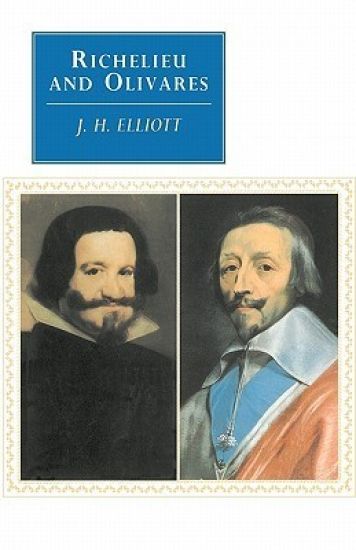
Richelieu and Olivares

Richelieu and Olivares

J. H. Elliott

Cambridge University Press
1991
pokkari
Cardinal Richelieu is one of the best known and most studied statesmen in European history; his Spanish contemporary and rival, the Count-Duke of Olivares, one of the least known. The contrasting historical fortunes of the two men reflect the outcome of the great struggle in seventeenth-century Europe between France and Spain: the triumph of France assured the fame of Richelieu, while Spain’s failure condemned Olivares to historical neglect. This fascinating book by the distinguished historian J. H. Elliott argues that contemporaries, for whom Olivares was at least as important as Richelieu, shared none of posterity’s certainty about the inevitability of that outcome. His absorbing comparative portrait of the two men, as personalities and as statesmen, through their policies and their mutual struggle, offers unique insights into seventeenth-century Europe and the nature of power and statesmanship.
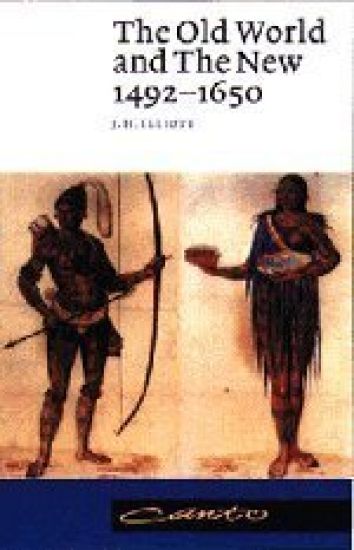
The Old World and the New

The Old World and the New

J. H. Elliott

Cambridge University Press
1992
pokkari
The impact of Europe on a newly-discovered world of America has long been a subject of historical fascination. Yet the impact of that discovery and conquest for the European conquering powers has traditionally received less attention. In this pioneering book J. H. Elliott set out to show how traditional European assumptions about geography, theology, history and the nature of man were challenged by the encounter with new lands and people; trading relationships around the world were affected by an influx of gold and silver imports from America; while politically, the sources of power were no longer confined to European territory. The 500th anniversary of Columbus’s discovery has prompted renewed enquiry into the relationship of the Old World and the New; John Elliott’s fascinating and now classic account is here reissued with a new foreword addressing the significance of the book’s insights for a new generation of readers.