
Kirjahaku
Etsi kirjoja tekijän nimen, kirjan nimen tai ISBN:n perusteella.
10 kirjaa tekijältä J.E. Blakeley

This book offers a complete survey of contemporary Soviet theory of knowledge. It is by no means meant to replace De Vries' excellent treatise on the same subject. Since De Vries depended mainly on the 'classics of Marxism' and the few contemporary Soviet works which were available in German translation, his account is at best an in troduction to the contemporary period. In a sense this book is com plementary to his: he presents the doctrines of the classics and criticizes them, this book recounts what came after and what is going on now. Epistemology and theory of knowledge are taken here as equivalent terms, representing the Soviet gnose%gija and teorija poznanija. No attempt to justify the existence of such a philosophical discipline will be attempted here. Even outside of this question of the legitimacy of epistemo logy, it is not easy to delimit the domain of its purvey. We have, therefore, taken it in a wider rather than narrow sense. This means that some ques tions of logic and psychology have been taken up - to the extent that they overlap with the field of philosophical consideration of knowledge.

This book offers a complete survey of contemporary Soviet theory of knowledge. It is by no means meant to replace De Vries' excellent treatise on the same subject. Since De Vries depended mainly on the 'classics of Marxism' and the few contemporary Soviet works which were available in German translation, his account is at best an in troduction to the contemporary period. In a sense this book is com plementary to his: he presents the doctrines of the classics and criticizes them, this book recounts what came after and what is going on now. Epistemology and theory of knowledge are taken here as equivalent terms, representing the Soviet gnose%gija and teorija poznanija. No attempt to justify the existence of such a philosophical discipline will be attempted here. Even outside of this question of the legitimacy of epistemo logy, it is not easy to delimit the domain of its purvey. We have, therefore, taken it in a wider rather than narrow sense. This means that some ques tions of logic and psychology have been taken up - to the extent that they overlap with the field of philosophical consideration of knowledge.
The present work is a study of the method of contemporary Soviet philosophy. By "Soviet philosophy" we mean philosophy as published in the Soviet Union. For practical purposes we have limited our attention to Soviet sources in Russian in spite of the fact that Soviet philosophical works are also published in other languages (see B 2029(21)(38». The term "method" is taken in the sense usual in Western books on methodology .1 In view of the content of the first chapter it will be useful to explain the last term a little more fully. By method we mean a procedure and it is obvious that the principles according to which a procedure is carried out are rules, i.e. imperatives, which tell us not what is but what should be done. Such imperatives mayor may not be connected with and founded on certain descriptive statements (the fact that every rule of formal logic is based on a corresponding law has been well-known since Husserl's "Logische Unter suchungen" and is generally accepted in contemporary logic), but such a foundation is irrelevant to a methodological study. The object of such a study is to find out what these rules are, why they are accepted and how they are inter-connected and applied. This is how methodology - the science of method - is conceived in Western treatises on the subject and this is also the standpoint assumed here.
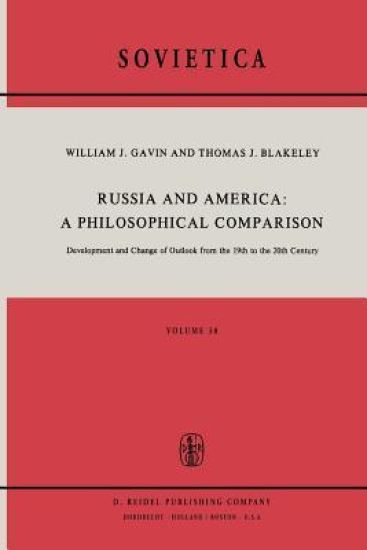
Russia and America: A Philosophical Comparison
W.J. Gavin; J.E. Blakeley
Kluwer Academic Publishers
1976
sidottu
In this year of bicentennial celebration, there will no doubt take place several cultural analyses of the American tradition. This is only as it should be, for without an extensive, broad-based inquiry into where we have come from, we shall surely not foresee where we might go. Nonetheless, most cultural analyses of the American context suffer from a common fault - the lack of a different context to use for purposes of comparison. True, American values and ideals were partly inherited from the European tradition. But that tradition is in many ways an inadequate mode of comparison. Without going too far afield, let us note two points: first, European culture was the proud inheritor of the Renaissance tradition, and, going back still further, of classical culture; second, the European countries are compact. Their land masses are such that the notion of "frontier" simply would not have arisen in the same way as it did in America. On the other side of the globe, however, there does exist a country capable of serving as a suitable mirror. We speak, of course, of Russia. That country also came relatively late onto the cultural horizon, and was not privy to the Renaissance tradition. Furthermore, her land mass is such as to be "experi mentally infmite" in character - not unlike the American frontier. It is hoped that much can be leamed about the present cultural context by com paring the two countries in their youthful stages.
In this year of bicentennial celebration, there will no doubt take place several cultural analyses of the American tradition. This is only as it should be, for without an extensive, broad-based inquiry into where we have come from, we shall surely not foresee where we might go. Nonetheless, most cultural analyses of the American context suffer from a common fault - the lack of a different context to use for purposes of comparison. True, American values and ideals were partly inherited from the European tradition. But that tradition is in many ways an inadequate mode of comparison. Without going too far afield, let us note two points: first, European culture was the proud inheritor of the Renaissance tradition, and, going back still further, of classical culture; second, the European countries are compact. Their land masses are such that the notion of "frontier" simply would not have arisen in the same way as it did in America. On the other side of the globe, however, there does exist a country capable of serving as a suitable mirror. We speak, of course, of Russia. That country also came relatively late onto the cultural horizon, and was not privy to the Renaissance tradition. Furthermore, her land mass is such as to be "experi mentally infmite" in character - not unlike the American frontier. It is hoped that much can be leamed about the present cultural context by com paring the two countries in their youthful stages.
On February 24-25, 1956, in a closed session of the 20th Congress of the Communist Party of the Soviet Union, Nikita S. Khrushchev made his now famous speech on the crimes of the Stalin era. That speech marked a break with the past and it marked the end of what J.M. Bochenski dubbed the "dead period" of Soviet philosophy. Soviet philosophy changed abruptly after 1956, especially in the area of dialectical materialism. Yet most philosophers in the West neither noticed nor cared. For them, the resurrection of Soviet philosophy, even if believable, was of little interest. The reasons for the lack of belief and interest were multiple. Soviet philosophy had been dull for so long that subtle differences made little difference. The Cold War was in a frigid period and reinforced the attitude of avoiding anything Soviet. Phenomenology and exis tentialism were booming in Europe and analytic philosophy was king on the Anglo-American philosophical scene. Moreover, not many philosophers in the West knew or could read Russian or were motivated to learn it to be able to read Soviet philosophical works. The launching of Sputnik awakened the West from its self complacent slumbers. Academic interest in the Soviet Union grew.

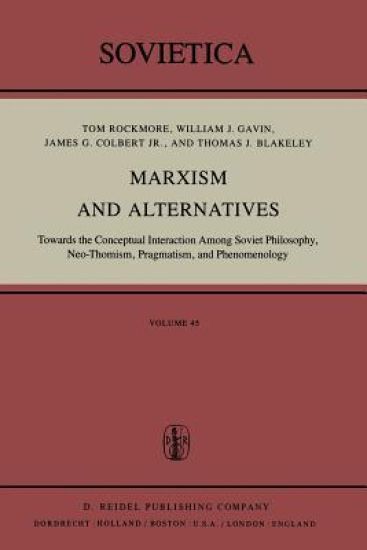
Marxism and Alternatives
I Rockmore; W.J. Gavin; J.G. Colbert Jr.; J.E. Blakeley
Kluwer Academic Publishers
1981
sidottu
Contemporary philosophy is by its nature pluralistic, to a perhaps greater extent than at any moment of the preceding tradition, in that there are multiple forms of thought competing for a position on the center of the philosophic stage. The reasons for this conceptual proliferation are numerous. But certainly one factor is the increasing development of contemporary means of publication and communication, which in turn make possible the rapid dissemination of ideas as well as an informed reaction to them. And this in turn has increased the possibility for serious philosophic exchange by enhancing the available opportunities for the interaction of competing forms of thought. But, although informed philosophic interaction has in principle become increasingly possible in recent years, the frequency, scope and quality of such discussion has often been less than satisfactory. Contemporary philosophic viewpoints tend not to interact in a Hegelian manner, as complementary aspects of a totally satisfactory and a-perspectival view, facets of a singly and all-embracing true position. Rather, contemporary philosophic viewpoints tend to portray themselves as mutually exclusive alternatives only occasionally willing to acknowledge the possible validity or even the intrinsic interest of other perspectives. Thus, although the multiplication of different forms of philosophy in principle means that there are greater possibilities for meaning ful exchange between them, in practice the tendency of each of the various philosophic positions to raise claims to philosophic truth from its point of view alone has had the effect of impeding such interaction.
Marxism and Alternatives
I Rockmore; W.J. Gavin; J.G. Colbert Jr.; J.E. Blakeley
Springer
2011
nidottu
Contemporary philosophy is by its nature pluralistic, to a perhaps greater extent than at any moment of the preceding tradition, in that there are multiple forms of thought competing for a position on the center of the philosophic stage. The reasons for this conceptual proliferation are numerous. But certainly one factor is the increasing development of contemporary means of publication and communication, which in turn make possible the rapid dissemination of ideas as well as an informed reaction to them. And this in turn has increased the possibility for serious philosophic exchange by enhancing the available opportunities for the interaction of competing forms of thought. But, although informed philosophic interaction has in principle become increasingly possible in recent years, the frequency, scope and quality of such discussion has often been less than satisfactory. Contemporary philosophic viewpoints tend not to interact in a Hegelian manner, as complementary aspects of a totally satisfactory and a-perspectival view, facets of a singly and all-embracing true position. Rather, contemporary philosophic viewpoints tend to portray themselves as mutually exclusive alternatives only occasionally willing to acknowledge the possible validity or even the intrinsic interest of other perspectives. Thus, although the multiplication of different forms of philosophy in principle means that there are greater possibilities for meaning ful exchange between them, in practice the tendency of each of the various philosophic positions to raise claims to philosophic truth from its point of view alone has had the effect of impeding such interaction.