Kirjojen hintavertailu. Mukana 11 699 587 kirjaa ja 12 kauppaa.

Kirjahaku

Etsi kirjoja tekijän nimen, kirjan nimen tai ISBN:n perusteella.

3 kirjaa tekijältä J.K. Petersen

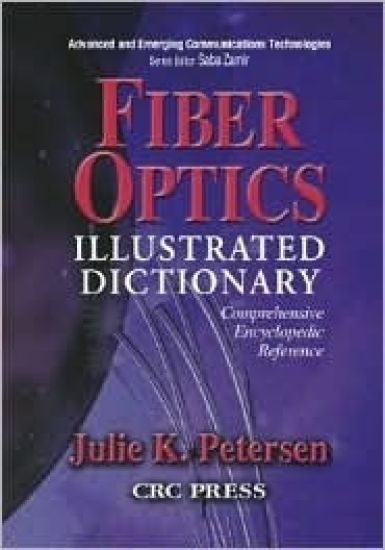
Fiber Optics Illustrated Dictionary

Fiber Optics Illustrated Dictionary

J.K. Petersen

CRC Press Inc
2002
nidottu
Within a few short years, fiber optics has skyrocketed from an interesting laboratory experiment to a billion-dollar industry. But with such meteoric growth and recent, exciting advances, even references published less than five years ago are already out of date. The Fiber Optics Illustrated Dictionary fills a gap in the literature by providing instructors, hobbyists, and top-level engineers with an accessible, current reference. From the author of the best-selling Telecommunications Illustrated Dictionary, this comprehensive reference includes fundamental physics, basic technical information for fiber splicing, installation, maintenance, and repair, and follow-up information for communications and other professionals using fiber optic components. Well-balanced, well-researched, and extensively cross-referenced, it also includes hundreds of photographs, charts, and diagrams that clarify the more complex ideas and put simpler ideas into their applications context. Fiber optics is a vibrant field, not just in terms of its growth and increasing sophistication, but also in terms of the people, places, and details that make up this challenging and rewarding industry. In addition to furnishing an authoritative, up-to-date resource for relevant industry definitions, this dictionary introduces many exciting recent applications as well as hinting at emerging future technologies.
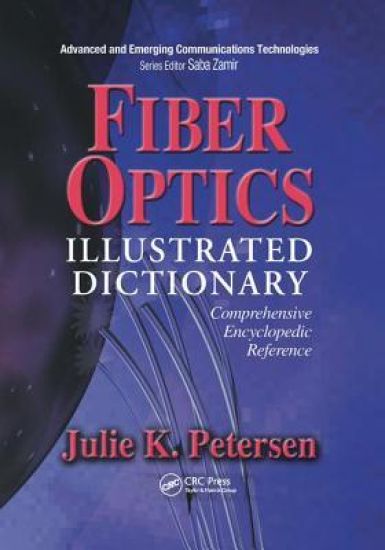
Fiber Optics Illustrated Dictionary
Within a few short years, fiber optics has skyrocketed from an interesting laboratory experiment to a billion-dollar industry. But with such meteoric growth and recent, exciting advances, even references published less than five years ago are already out of date. The Fiber Optics Illustrated Dictionary fills a gap in the literature by providing instructors, hobbyists, and top-level engineers with an accessible, current reference. From the author of the best-selling Telecommunications Illustrated Dictionary, this comprehensive reference includes fundamental physics, basic technical information for fiber splicing, installation, maintenance, and repair, and follow-up information for communications and other professionals using fiber optic components. Well-balanced, well-researched, and extensively cross-referenced, it also includes hundreds of photographs, charts, and diagrams that clarify the more complex ideas and put simpler ideas into their applications context. Fiber optics is a vibrant field, not just in terms of its growth and increasing sophistication, but also in terms of the people, places, and details that make up this challenging and rewarding industry. In addition to furnishing an authoritative, up-to-date resource for relevant industry definitions, this dictionary introduces many exciting recent applications as well as hinting at emerging future technologies.
Introduction to Surveillance Studies

Introduction to Surveillance Studies

J.K. Petersen

Routledge Member of the Taylor and Francis Group
2012
sidottu
Surveillance is a divisive issue—one might say it is inherently controversial. Used by private industry, law enforcement, and for national security, it can be a potent tool for protecting resources and assets. It can also be extremely invasive, calling into question our basic rights to freedom and privacy. Introduction to Surveillance Studies explores technological trends, past- and present-day rationales for surveillance and surveillance devices, and current social issues surrounding them.The book begins with a brief historical perspective on the evolution of surveillance technologies, then charts the development of modern-day devices from the invention of radar to the dawn of the Internet. Next, it describes emerging technologies—including GIS, GPS devices, Google Maps, biometric technology, surveillance cameras, global satellites, miniaturization of devices, and social media—that are challenging notions of privacy and the right of access to information. While focusing on the technology, the book also discusses surveillance as a phenomenon and what these technologies mean to our understanding of freedom, privacy, and the impact of technology on communications and the structure of society. Enhanced with numerous photos, the book presents the pros and cons—and some of the controversy—of these increasingly sophisticated technologies, their collective impact, and what the future may hold. It is ideal for those new to surveillance; security, military, and law enforcement professionals who utilize surveillance technologies; and students of privacy, constitutional freedom, journalism, and sociology.