Kirjojen hintavertailu. Mukana 11 342 296 kirjaa ja 12 kauppaa.

Kirjahaku

Etsi kirjoja tekijän nimen, kirjan nimen tai ISBN:n perusteella.

6 kirjaa tekijältä Jacob L. Wright

David, King of Israel, and Caleb in Biblical Memory

David, King of Israel, and Caleb in Biblical Memory

Jacob L. Wright

Cambridge University Press
2014
sidottu
Of all the Bible's personalities, David is the most profoundly human. Courageous, cunning, and complex, he lives life to the hilt. Whatever he does, he does with all his might, exuding both vitality and vulnerability. No wonder it has been said that Israel revered Moses yet loved David. But what do we now know about the historical David? Why does his story stand at the center of the Bible? Why didn't the biblical authors present him in a more favorable light? And what is the special connection between him and Caleb - the Judahite hero remembered for his valor during the wars of conquest? In this groundbreaking study, Jacob L. Wright addresses all these questions and presents a new way of reading the biblical accounts. His work compares the function of these accounts to the role war memorials play over time. The result is a rich study that treats themes of national identity, statehood, the exercise of power, and the human condition.
David, King of Israel, and Caleb in Biblical Memory

David, King of Israel, and Caleb in Biblical Memory

Jacob L. Wright

Cambridge University Press
2014
pokkari
Of all the Bible's personalities, David is the most profoundly human. Courageous, cunning, and complex, he lives life to the hilt. Whatever he does, he does with all his might, exuding both vitality and vulnerability. No wonder it has been said that Israel revered Moses yet loved David. But what do we now know about the historical David? Why does his story stand at the center of the Bible? Why didn't the biblical authors present him in a more favorable light? And what is the special connection between him and Caleb - the Judahite hero remembered for his valor during the wars of conquest? In this groundbreaking study, Jacob L. Wright addresses all these questions and presents a new way of reading the biblical accounts. His work compares the function of these accounts to the role war memorials play over time. The result is a rich study that treats themes of national identity, statehood, the exercise of power, and the human condition.
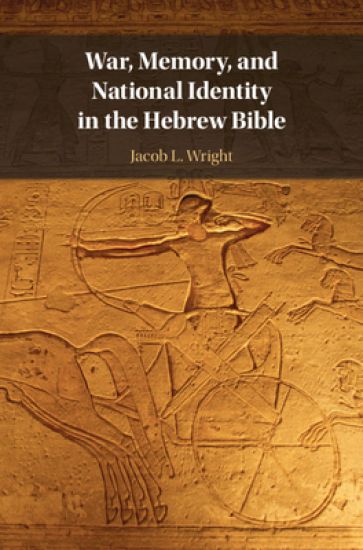
War, Memory, and National Identity in the Hebrew Bible

War, Memory, and National Identity in the Hebrew Bible

Jacob L. Wright

Cambridge University Press
2020
sidottu
The Hebrew Bible is permeated with depictions of military conflicts that have profoundly shaped the way many think about war. Why does war occupy so much space in the Bible? In this book, Jacob Wright offers a fresh and fascinating response to this question: War pervades the Bible not because ancient Israel was governed by religious factors (such as 'holy war') or because this people, along with its neighbors in the ancient Near East, was especially bellicose. The reason is rather that the Bible is fundamentally a project of constructing a new national identity for Israel, one that can both transcend deep divisions within the population and withstand military conquest by imperial armies. Drawing on the intriguing interdisciplinary research on war commemoration, Wright shows how biblical authors, like the architects of national identities from more recent times, constructed a new and influential notion of peoplehood in direct relation to memories of war, both real and imagined. This book is also available as Open Access on Cambridge Core.
Why the Bible Began

Why the Bible Began

Jacob L. Wright

Cambridge University Press
2023
sidottu
Why did no other ancient society produce something like the Bible? That a tiny, out of the way community could have created a literary corpus so determinative for peoples across the globe seems improbable. For Jacob Wright, the Bible is not only a testimony of survival, but also an unparalleled achievement in human history. Forged after Babylon's devastation of Jerusalem, it makes not victory but total humiliation the foundation of a new idea of belonging. Lamenting the destruction of their homeland, scribes who composed the Bible imagined a promise-filled past while reflecting deeply on abject failure. More than just religious scripture, the Bible began as a trailblazing blueprint for a new form of political community. Its response to catastrophe offers a powerful message of hope and restoration that is unique in the Ancient Near Eastern and Greco-Roman worlds. Wright's Bible is thus a social, political, and even economic roadmap - one that enabled a small and obscure community located on the periphery of leading civilizations and empires not just to come back from the brink, but ultimately to shape the world's destiny. The Bible speaks ultimately of being a united yet diverse people, and its pages present a manual of pragmatic survival strategies for communities confronting societal collapse.
Why the Bible Began

Why the Bible Began

Jacob L. Wright

Cambridge University Press
2025
pokkari
Why did no other ancient society produce something like the Bible? That a tiny, out of the way community could have created a literary corpus so determinative for peoples across the globe seems improbable. For Jacob Wright, the Bible is not only a testimony of survival, but also an unparalleled achievement in human history. Forged after Babylon's devastation of Jerusalem, it makes not victory but total humiliation the foundation of a new idea of belonging. Lamenting the destruction of their homeland, scribes who composed the Bible imagined a promise-filled past while reflecting deeply on abject failure. More than just religious scripture, the Bible began as a trailblazing blueprint for a new form of political community. Its response to catastrophe offers a powerful message of hope and restoration that is unique in the Ancient Near Eastern and Greco-Roman worlds. Wright's Bible is thus a social, political, and even economic roadmap - one that enabled a small and obscure community located on the periphery of leading civilizations and empires not just to come back from the brink, but ultimately to shape the world's destiny. The Bible speaks ultimately of being a united yet diverse people, and its pages present a manual of pragmatic survival strategies for communities confronting societal collapse.
Rebuilding Identity

Rebuilding Identity

Jacob L. Wright

De Gruyter
2004
sidottu
This monograph presents a fresh and detailed treatment of the problems posed by the Nehemiah-Memoir. Starting from the pre-critical interpretations of Ezra-Neh, the study demonstrates that the use of the first-person does not suffice as a criterion for distinguishing between the verba Neemiae and the additions of later authors. The earliest edition of the Memoir isconfined to a building report, which was expanded as early generations of readers developed the implications of Nehemiah's accomplishments for the consolidation and centralization of Judah. The expansions occasioned in turn the composition of the history of the "Restoration" in Ezra-Neh.