Kirjojen hintavertailu. Mukana 12 390 323 kirjaa ja 12 kauppaa.

Kirjahaku

Etsi kirjoja tekijän nimen, kirjan nimen tai ISBN:n perusteella.

10 kirjaa tekijältä Jacqueline de Romilly

The Mind of Thucydides

The Mind of Thucydides

Jacqueline de Romilly

Cornell University Press
2012
sidottu
The publication of Jacqueline de Romilly's Histoire et raison chez Thucydide in 1956 virtually transformed scholarship on Thucydides. Rather than mining The Peloponnesian War to speculate on its layers of composition or second-guess its accuracy, it treated it as a work of art deserving rhetorical and aesthetic analysis. Ahead of its time in its sophisticated focus upon the verbal texture of narrative, it proved that a literary approach offered the most productive and nuanced way to study Thucydides. Still in print in the original French, the book has influenced numerous Classicists and historians, and is now available in English for the first time in a careful translation by Elizabeth Trapnell Rawlings. The Cornell edition includes an introduction by Hunter R. Rawlings III and Jeffrey Rusten tracing the context of this book's original publication and its continuing influence on the study of Thucydides. Romilly shows that Thucydides constructs his account of the Peloponnesian War as a profoundly intellectual experience for readers who want to discern the patterns underlying historical events. Employing a commanding logic that exercises total control over the data of history, Thucydides uses rigorous principles of selection, suggestive juxtapositions, and artfully opposed speeches to reveal systematic relationships between plans and outcomes, impose meaning on the smallest events, and insist on the constant battle between intellect and chance. Thucydides' mind found in unity and coherence its ideal of historical truth.
The Mind of Thucydides

The Mind of Thucydides

Jacqueline de Romilly

Cornell University Press
2017
pokkari
The publication of Jacqueline de Romilly's Histoire et raison chez Thucydide in 1956 virtually transformed scholarship on Thucydides. Rather than mining The Peloponnesian War to speculate on its layers of composition or second-guess its accuracy, it treated it as a work of art deserving rhetorical and aesthetic analysis. Ahead of its time in its sophisticated focus upon the verbal texture of narrative, it proved that a literary approach offered the most productive and nuanced way to study Thucydides. Still in print in the original French, the book has influenced numerous Classicists and historians, and is now available in English for the first time in a careful translation by Elizabeth Trapnell Rawlings. The Cornell edition includes an introduction by Hunter R. Rawlings III and Jeffrey Rusten tracing the context of this book's original publication and its continuing influence on the study of Thucydides. Romilly shows that Thucydides constructs his account of the Peloponnesian War as a profoundly intellectual experience for readers who want to discern the patterns underlying historical events. Employing a commanding logic that exercises total control over the data of history, Thucydides uses rigorous principles of selection, suggestive juxtapositions, and artfully opposed speeches to reveal systematic relationships between plans and outcomes, impose meaning on the smallest events, and insist on the constant battle between intellect and chance. Thucydides' mind found in unity and coherence its ideal of historical truth.
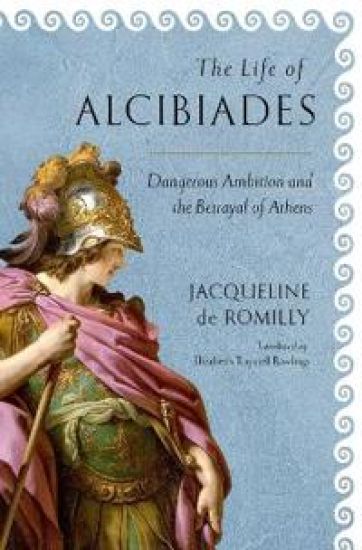
The Life of Alcibiades

The Life of Alcibiades

Jacqueline de Romilly

Cornell University Press
2019
sidottu
This biography of Alcibiades, the charismatic Athenian statesman and general (c. 450–404 BC) who achieved both renown and infamy during the Peloponnesian War, is both an extraordinary adventure story and a cautionary tale that reveals the dangers that political opportunism and demagoguery pose to democracy. As Jacqueline de Romilly brilliantly documents, Alcibiades's life is one of wanderings and vicissitudes, promises and disappointments, brilliant successes and ruinous defeats. Born into a wealthy and powerful family in Athens, Alcibiades was a student of Socrates and disciple of Pericles, and he seemed destined to dominate the political life of his city—and his tumultuous age. Romilly shows, however, that he was too ambitious. Haunted by financial and sexual intrigues and political plots, Alcibiades was exiled from Athens, sentenced to death, recalled to his homeland, only to be exiled again. He defected from Athens to Sparta and from Sparta to Persia and then from Persia back to Athens, buffeted by scandal after scandal, most of them of his own making. A gifted demagogue and, according to his contemporaries, more handsome than the hero Achilles, Alcibiades is also a strikingly modern figure, whose seductive celebrity and dangerous ambition anticipated current crises of leadership.
La Crainte Et L'Angoisse Dans Le Theatre D'Eschyle

La Crainte Et L'Angoisse Dans Le Theatre D'Eschyle

Jacqueline de Romilly

Les Belles Lettres
1971
nidottu
'Why am I shivering' Orestes cries out as madness overtakes him. While Racine chose to put these words in the mouth of the Greek hero, they would have been perfectly suited for Aeschylus' eponymous tragedy and, in broader terms, for all of his plays. In all its forms - metaphorical, sentimental, religious, physical or even medical - fear inhabits Aeschylus' characters and invades the audience. In this groundbreaking study, Jacqueline de Romilly analyses the various faces of fear in Aeschylus' poetry, as well as their meaning.
La Douceur Dans La Pensee Grecque

La Douceur Dans La Pensee Grecque

Jacqueline de Romilly

Les Belles Lettres
1979
nidottu
Why speak of gentleness in a world dominated by justice and heroism, in which cruel myths and tragedies abound, and in which the view of human life is harsh and violent? The Iliad is a poem about battles and death. Thucydides' historical works depict the violent physical and moral acts committed in a merciless war. The emergence of a gentleness ideal in Greek thought is an even more extraordinary phenomenon. How did it manage to occur in such an unfavourable context, gain so much momentum at the end of the fifth century that it is still evident in contemporary Greek philosophy? Gentleness is described on these pages as a humane attitude, one belonging to the realm of ethics and embodying the Greek ideal. In this book, Jacqueline de Romilly examines a practical behaviour whose nature varies according to circumstances: gentle ways, kindness towards others, generosity, goodness, tolerance, understanding, humanity, charity, mildness, and other values designated by the same word: praos.
L' Evolution Du Pathetique d'Eschyle a Euripide

L' Evolution Du Pathetique d'Eschyle a Euripide

Jacqueline de Romilly

Les Belles Lettres
1980
nidottu
Toute connaissance s'eclaire par la comparaison. En particulier, toute oeuvre litteraire se comprend d'autant mieux que l'on peut la situer plus rigoureusement par rapport a celles qui l'ont precedee et a partir desquelles elle s'est definie. Or, s'il est un domaine qui prete a des comparaisons de ce genre, c'est bien celui du theatre grec. Sans doute serait-ce le cas pour n'importe quelle serie d'oeuvres dans la litterature grecque, car celle-ci presente ce double caractere d'avoir ete entrainee, du moins a l'epoque classique, par un elan de renouvellement exceptionel et d'avoir cependant volontiers deguise ses innovations sous le masque de la tradition. Cependant, le fait est plus sensible encore dans le domaine de la tragedie. La, en l'espace d'un siecle, on dispose de trois auteurs, qui se sont succede de facon continue, avec des periodes de chevauchement importantes; et ces trois auteurs n'ont cesse de donner a un meme public, dans un meme cadre materiel, des pieces de meme structure, pourtant sur les memes sujets - pieces qui etaient, pourtant, profondement differentes.
Magie Et Rhetorique En Grece Ancienne

Magie Et Rhetorique En Grece Ancienne

Jacqueline De Romilly

Les Belles Lettres
2019
nidottu
Creditee d'une origine divine par les Anciens, la poesie a le pouvoir d'emouvoir et de charmer. Les fondateurs de la rhetorique l'avaient bien compris, utilisant les rythmes et les styles poetiques pour conferer a leurs discours le pouvoir d'envouter l'auditoire a la maniere des magiciens. Dans ces quatre conferences prononcees a l'universite de Harvard en 1974, inedites en francais, Jacqueline de Romilly analyse la relation liant l'enchantement par les mots a l'inspiration divine et a la magie. Depuis l'audace des procedes oratoires de Gorgias et leur condamnation platonicienne, a travers la volonte de definition d'un art du discours par Isocrate et Aristote, jusqu'a la reintroduction du sublime et de l'irrationnel en litterature par les auteurs plus tardifs, Jacqueline de Romilly met en valeur l'aptitude des anciens Grecs a entretenir un dialogue a travers les siecles, dans lequel chacun repond avec precision et subtilite a son predecesseur.