Kirjojen hintavertailu. Mukana 11 699 587 kirjaa ja 12 kauppaa.

Kirjahaku

Etsi kirjoja tekijän nimen, kirjan nimen tai ISBN:n perusteella.

5 kirjaa tekijältä Jae Ho Chung

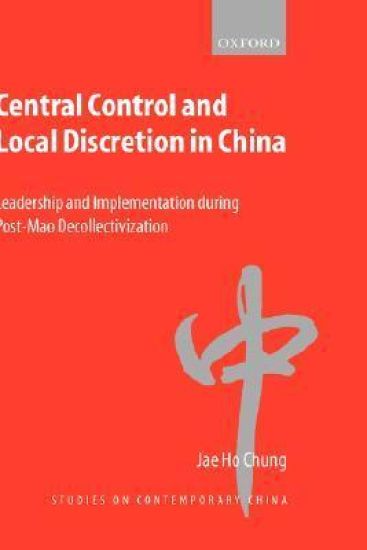
Central Control and Local Discretion in China

Central Control and Local Discretion in China

Jae Ho Chung

Oxford University Press
2000
sidottu
This book analyses the decollectivization reform in China during the early 1980s in order to gauge the impact of post-Mao decentralization on central control and provincial discretion. The volume challenges the notion that the decision to decentralize administrative authority ipso facto produces local discretion properly keyed to local conditions. In fact, outcomes often differ from the intended goals. While, generally, local interests and central-local clientilistic networks determine the policy responses of the provinces, bureaucratic careerism also plays a crucial role. In the case of post-Mao decollectivization, national-level analyses suggest that a majority of provinces adopted household farming neither too quickly nor too slowly, since both 'pioneering' and 'resisting' entailed potentially enormous political risks. Once Beijing's preference appeared firmly fixed, however, they all quickly bandwagoned by popularizing the policy as swiftly as possible. Three detailed case studies of Anhui as a pioneer, Shandong as a bandwagoner, and Heilongjiang as a resister further highlight the evolutionary process in which provincial variations came to be replaced by uniform compliance imposed by Beijing. Theoretically, this study contends that the overall scope of local discretion is circumscribed by the dominant norms and incentive relations embedded in the implementation dynamics. Methodologically, the book employs a combination of aggregate analyses and comparative case studies. Empirically, on the basis of newly available materials (including classified documents) and interviews, it challenges the 'peasant-power' school which has somehow allowed local governments to evaporate in its descriptions of post-Mao decollectivization.
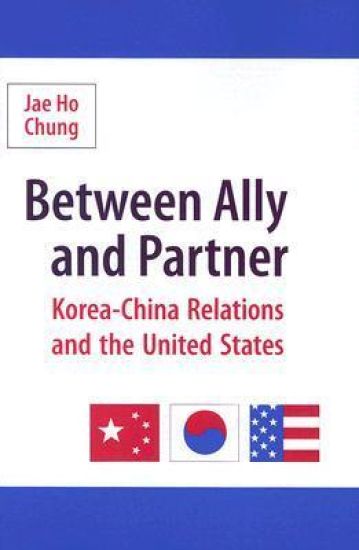
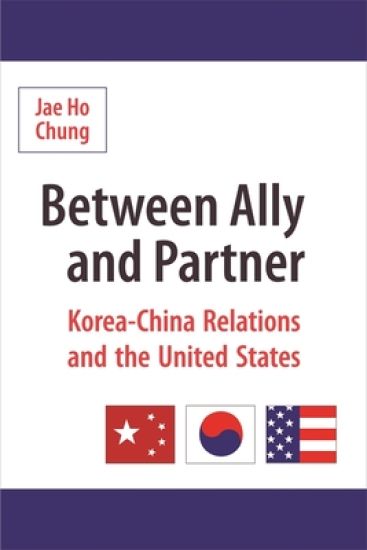
Between Ally and Partner

Between Ally and Partner

Jae Ho Chung

Columbia University Press
2006
sidottu
China and South Korea have come a long way since they were adversaries. The arc of their relationship since the late 1970s is an excellent model of East-West cooperation and, at the same time, highlights the growing impact of China's "rise" over its regional neighbors, including America's close allies. South Korea-China relations have rarely been studied as an independent theme. The accumulation of more than fifteen years of research, Between Ally and Partner reconstructs a comprehensive portrait of Sino-Korean rapprochement and examines the strategic dilemma that the rise of China has posed for South Korea and its alliance with the United States. Jae Ho Chung makes use of declassified government archives, internal reports, and opinion surveys and conducts personal interviews with Korean, Chinese, and American officials. He tackles three questions: Why did South Korea and China reconcile before the end of the cold war? How did rapprochement lay the groundwork for diplomatic normalization? And what will the intersection of security concerns and economic necessity with China mean for South Korea's relationship with its close ally, the United States? The implications of Sino-Korean relations go far beyond the Korean Peninsula. South Korea was caught largely unprepared, both strategically and psychologically, by China's rise, and the dilemma that South Korea now faces has crucial ramifications for many countries in Asia, where attempts to counterbalance China have been rare. Thoroughly investigated and clearly presented, this book answers critical questions concerning what kept these two countries talking and how enmity was transformed into a zeal for partnership.
Between Ally and Partner

Between Ally and Partner

Jae Ho Chung

Columbia University Press
2008
pokkari
China and South Korea have come a long way since they were adversaries. The arc of their relationship since the late 1970s is an excellent model of East-West cooperation and, at the same time, highlights the growing impact of China's "rise" over its regional neighbors, including America's close allies. South Korea-China relations have rarely been studied as an independent theme. The accumulation of more than fifteen years of research, Between Ally and Partner reconstructs a comprehensive portrait of Sino-Korean rapprochement and examines the strategic dilemma that the rise of China has posed for South Korea and its alliance with the United States. Jae Ho Chung makes use of declassified government archives, internal reports, and opinion surveys and conducts personal interviews with Korean, Chinese, and American officials. He tackles three questions: Why did South Korea and China reconcile before the end of the cold war? How did rapprochement lay the groundwork for diplomatic normalization? And what will the intersection of security concerns and economic necessity with China mean for South Korea's relationship with its close ally, the United States? The implications of Sino-Korean relations go far beyond the Korean Peninsula. South Korea was caught largely unprepared, both strategically and psychologically, by China's rise, and the dilemma that South Korea now faces has crucial ramifications for many countries in Asia, where attempts to counterbalance China have been rare. Thoroughly investigated and clearly presented, this book answers critical questions concerning what kept these two countries talking and how enmity was transformed into a zeal for partnership.
Centrifugal Empire

Centrifugal Empire

Jae Ho Chung

Columbia University Press
2016
sidottu
Despite the destabilizing potential of governing of a vast territory and a large multicultural population, the centralized government of the People's Republic of China has held together for decades, resisting efforts at local autonomy. By analyzing Beijing's strategies for maintaining control even in the reformist post-Mao era, Centrifugal Empire reveals the unique thinking behind China's approach to local governance, its historical roots, and its deflection of divergent interests. Centrifugal Empire examines the logic, mode, and instrument of local governance established by the People's Republic, and then compares the current system to the practices of its dynastic predecessors. The result is an expansive portrait of Chinese leaders' attitudes toward regional autonomy and local challenges, one concerned with territory-specific preoccupations and manifesting in constant searches for an optimal design of control. Jae Ho Chung reveals how current communist instruments of local governance echo imperial institutions, while exposing the Leninist regime's savvy adaptation to contemporary issues and its need for more sophisticated inter-local networks to keep its unitary rule intact. He casts the challenges to China's central-local relations as perennial, since the dilution of the system's "socialist" or "Communist" character will only accentuate its fundamentally Chinese-or centrifugal-nature.
Centrifugal Empire

Centrifugal Empire

Jae Ho Chung

Columbia University Press
2019
pokkari
Despite the destabilizing potential of governing of a vast territory and a large multicultural population, the centralized government of the People's Republic of China has held together for decades, resisting efforts at local autonomy. By analyzing Beijing's strategies for maintaining control even in the reformist post-Mao era, Centrifugal Empire reveals the unique thinking behind China's approach to local governance, its historical roots, and its deflection of divergent interests.Centrifugal Empire examines the logic, mode, and instrument of local governance established by the People's Republic, and then compares the current system to the practices of its dynastic predecessors. The result is an expansive portrait of Chinese leaders' attitudes toward regional autonomy and local challenges, one concerned with territory-specific preoccupations and manifesting in constant searches for an optimal design of control. Jae Ho Chung reveals how current communist instruments of local governance echo imperial institutions, while exposing the Leninist regime's savvy adaptation to contemporary issues and its need for more sophisticated inter-local networks to keep its unitary rule intact. He casts the challenges to China's central–local relations as perennial, since the dilution of the system's "socialist" or "Communist" character will only accentuate its fundamentally Chinese—or centrifugal—nature.