
Kirjojen hintavertailu. Mukana 12 390 323 kirjaa ja 12 kauppaa.

Kirjahaku

Etsi kirjoja tekijän nimen, kirjan nimen tai ISBN:n perusteella.

4 kirjaa tekijältä Jae-Hee Jung

Shared Morals

Shared Morals

Jae-Hee Jung

Cambridge University Press
2026
sidottu
Political parties often use moral arguments—judgements about fundamental notions of right and wrong—to frame and explain their political views. Morality is an aspect of politics that people are regularly exposed to in real life. But what role does moral rhetoric play in party politics? And how does it shape our views? Focusing on Western democracies, Shared Morals examines what moral rhetoric looks like, how it affects voters, and how it is relevant for democratic representation. Drawing from studies on party competition, political behavior, and moral and political psychology, the book illustrates that moral rhetoric is an integral aspect of party communication. Yet, unlike many current narratives in the scholarly and policymaking worlds, Shared Morals draws attention to the potential for moral rhetoric to highlight common grounds, bridge differences, and bring people together.

Shared Morals

Shared Morals

Jae-Hee Jung

Cambridge University Press
2026
pokkari
Political parties often use moral arguments—judgements about fundamental notions of right and wrong—to frame and explain their political views. Morality is an aspect of politics that people are regularly exposed to in real life. But what role does moral rhetoric play in party politics? And how does it shape our views? Focusing on Western democracies, Shared Morals examines what moral rhetoric looks like, how it affects voters, and how it is relevant for democratic representation. Drawing from studies on party competition, political behavior, and moral and political psychology, the book illustrates that moral rhetoric is an integral aspect of party communication. Yet, unlike many current narratives in the scholarly and policymaking worlds, Shared Morals draws attention to the potential for moral rhetoric to highlight common grounds, bridge differences, and bring people together.
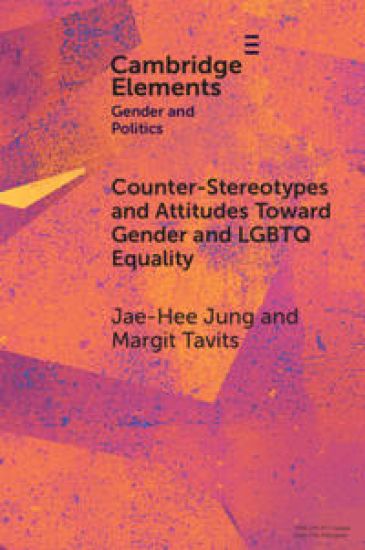
Counter-Stereotypes and Attitudes Toward Gender and LGBTQ Equality

Counter-Stereotypes and Attitudes Toward Gender and LGBTQ Equality

Jae-Hee Jung; Margit Tavits

Cambridge University Press
2024
pokkari
Insights from social psychology and the gender and politics literature, as well as discussions and campaigns in the policymaking world, suggest that exposure to counter-stereotypes about gender roles might improve people's attitudes toward gender equality and LGBTQ rights. The authors test this expectation by conducting five survey experiments (N=6,916) and a separate, follow-up experiment (N=3,600) in the US context using counter-stereotypical treatments commonly encountered in the real world. They examine both political and non-political attitudes, manipulate stereotypes about both men and women, and provide visual as well as textual stimuli. The treatments undermined stereotypes about the gender roles depicted in the counter-stereotypical exemplars. However, they failed to alter respondents' generic core beliefs about women and men and increase equitable attitudes. The results improve our understanding of how stereotypes contribute to gender and anti-LGBTQ bias.
Counter-Stereotypes and Attitudes Toward Gender and LGBTQ Equality

Counter-Stereotypes and Attitudes Toward Gender and LGBTQ Equality

Jae-Hee Jung; Margit Tavits

Cambridge University Press
2024
sidottu
Insights from social psychology and the gender and politics literature, as well as discussions and campaigns in the policymaking world, suggest that exposure to counter-stereotypes about gender roles might improve people's attitudes toward gender equality and LGBTQ rights. The authors test this expectation by conducting five survey experiments (N=6,916) and a separate, follow-up experiment (N=3,600) in the US context using counter-stereotypical treatments commonly encountered in the real world. They examine both political and non-political attitudes, manipulate stereotypes about both men and women, and provide visual as well as textual stimuli. The treatments undermined stereotypes about the gender roles depicted in the counter-stereotypical exemplars. However, they failed to alter respondents' generic core beliefs about women and men and increase equitable attitudes. The results improve our understanding of how stereotypes contribute to gender and anti-LGBTQ bias.