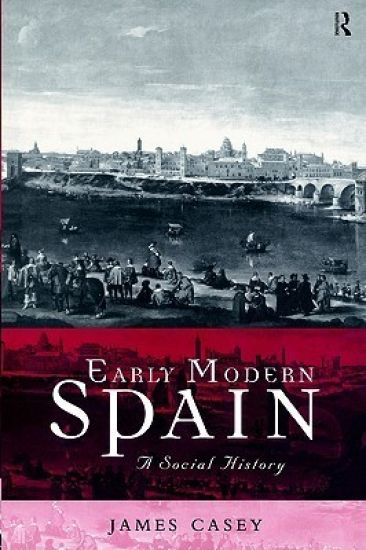
Early Modern Spain: A social History explores the solidarities which held the Spanish nation together at this time of conflict and change. The book studies the pattern of fellowship and patronage at the local level which contributed to the notable absence of popular revolts characteristic of other European countries at this time. It also analyses the Counter-Reformation, which transformed religious attitudes, and which had a huge impact on family life, social control and popular culture.Focusing on the main themes of the development of capitalism, the growth of the state and religious upheaval, this comprehensive social history sheds light on changes throughout Europe in the critical early modern period.
Early Modern Spain: A social History explores the solidarities which held the Spanish nation together at this time of conflict and change. The book studies the pattern of fellowship and patronage at the local level which contributed to the notable absence of popular revolts characteristic of other European countries at this time. It also analyses the Counter-Reformation, which transformed religious attitudes, and which had a huge impact on family life, social control and popular culture.Focusing on the main themes of the development of capitalism, the growth of the state and religious upheaval, this comprehensive social history sheds light on changes throughout Europe in the critical early modern period.
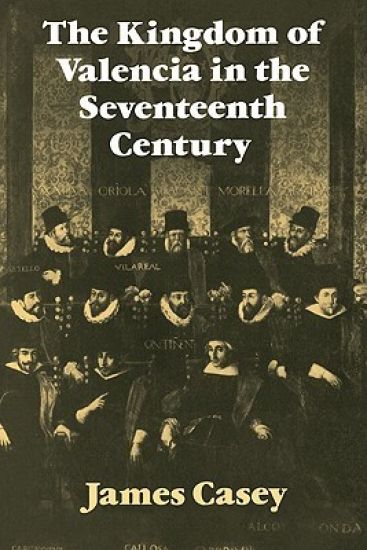
Drawing on hitherto unpublished sources James Casey explores two major themes in Spanish historiography - the consequences of the expulsion of the Moriscos (heavily concentrated in Valencia in the early seventeenth century), and the way in which the Habsburg Monarchy kept or lost control over its peripheral provinces. The study ranges widely over questions of population (including a pioneering attempt for early modern Spain at family reconstitution), landholding and agriculture, exploring the links between depopulation and economic decline - twin phenomena which characterized the peninsula in the age of Spain's decline. Dr Casey has drawn on a variety of previously neglected sources - parish registers, tithe records, cadastral surveys - in order to quantify these developments as far as possible. The result is a reassessment of the chronology and extent of economic recession in one of Spain's most fertile provinces, and a revision of some ideas about the importance of the expulsion of the Moriscos.
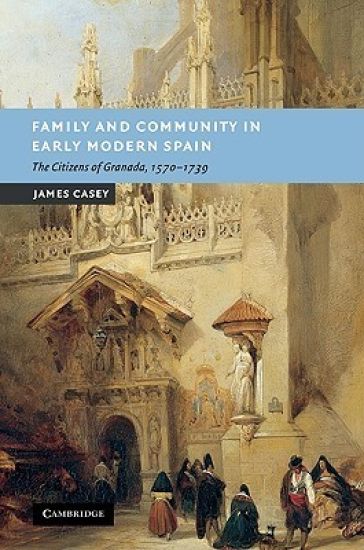
James Casey offers an innovative study of prestige, power and the role of the family in a Mediterranean city during the early modern period. He focuses on the structure and values of the ruling class of Granada, where a new elite consolidated its authority. The study suggests that their power was linked to the pursuit of honour, which demanded participation in the politics of the commonwealth and depended greatly on the network of personal relations which they were able to build with kinsmen, clients and patrons. It explores the way in which this system contributed to the relative tranquillity of the community during a turbulent time of religious and political change, that of the rise of absolutism and of the Counter Reformation. The book sheds fresh light on the nature of the early modern family and will be essential reading for historians of early modern Spain and Europe.
James Casey offers an innovative study of prestige, power and the role of the family in a Mediterranean city during the early modern period. He focuses on the structure and values of the ruling class of Granada, where a new elite consolidated its authority. The study suggests that their power was linked to the pursuit of honour, which demanded participation in the politics of the commonwealth and depended greatly on the network of personal relations which they were able to build with kinsmen, clients and patrons. It explores the way in which this system contributed to the relative tranquillity of the community during a turbulent time of religious and political change, that of the rise of absolutism and of the Counter Reformation. The book sheds fresh light on the nature of the early modern family and will be essential reading for historians of early modern Spain and Europe.
The History of the Family concerns the changing interactions between family and social, political and religious structures over the last thousand years of European history. The family is usually described in terms of patterns of kinship, inheritance, and relations between sexes and generations. The author examines the contemporary use of these terms and their evolution from nineteenth-century anthropology and social thought. He then considers how these concepts apply to and reveal the nature of European and other societies.
A former monk who taught religion and philosophy in both high school and college settings reflects on life. The story he inherited told him who he is, why he is here, where he is going and how to live along the way. In questioning that story, he explores the quest for meaning in the world today that seems to be questioning traditional values and social structures that once supported individuals. His reflections suggest that we are in a transitional phase between stories based on an ancient worldview formed without the information we have about our world today and the beginning of a new story that seeks meaning in a scientific and technological world.
. . . one should not be too ready to erect a wall of separation between nature and the human mind. d'Alembert [Dugas (1955)] It is possible to present mathematics in a purely fonnal way, that is to say, without any reference to the physical world. Indeed, in the more advanced parts of abstract algebra and mathematical logic, one can pro ceed only in this manner. In other parts of mathematics, especially in Euclidean geometry, calculus, differential equations, and surface ge ometry, intimate connections exist between the mathematical ideas and physical things. In such cases, a deeper (and sometimes quicker) under standing can be gained by taking advantage of these connections. I am not, of course, suggesting that one should appeal to physical intuition whenever one gets stuck in a mathematical proof: in proofs, there is no substitute for rigor. Rather, the connections with physical reality should be made either to motivate mathematical assumptions, or to introduce questions out of which theorems arise, or to illustrate the results of an analysis. Such interconnections are especially important in the teaching of mathematics to science and engineering students. But, mathematics students too have much to gain by familiarizing themselves with the interconnections between ideas and real things. The present book explores the geometry of curves and surfaces in a physical way.