James Fenimore Cooper's magnificent vision of American civilization was probably doomed from the outset. Yet the dream died hard, as the years (1845-1851) recorded in volumes V and VI of his Letters and Journals show. Vigorous and perceptive as ever at 55, he continued to combat forces in the national life that he feared were destroying its civility and constitutional structures. When, finally, he realized that his efforts were barren, he found some solace in religion. Cooper mellowed perceptibly in his later years, and his genius for friendship is perhaps better revealed here than in earlier volumes. And his range of observation remained kaleidoscopic: the Mexican War, the Navy, the French Revolution of 1848, the theatre, and the latest New York scandal. Nor did his productivity slacken. Between 1845 and 1850, he averaged two books a year, undertook a revised edition of his works in fine format, composed a play, and, at the time of his death, had in press The Towns of Manhattan, which was to have been the first history of Greater New York City.
James Fenimore Cooper's magnificent vision of American civilization was probably doomed from the outset. Yet the dream died hard, as the years (1845-1851) recorded in volumes V and VI of his Letters and Journals show. Vigorous and perceptive as ever at 55, he continued to combat forces in the national life that he feared were destroying its civility and constitutional structures. When, finally, he realized that his efforts were barren, he found some solace in religion. Cooper mellowed perceptibly in his later years, and his genius for friendship is perhaps better revealed here than in earlier volumes. And his range of observation remained kaleidoscopic: the Mexican War, the Navy, the French Revolution of 1848, the theatre, and the latest New York scandal. Nor did his productivity slacken. Between 1845 and 1850, he averaged two books a year, undertook a revised edition of his works in fine format, composed a play, and, at the time of his death, had in press The Towns of Manhattan, which was to have been the first history of Greater New York City. Volume VI provides a cumulative index to the entire edition and contains an important section of additional letters (1825-1844) discovered since the earlier volumes were published.
Title: Notions of the Americans; picked up by a travelling bachelor i.e. James Fenimore Cooper].Publisher: British Library, Historical Print EditionsThe British Library is the national library of the United Kingdom. It is one of the world's largest research libraries holding over 150 million items in all known languages and formats: books, journals, newspapers, sound recordings, patents, maps, stamps, prints and much more. Its collections include around 14 million books, along with substantial additional collections of manuscripts and historical items dating back as far as 300 BC.The HISTORY OF TRAVEL collection includes books from the British Library digitised by Microsoft. This collection contains personal narratives, travel guides and documentary accounts by Victorian travelers, male and female. Also included are pamphlets, travel guides, and personal narratives of trips to and around the Americas, the Indies, Europe, Africa and the Middle East. ++++The below data was compiled from various identification fields in the bibliographic record of this title. This data is provided as an additional tool in helping to insure edition identification: ++++ British Library Anonymous; Cooper, James Fenimore; 1833. 2 vol.; 12 . 10411.bbb.28.
The Deerslayer, or The First Warpath (1841) was the last of James Fenimore Cooper's Leatherstocking Tales to be written. Its 1740-1745 time period makes it the first installment chronologically and in the lifetime of the hero of the Leatherstocking tales, Natty Bumppo. The novel's setting on Otsego Lake in central, upstate New York, is the same as that of The Pioneers, the first of the Leatherstocking Tales to be published (1823). The Deerslayer is considered to be the prequel to the rest of the series. Fenimore Cooper begins his work by relating the astonishing advance of civilization in New York State, which is the setting of four of his five Leatherstocking Tales. This novel introduces Natty Bumppo as "Deerslayer": a young frontiersman in early 18th-century New York, who objects to the practice of taking scalps, on grounds that every living thing should follow "the gifts" of its nature, which would keep European Americans from taking scalps. Two characters who actually seek to take scalps are Deerslayer's foil Henry March (alias "Hurry Harry") and the former pirate 'Floating Tom' Hutter, to whom Deerslayer is introduced en route to a rendezvous with the latter's lifelong friend Chingachgook (initially apparent in The Last of the Mohicans). Shortly before the rendezvous, Hutter's residence is besieged by the indigenous Hurons, and Hutter and March sneak into the camp of the besiegers to kill and scalp as many as they can; but are captured in the act, and later ransomed by Bumppo, Chingachgook, and Hutter's daughters Judith and Hetty. Bumppo and Chingachgook thereafter plan to rescue Chingachgook's kidnapped betrothed Wah-ta-Wah (alias 'Hist') from the Hurons; but, in rescuing her, Bumppo is captured. In his absence, the Hurons invade Hutter's home, and Hutter is scalped alive. On his deathbed, he confesses that Judith and Hetty were not his daughters by birth, and Judith determines to discover her natural father's identity; but her search reveals only that her late mother had been of aristocratic descent, and had married 'Floating Tom' after the collapse of an illicit affair. Later, Judith attempts and fails to rescue Deerslayer; and they are all saved at last when March returns with English reinforcements, who massacre the Hurons and mortally wound Hetty. After Hetty's death, Judith proposes marriage to Deerslayer, but is refused, and is last described as the paramour of a soldier. Fifteen years later, Bumppo and Chingachgook return to the site, to find Hutter's house in ruins.The brunt of Mark Twain's satire and criticism of Cooper's writing, Fenimore Cooper's Literary Offenses (1895), fell on The Deerslayer and The Pathfinder. Twain wrote at the beginning of the essay: "In one place in Deerslayer, and in the restricted space of two-thirds of a page, Cooper has scored 114 offenses against literary art out of a possible 115. It breaks the record." 1] He then lists 18 out of 19 rules "governing literary art in domain of romantic fiction" that Cooper violates in The Deerslayer. In Carl Van Doren's view the book is essentially a romance, at the same time considerably realistic. The dialect is careful, the woodcraft generally sound. The movement is rapid, the incidents varied, and the piece as a whole absorbing. The reality of the piece comes chiefly from the reasoned presentation of the central issue: the conflict in Leather-Stocking between the forces which draw him to the woods and those which seek to attach him to his human kind. Van Doren calls Judith Hutter one of the few convincing young women in Cooper's works; of the minor characters only the ardent young Chingachgook and the silly Hetty Hutter call for his notice.
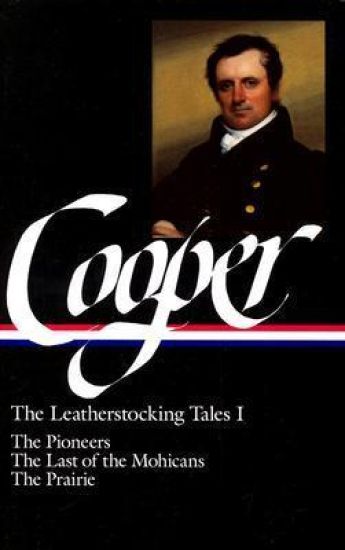
The Pioneers, or The Sources of the Susquehanna; a Descriptive Tale is a historical novel by American writer James Fenimore Cooper. It was the first of five novels known as the Leatherstocking Tales. Published in 1823, the period it covers makes The Pioneers the fourth chronologically in terms of the novels' plots.The story takes place on the rapidly advancing frontier of New York State and features an elderly Leatherstocking (Natty Bumppo), Judge Marmaduke Temple of Templeton (whose life parallels that of the author's father Judge William Cooper), and Elizabeth Temple (based on the author's sister, Hannah Cooper), daughter of the fictional Templeton. The story begins with an argument between the judge and Leatherstocking over who killed a buck. Through their discussion, Cooper reviews many of the changes to New York's Lake Otsego, questions of environmental stewardship, conservation, and use prevail. Leatherstocking and his closest friend, the Mohican Indian Chingachgook, begin to compete with the Temples for the loyalties of a mysterious young visitor, a "young hunter" known as Oliver Edwards. He eventually marries Elizabeth. Chingachgook dies, representing fears of the race of "dying Indians", and Natty vanishes into the sunset.









![Notions of the Americans; Picked Up by a Travelling Bachelor [I.E. James Fenimore Cooper].](/covers/9781241329808.jpg)