Kirjojen hintavertailu. Mukana 11 699 587 kirjaa ja 12 kauppaa.

Kirjahaku

Etsi kirjoja tekijän nimen, kirjan nimen tai ISBN:n perusteella.

11 kirjaa tekijältä James G. March

Technological Innovation

Technological Innovation

James G. March

Cambridge University Press
2008
pokkari
The capacity for technology businesses to grow and change with the times is linked to how they develop and market technological innovations. Despite the importance of technological changes for corporate vitality, there are documented instances of corporations failing to capitalize on technological opportunities. Innovation outcome is contingent upon a match between a firm's internal capabilities and its external environments, even as innovation activities are complex and constrained. How can the slim odds of success be enhanced? Technological Innovation analyses why companies choose certain new technologies, from a technological, economic and institutional perspective. Based upon multidisciplinary research on technological choice, the book bridges research and practice.
Technological Innovation

Technological Innovation

James G. March

Cambridge University Press
1997
sidottu
The capacity for technology businesses to grow and change with the times is linked to how they develop and market technological innovations. Despite the importance of technological changes for corporate vitality, there are documented instances of corporations failing to capitalize on technological opportunities. Innovation outcome is contingent upon a match between a firm's internal capabilities and its external environments, even as innovation activities are complex and constrained. How can the slim odds of success be enhanced? Technological Innovation analyses why companies choose certain new technologies, from a technological, economic and institutional perspective. Based upon multidisciplinary research on technological choice, the book bridges research and practice.
Decisions and Organizations

Decisions and Organizations

James G. March

Blackwell Publishers
1989
nidottu
This book collects together for the first time over 20 of James March's key essays, including those co-authorised with R.M. Cyert and J.P. Olsen and others. The coverage ranges from his early work on the behavioural theory of the firm, through conflict and adaptive rules in organizations, to decision-making under ambiguity (including the famed 'garbage can' model).
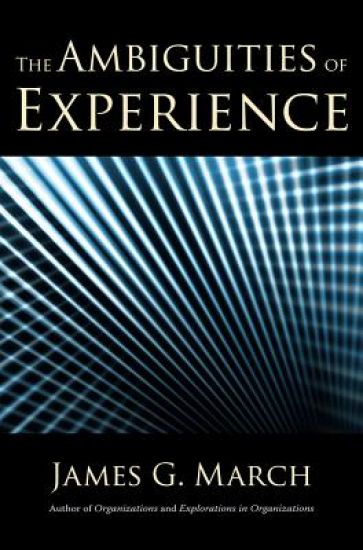
The Ambiguities of Experience

The Ambiguities of Experience

James G. March

Cornell University Press
2010
sidottu
The first component of intelligence involves effective adaptation to an environment. In order to adapt effectively, organizations require resources, capabilities at using them, knowledge about the worlds in which they exist, good fortune, and good decisions. They typically face competition for resources and uncertainties about the future. Many, but possibly not all, of the factors determining their fates are outside their control. Populations of organizations and individual organizations survive, in part, presumably because they possess adaptive intelligence; but survival is by no means assured. The second component of intelligence involves the elegance of interpretations of the experiences of life. Such interpretations encompass both theories of history and philosophies of meaning, but they go beyond such things to comprehend the grubby details of daily existence. Interpretations decorate human existence. They make a claim to significance that is independent of their contribution to effective action. Such intelligence glories in the contemplation, comprehension, and appreciation of life, not just the control of it.—from The Ambiguities of Experience In The Ambiguities of Experience, James G. March asks a deceptively simple question: What is, or should be, the role of experience in creating intelligence, particularly in organizations? Folk wisdom both trumpets the significance of experience and warns of its inadequacies. On one hand, experience is described as the best teacher. On the other hand, experience is described as the teacher of fools, of those unable or unwilling to learn from accumulated knowledge or the teaching of experts. The disagreement between those folk aphorisms reflects profound questions about the human pursuit of intelligence through learning from experience that have long confronted philosophers and social scientists. This book considers the unexpected problems organizations (and the individuals in them) face when they rely on experience to adapt, improve, and survive. While acknowledging the power of learning from experience and the extensive use of experience as a basis for adaptation and for constructing stories and models of history, this book examines the problems with such learning. March argues that although individuals and organizations are eager to derive intelligence from experience, the inferences stemming from that eagerness are often misguided. The problems lie partly in errors in how people think, but even more so in properties of experience that confound learning from it. "Experience," March concludes, "may possibly be the best teacher, but it is not a particularly good teacher."
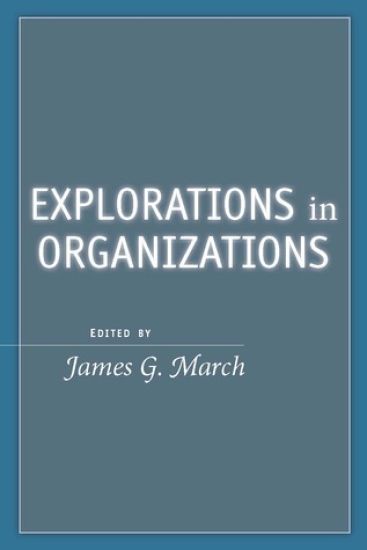
Explorations in Organizations

Explorations in Organizations

James G. March

Stanford University Press
2008
sidottu
Explorations in Organizations presents readers with contemporary issues in the study of organizations, and introduces the paths down which tomorrow's organizational scholarship might travel. A collection of recent papers by or co-authored by the eminent James G. March, the book consists of five sections: exploring theories of organizational action; novelty in organizational adaptation; institutions and the logic of appropriateness; the history of organization studies; and uses of literature in the study of organizations. Each section begins with a new essay by a scholar whose work has focused on the theme explored in that part of the book. These introductory essays not only introduce and tie together the papers that follow, but also serve to add additional voices to the volume in order to deepen the discussion within it.
Explorations in Organizations

Explorations in Organizations

James G. March

Stanford University Press
2008
pokkari
Explorations in Organizations presents readers with contemporary issues in the study of organizations, and introduces the paths down which tomorrow's organizational scholarship might travel. A collection of recent papers by or co-authored by the eminent James G. March, the book consists of five sections: exploring theories of organizational action; novelty in organizational adaptation; institutions and the logic of appropriateness; the history of organization studies; and uses of literature in the study of organizations. Each section begins with a new essay by a scholar whose work has focused on the theme explored in that part of the book. These introductory essays not only introduce and tie together the papers that follow, but also serve to add additional voices to the volume in order to deepen the discussion within it.
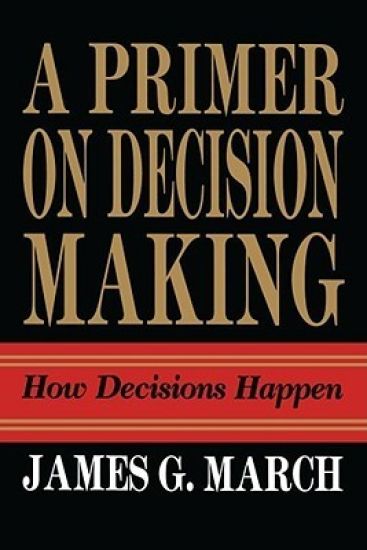
Primer on Decision Making

Primer on Decision Making

James G. March

The Free Press
2009
pokkari
Building on lecture notes from his acclaimed course at Stanford University, James March provides a brilliant introduction to decision making, a central human activity fundamental to individual, group, organizational, and societal life. March draws on research from all the disciplines of social and behavioral science to show decision making in its broadest context. By emphasizing how decisions are actually made -- as opposed to how they should be made -- he enables those involved in the process to understand it both as observers and as participants.March sheds new light on the decision-making process by delineating four deep issues that persistently divide students of decision making: Are decisions based on rational choices involving preferences and expected consequences, or on rules that are appropriate to the identity of the decision maker and the situation? Is decision making a consistent, clear process or one characterized by ambiguity and inconsistency? Is decision making significant primarily for its outcomes, or for the individual and social meanings it creates and sustains? And finally, are the outcomes of decision processes attributable solely to the actions of individuals, or to the combined influence of interacting individuals, organizations, and societies? March's observations on how intelligence is -- or is not -- achieved through decision making, and possibilities for enhancing decision intelligence, are also provided.March explains key concepts of vital importance to students of decision making and decision makers, such as limited rationality, history-dependent rules, and ambiguity, and weaves these ideas into a full depiction of decision making.He includes a discussion of the modern aspects of several classic issues underlying these concepts, such as the relation between reason and ignorance, intentionality and fate, and meaning and interpretation.This valuable textbook by one of the seminal figures in the history of organizational decision making will be required reading for a new generation of scholars, managers, and other decision makers.
The Ambiguities of Experience

The Ambiguities of Experience

James G. March

Cornell University Press
2017
pokkari
The first component of intelligence involves effective adaptation to an environment. In order to adapt effectively, organizations require resources, capabilities at using them, knowledge about the worlds in which they exist, good fortune, and good decisions. They typically face competition for resources and uncertainties about the future. Many, but possibly not all, of the factors determining their fates are outside their control. Populations of organizations and individual organizations survive, in part, presumably because they possess adaptive intelligence; but survival is by no means assured. The second component of intelligence involves the elegance of interpretations of the experiences of life. Such interpretations encompass both theories of history and philosophies of meaning, but they go beyond such things to comprehend the grubby details of daily existence. Interpretations decorate human existence. They make a claim to significance that is independent of their contribution to effective action. Such intelligence glories in the contemplation, comprehension, and appreciation of life, not just the control of it.—from The Ambiguities of Experience In The Ambiguities of Experience, James G. March asks a deceptively simple question: What is, or should be, the role of experience in creating intelligence, particularly in organizations? Folk wisdom both trumpets the significance of experience and warns of its inadequacies. On one hand, experience is described as the best teacher. On the other hand, experience is described as the teacher of fools, of those unable or unwilling to learn from accumulated knowledge or the teaching of experts. The disagreement between those folk aphorisms reflects profound questions about the human pursuit of intelligence through learning from experience that have long confronted philosophers and social scientists. This book considers the unexpected problems organizations (and the individuals in them) face when they rely on experience to adapt, improve, and survive. While acknowledging the power of learning from experience and the extensive use of experience as a basis for adaptation and for constructing stories and models of history, this book examines the problems with such learning. March argues that although individuals and organizations are eager to derive intelligence from experience, the inferences stemming from that eagerness are often misguided. The problems lie partly in errors in how people think, but even more so in properties of experience that confound learning from it. "Experience," March concludes, "may possibly be the best teacher, but it is not a particularly good teacher."

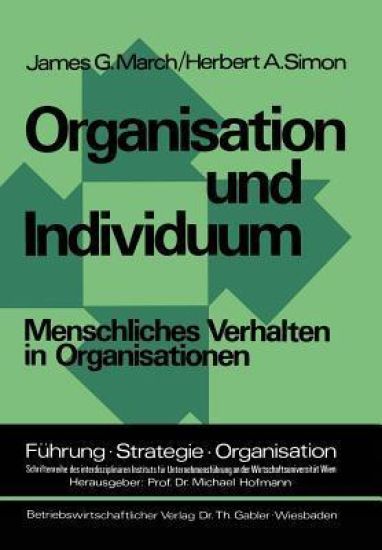
Organisation und Individuum

Organisation und Individuum

James G. March

Gabler Verlag
1976
nidottu
Mit dem vorliegenden Band wollen wir ein bereits klassisch gewordenes Werk dem deutschen Sprachgebiet zugänglich machen. Das Buch bietet eine Zusammenfassung der bedeutendsten Literatur über Organisationen und versucht einen Überblick über die verschiedenen Organisationstheorien zu geben. Die Autoren übernehmen es, diese Theorien, ihre Bedeurung und ihren Zweck darzulegen und liefern dabei eine eigene Interpretation der grundlegenden Theorien des menschlichen Verhaltens in Organi­ sationen. Das Buch läßt sich in drei Hauptteile gliedern. Ausgangspunkt bildet die Betrachtung des Indi­ viduums als Insttument und physiologischer Automat - eine für die "Wissenschaftliche Be­ triebsführung" typische Ansicht. Anschließend beschäftigen sich die Autoren mit motivationa­ len und affektiven Aspekten des menschlichen Verhaltens in Organisationen. Dabei stützen sie ihre Aussagen auf umfangreiches empirisches Untersuchungsmaterial. Den Abschluß des Buches bilden Theorien über kognitive Prozesse des organisatorischen Verhaltens. Hier bewegen sie sich zum Teil noch auf reichlich unerforschtem Neuland. Das Buch fUgt sich daher hervorragend in unsere Schriftenreihe ein und - obwohl bereits ein klassisches Werk - ist es eine zeitlose Informationsquelle für den Wissenschaftler, da es eine gedrängte, aber geordnete Zusammenfassung der wichtigsten Organisationstheorien mit Anregungen zu weiterer Forschungstätigkeit bietet, für den Praktiker, da es ihm hilft, die Komplexität moderner Großorganisationen besser zu erkennen, was zu einem besseren Verständnis seiner eigenen Organi­ sationsprobleme führen kann, für den Studenten, der sich für die soziale Welt der Organisationen, die ja später auch sein Leben beeinflussen werden, interessiert.
Fornuft og forandring

Fornuft og forandring

James G. March

SAMFUNDSLITTERATUR
2008
nidottu
Fornuft og forandring er en tankevækkende bog skrevet af en af organisationsteoriens helt store tænkere, James G. March. James G. March diskuterer i denne bog myten om rationalitet og alternativerne hertil inden for en række forskellige temaer: ledelse, beslutningstagen, informationsbehandling, risikoadfærd, læring og udvikling. Bogen består af en række artikler, udvalgt af forfatteren selv. I bogen sætter James G. March spørgsmålstegn ved meget af det, vi normalt betragter som selvindlysende rigtigt og effektivt for ledere at gøre. Der er ikke længere grund til at tro, at en rationel handlemåde er det eneste fornuftige. Andre handlemåder, der fx bygger på erfaring eller identitet, kan være både mere effektive og hensigtsmæssige. Det, ledere rent faktisk gør, er ikke per definition ringere end det, vi andre siger, de burde gøre. Beslutningsprocesser og andre organisatoriske processer, der ikke følger et rationelt mønster, kan sagtens rumme både fornuft og orden. At visse ledere og organisationsformer får succes og vinder udbredelse, betyder ikke i sig selv, at disse ledere og organisationsformer er bedre end dem, der faldt fra i processen. Denne 2. udgave af bogen indledes med et interview, hvor March fortæller om en række af de emner, der har optaget ham gennem hele forfatterskabet.