In recent years car production in the United States has undergone changes on a scale unknown since the pioneering era prior to World War One. New plants have been opened in the interior of the country, while most of those located along the east and west coast have been closed. The Changing U.S. Auto Industry uses concepts drawn from geography, such as access to markets and shipments of parts, to understand some of the reasons for the recent changes. Also critical is the changing role of labour in the production process, including the search by Japanese firms for a union-free environment, the re-location of some production to Mexico and the debate over the appropriate level of union-management cooperation.
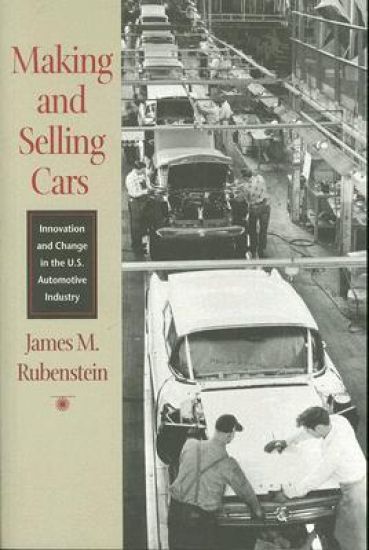
From the creation of fast food, to the design of cities, to the character of our landscape, the automobile has shaped nearly every aspect of modern American life. In fact, the U.S. motor vehicle industry is the largest manufacturing industry in the world. James Rubenstein documents the story of the automotive industry...which despite its power, is an industry constantly struggling to redefine itself and assure its success. Making and Selling Cars: Innovation and Change in the U.S. Automotive Industry shows how this industry made adjustments and fostered innovations in both production and marketing in order to remain a viable force throughout the twentieth-century. Rubenstein builds his study of the American auto industry with care, taking the reader through this quintessentially modern history of production and consumption. Avoiding jargon while never over simplifying, Rubenstein gives a detailed and straightforward account of both the production and merchandising of cars. We learn how the industry began and about its methods for building cars and the modern American marketplace. Along the way there were many missteps and challenges-the Edsel, the fuel crisis, and the ascendancy of Japanese cars in the 1980s. The industry met these types of problems with new techniques and approaches. To demonstrate this, Rubenstein gives the reader examples of how the auto industry used to work, which he alternates with chapters showing how the industry has reinvented itself. Making and Selling Cars explains why the U.S. automotive industry has been and remains a vigorous shaper of the American economy.
In recent years car production in the United States has undergone changes on a scale unknown since the pioneering era prior to World War One. New plants have been opened in the interior of the country, while most of those located along the east and west coast have been closed. The Changing U.S. Auto Industry uses concepts drawn from geography, such as access to markets and shipments of parts, to understand some of the reasons for the recent changes. Also critical is the changing role of labour in the production process, including the search by Japanese firms for a union-free environment, the re-location of some production to Mexico and the debate over the appropriate level of union-management cooperation.
Originally published in 1978. At the time this book was published, new towns were cropping up as a matter of public policy in "advanced industrial countries," yet the United States abandoned this project and deemed new towns "inappropriate and impractical for the American situation." The purpose of this book is to inform planners and policy makers around the world about French new towns. It analyzes what French new towns tried to accomplish; the administrative, financial, and political reforms needed to secure implementation of the program; and the achievements of the new towns. The author's evaluation of French new towns is undertaken with an eye to international applicability.In the United States, new towns have been proposed as a means for integrating low-income families into suburbs that are otherwise closed to them. The French experience demonstrates that socially heterogeneous new communities can be developed, even within the framework of a market system, if a sufficiently high priority is placed on the effort.