Kirjojen hintavertailu. Mukana 11 244 527 kirjaa ja 12 kauppaa.

Kirjahaku

Etsi kirjoja tekijän nimen, kirjan nimen tai ISBN:n perusteella.

3 kirjaa tekijältä James N. Butler

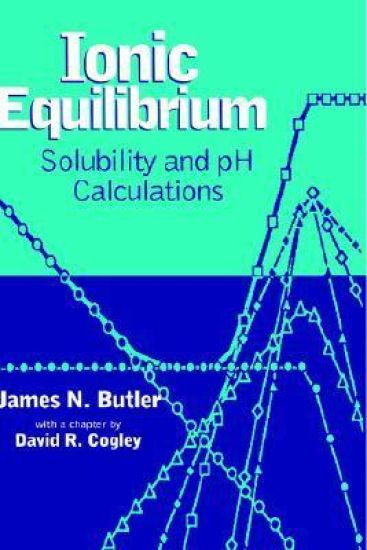
Ionic Equilibrium

Ionic Equilibrium

James N. Butler

John Wiley Sons Inc
1998
sidottu
A celebrated classic in the field updated and expanded to includethe latest computerized calculation techniques In 1964, James N. Butler published a book in which he presentedsome simple graphical methods of performing acid-base, solubility,and complex formation equilibrium calculations. Today, both thebook and these methods have become standard for generations ofstudents and professionals in fields ranging from environmentalscience to analytical chemistry. Named a "Citation Classic" by theScience Citation Index in 1990, the book, Ionic Equilibrium,continues to be one of the most widely used texts on the subject.So why tamper with near-perfection by attempting a revision of thatclassic? The reason is simple-- the recent rapid development andwide availability of personal computers. In the revised Ionic Equilibrium, Dr. Butler updates his 1964 workby abandoning the slide rule and graph paper for the PCspreadsheet. He also expands the original coverage with extensivematerial on basic principles and recent research. The first part of Ionic Equilibrium is devoted to the fundamentalsof acid-base, solubility, and complex formation equilibria. In thesecond part, the author discusses oxidation-reduction equilibria,develops the principles of carbon dioxide equilibria, presents casestudies demonstrating the ways in which carbon dioxide equilibriaare used in physiology and oceanography, and explores thepossibility of a pH scale for brines. The concluding chapter,written by David R. Cogley, gives examples of general computerprograms that are capable of performing equilibrium calculations onsystems of many components. Replete with real-world examples, details of importantcalculations, and practical problems, Ionic Equilibrium is an idealcourse text for students of environmental chemistry, engineering,or health; analytical chemistry; oceanography; geochemistry;biochemistry; physical chemistry; and clinical chemistry. It isalso a valuable working resource for professionals in those fieldsas well as industrial chemists involved with solution chemistry.
Carbon Dioxide Equilibria and Their Applications
Carbon dioxide, bicarbonate ion, and carbonate ion comprise the most important acid-base system in natural waters, and the equilibria between them regulate the pH of seawater, as well as most rainwater, stream water, river water, and groundwater. Carbon Dioxide Equilibria and Their Applications provides a clear, compact presentation of this topic, which is central to geochemistry and environmental engineering. It emphasizes a rigorous mathematical and thermodynamic basis for calculations and their application to realistic problems. The book's first four chapters present the basic equations, mathematical techniques for visualizing and manipulating them, and data on equilibrium constants and activity coefficients. These are presented in the general context of acid-base titration and solubility of CaCO3. The remaining chapters show how these concepts and techniques are applied to geochemistry and oceanography, in addition to their applications to water conditioning. Specific topics discussed include acid rain, freshwater, seawater, carbonate sediments in the deep oceans, the effects of increased atmospheric CO2 on the oceans, estuarine waters, brines, hydrothermal solutions, pH adjustment, prediction of calcium carbonate saturation, corrosion inhibition, and water softening.
Carbon Dioxide Equilibria and Their Applications
Carbon dioxide, bicarbonate ion, and carbonate ion comprise the most important acid-base system in natural waters, and the equilibria between them regulate the pH of seawater, as well as most rainwater, stream water, river water, and groundwater. Carbon Dioxide Equilibria and Their Applications provides a clear, compact presentation of this topic, which is central to geochemistry and environmental engineering. It emphasizes a rigorous mathematical and thermodynamic basis for calculations and their application to realistic problems. The book's first four chapters present the basic equations, mathematical techniques for visualizing and manipulating them, and data on equilibrium constants and activity coefficients. These are presented in the general context of acid-base titration and solubility of CaCO3. The remaining chapters show how these concepts and techniques are applied to geochemistry and oceanography, in addition to their applications to water conditioning. Specific topics discussed include acid rain, freshwater, seawater, carbonate sediments in the deep oceans, the effects of increased atmospheric CO2 on the oceans, estuarine waters, brines, hydrothermal solutions, pH adjustment, prediction of calcium carbonate saturation, corrosion inhibition, and water softening.