Kirjojen hintavertailu. Mukana 11 244 527 kirjaa ja 12 kauppaa.

Kirjahaku

Etsi kirjoja tekijän nimen, kirjan nimen tai ISBN:n perusteella.

6 kirjaa tekijältä James Procter

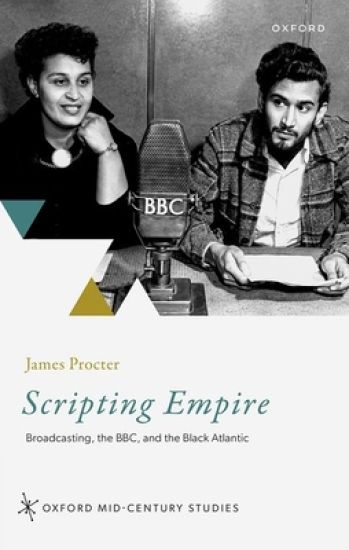
Scripting Empire

Scripting Empire

James Procter

Oxford University Press
2024
sidottu
Scripting Empire recovers the literary and cultural history of West Indian and West African writing at the BBC in order to rethink the critical mid-century decades of shrinking British sovereignty, late modernism, and mass migration to the metropole. Between the 1930s and the 1960s, a remarkable group of black Atlantic artists and intellectuals became producers, editors, and freelancers at the corporation, including Una Marson, Langston Hughes, Louise Bennett, Wole Soyinka, Derek Walcott, Amos Tutuola, V.S. Naipaul, Sam Selvon, Cyprian Ekwensi, Stuart Hall, and C.L.R. James. Operating at the interface of a range of literary and broadcast genres, this loose network of African Caribbean writers and thinkers prompt a reassessment of the aesthetic, formal, and political fallout of decolonization between the outbreak of World War II and the first airings of post-colonial independence. Scripting Empire works comparatively across dozens of different programmes spanning the General Overseas Service, Home Service, Light Programme, and Third Programme. Drawing upon a transnational archive of materials including scripts, correspondence, periodicals, visual records, and sound recordings, it seeks to re-position the cultural contribution of West Indians and West Africans within a more pervasive and porous account of radio transmission, the legacy of which extends well beyond broadcasting.
Stuart Hall

Stuart Hall

James Procter

Routledge
2004
sidottu
James Procter's introduction places Hall's work within its historical contexts, providing a clear guide to his key ideas and influences, as well as to his critics and his intellectual legacy.Stuart Hall has been pivotal to the development of cultural studies during the past forty years. Whether as director of the Centre for Contemporary Cultural Studies, or as one of the leading public intellectuals of the postwar period, he has helped transform our understanding of culture as both a theoretical catagory and a political practice. Topics include:* popular culture and youth subcultures* the CCCS and cultural studies* media and communication* racism and resistance* postmodernism and the postcolonial* Thatcherism* identity, ethnicity, diasporaStuart Hall is the ideal gateway to the work of a critic described by Terry Eagleton as 'a walking chronicle of everything from the New Left to New Times, Leavis to Lyotard, Aldermaston to ethnicity'
Stuart Hall

Stuart Hall

James Procter

Routledge
2004
nidottu
James Procter's introduction places Hall's work within its historical contexts, providing a clear guide to his key ideas and influences, as well as to his critics and his intellectual legacy.Stuart Hall has been pivotal to the development of cultural studies during the past forty years. Whether as director of the Centre for Contemporary Cultural Studies, or as one of the leading public intellectuals of the postwar period, he has helped transform our understanding of culture as both a theoretical catagory and a political practice. Topics include:* popular culture and youth subcultures* the CCCS and cultural studies* media and communication* racism and resistance* postmodernism and the postcolonial* Thatcherism* identity, ethnicity, diasporaStuart Hall is the ideal gateway to the work of a critic described by Terry Eagleton as 'a walking chronicle of everything from the New Left to New Times, Leavis to Lyotard, Aldermaston to ethnicity'
Dwelling Places

Dwelling Places

James Procter

Manchester University Press
2003
nidottu
Explores some of the key venues of black British literary and cultural production across the postwar period: bedsits and basements; streets and cafes; train stations and tourist landscapes; the suburbs and the city; the north and south. Pursues a 'devolving' landscape in order to consider what an analysis of 'dwelling' might contribute to the travelling theories of diaspora discourse and asks what happens when we 'situate' literatures of movement and migration. Offers fresh readings of work by some of the key literary figures of the postwar years, for example, Salman Rushdie, Hanif Kureishi, Meera Syal, Linton Kwesi Johnson. Contextualises writings alongside photography, painting, and film to consider their relationship to broader shifts in the politics of black representation over the past fifty years. Offers sustained anaysis of many of the texts reproduced in Procter's anthology Writing black Britain 1948-98 ( MUP, 2000) making an ideal companion to the earlier book.